
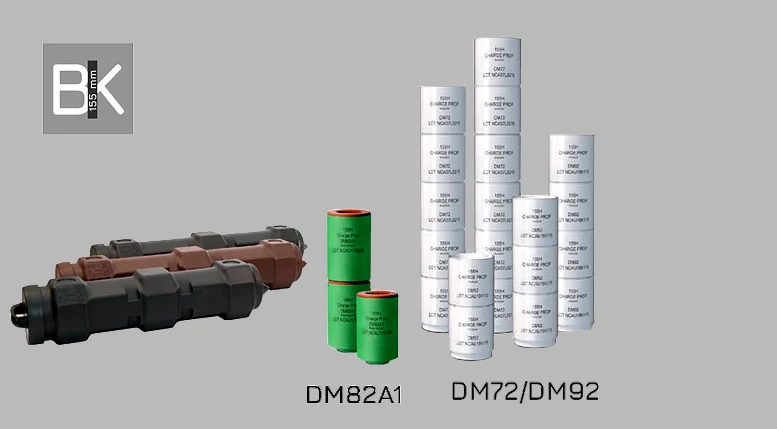
Bi-MODULAR CHARGE
What is the difference between the Modular Charge System (MCS) and the Bi-Modular BMCS
Modular systems of propelling charges, MACS and MPCS, are advanced propellant charge technologies used in modern NATO-standard 155 mm artillery. They have completely replaced the obsolete fabric bag charges, offering the “build-a-charge” concept of interchangeable modules. This makes it possible to flexibly select the firing range by assembling the required number of identical blocks
In the classic modular system (MCS) the charge is assembled from many modules of the same type, while the bi-modular system (BMCS) uses two types of modules of different sizes and chemical composition.
For example: the German modular charge D72 has only 2 identical propellant modules (green) loaded with a “fast propellant” with a low burning temperature. To increase the projectile's range in a predictable way, a propellant charge with a high working temperature is added (giving the D92 charge) to prevent a negative pressure differential that would reduce the pressure already built up by the initial charges. Put simply, the closer to the muzzle brake, the more the pressure must be EVENLY higher.
Range for a 39-caliber barrel (FH70/M109) with an L15 projectile
Muzzle velocity (21 °C):
810 m/s — zone 4
665 m/s — zone 3
525 m/s — zone 2
450 m/s — 2 base modules
303 m/s — 1 base module
The BMCS is a further stage in the development of charge system design for separate-loading ammunition. These are second-generation modular charges. The full Bi-Modular Charge System (BMCS) is, in essence, a charge system solution using two types of modules: the lower charge module, BC-E, and the upper charge module, TC-F. The BC-E module covers short firing ranges (it consists of one Zone-1 module and two Zone-2 modules). The TC-F module covers long and maximum firing ranges (it consists of three to six modules — Zones 3, 4, 5 and 6).
The BMCS has an advantage over traditional fabric bag charge systems thanks to simpler operation and reduced logistics during storage, transport and in military conditions.
Also on this site
- M232 charge (BMCS)
- Modular charge system
- Conversion of propellant charges
- Cognitive information — all articles of the section
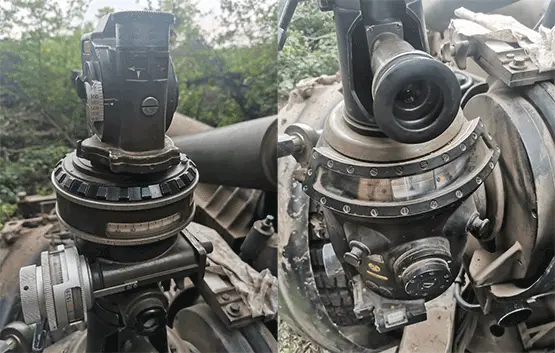
Orienting a 64-00 mils panoramic sight with the ПАБ-2М aiming circle
1. The preliminary setup and orientation of the PAB-2M aiming circle is no different from the usual one. We end up with the aiming circle pointed in the main direction of fire (MDF) and the angle-measuring (red) scales zeroed.
Technical parameters 155 mm 52 cal/23 dm³
Equivalent L15A1/A2 HEERFB-BT
| Zone | Unit | BC-E | 2×BC-E | 3×TC-F | 4×TC-F | 5×TC-F | 6×TC-F |
|---|---|---|---|---|---|---|---|
| Muzzle velocity | m/s | 315 | 470 | 560 | 690 | 822 | 940 |
| Pressure (max.) | MPa | 60 | 140 | 95 | 150 | 230 | 355 |
| Range (max.) | km | 8,0 | 13,0 | 15,5 | 20 | 24,5 | >30 |
| Overlap | % | — | min. 15 | min. 30 | min. 30 | min. 30 | min. 30 |
The maximum flight range with the HEERFB-BB is 43 km.
Main characteristics
| Parameter | BC-E (XE) | TC-F (XF) |
|---|---|---|
| Diameter | 158 mm | 158 mm |
| Length | 155 mm | 177 mm |
| Modules can be connected | No | 6 × TC-F |
| Propellant charge type | Single base | Triple base |
| Additives | Yes | Yes |
| Ignition | CBI + black powder | CBI + black powder |
| Charge weight | 1.9 kg | 2.8 kg |
| Propellant weight | 1,500 g | 2,300 g |
| Propellant charge weight | EFC value 2,500 | |
| Shelf life | >15 years of storage in the original undamaged packaging (average temperature 25 °C) | |
Warning: combining a TC-F or BC-E charge with a different type of charge is not allowed.
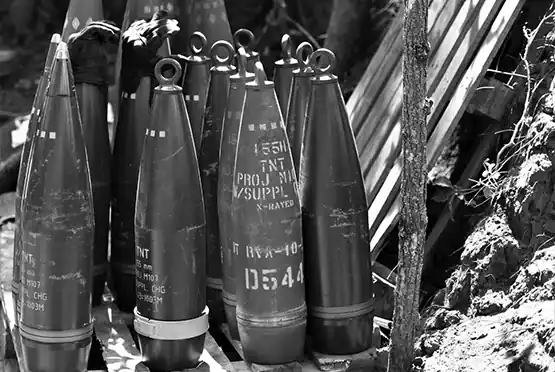
Markings and inscriptions on projectiles
A–3 – an American explosive consisting of a mixture of 91% RDX and 9% plasticizing oil, also known as microcrystalline wax;
Orienting a 64-00 mils panoramic sight with the ПАБ-2М aiming circle
1. The preliminary setup and orientation of the PAB-2M aiming circle is no different from the usual one. We end up with the aiming circle pointed in the main direction of fire (MDF) and the angle-measuring (red) scales zeroed.
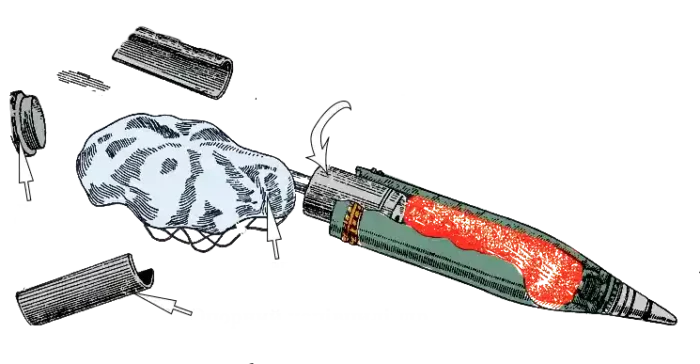
How to enter the correction when firing illuminating projectiles
During night combat operations, artillery units, in addition to fire missions to engage targets, perform the following tasks:
Oleh Syrota (Georgich©) for the Armed Forces of Ukraine /
Share your experience of working with 155 mm ammunition.
Send comments and suggestions by email: entropiaw@gmail.com
f FacebookKHMS 88
