
Projectiles M110 (WP Smoke, H/HD) 

Contents
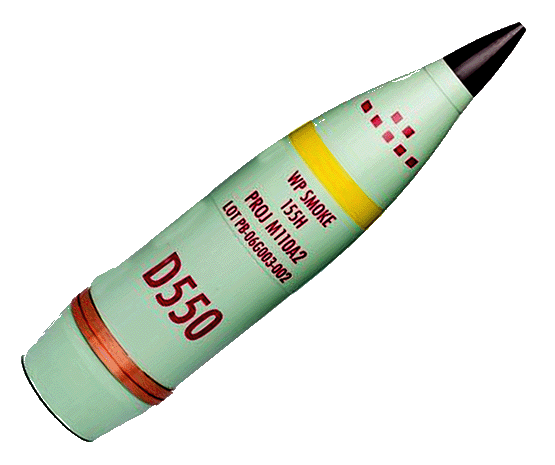
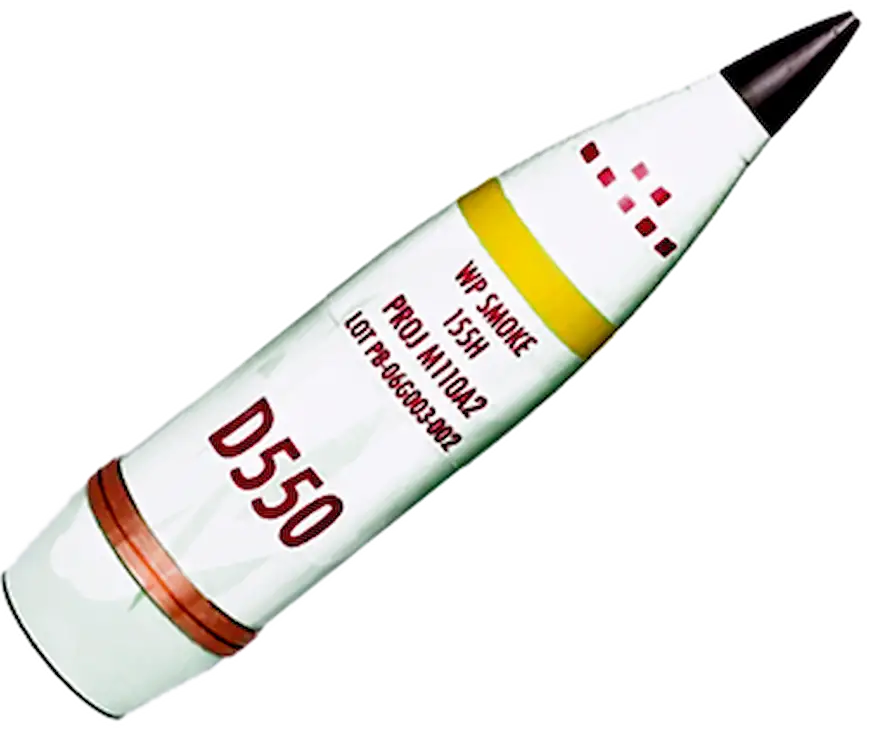
M110, M110E1, M110A1, M110A2 — smoke (WP) and chemical (H/HD) projectiles
These projectiles are fired from 155 mm howitzers to create a smoke screen. The projectiles also have a slight incendiary effect.
155 mm projectiles Smoke WP (white phosphorus), H GAS (toxic agent), H/HD (toxic agent for contaminating terrain).
The M110 and M110E1 consist mainly of a steel shell (casing) that contains an M6 fuze charged with TNT running through the center of the shell, and an explosive filler of 7.08 kg of WP (white phosphorus), H GAS (toxic agent).
The adapter in the nose of the projectile is threaded for attaching the fuze. For transport and handling, a lifting plug is installed in the nose fuze cavity. A rotating band surrounds the projectile body near the base and is protected by a transport sleeve. The sleeve should be removed before the projectile is loaded into the barrel.
A PD detonator is usually used with these projectiles. Apart from the WP (white phosphorus) content, these projectiles are exactly the same as the H/HD projectile. The ballistics match the cargo projectile M483A1
Technical specifications
- Maximum range - up to 18.7 km (39 caliber)
- Weight with fuze - 42.9 kg
- Length without fuze - 680 mm
- Body material - forged steel
- Amount of explosive - 5.3 kg
- Packaging - wooden pallet for 8 pcs.
Usage notes

Smoke and chemical projectiles.
Full information
m110a2
Chemical projectile M110 (agent H/HD — mustard gas)
Purpose. Fired from 155 mm guns for toxic action against personnel and contamination of terrain.
Description. A hollow steel body with a burster charge (burster) in the centre. The burster tube is filled with tetrytol, and the rest of the volume holds 5.31 kg of agent H or HD. A shipping plug (eyelet ring) is screwed into the nose cavity. A point-detonating fuze is normally used; the ballistics are the same as the M107.
Function. On firing, the gases accelerate the projectile, the rotating band cuts into the rifling and seals the bore. The point-detonating fuze functions on meeting an obstacle and sets off the burster, which ruptures the body and disperses the agent.
Weight zones:
| Zone | Weight, kg | Weight, lb | Marking |
|---|---|---|---|
| 2 | 40.82 – 41.41 | 90.0 – 91.3 | 2 dots |
| 3 | 41.32 – 41.91 | 91.1 – 92.4 | 3 dots |
| 4 | 41.82 – 42.41 | 92.2 – 93.5 | 4 dots |
| Parameter | Value |
|---|---|
| Agent | H/HD |
| Weight with shipping plug | 42.91 kg |
| Length with plug | 680 mm |
| Body material | steel |
| Colour (old production) | grey with green markings and two green bands |
| Colour (new, after 1976) | blue-grey with green markings, two green bands and one yellow band (burster filled) |
| Filling | H or HD — 5.31 kg |
| Firing temperature | from −40 °C to +52 °C |
| Storage temperature | lower −62.2 °C, no longer than 3 days; upper +52 °C, no longer than 4 hours a day |
| Storage compatibility group | K |
| DODAC | 1320-D543 |
Restriction. The projectile must not be used or stored at temperatures above +52 °C because of the tetryl burster.
Smoke projectile M110 and M110E1 (white phosphorus, WP)
Type classification. Standard.
Purpose. Fired from 155 mm howitzers to lay a smoke screen; it also has a minor incendiary effect.
Description. A steel body with an M6 burster filled with tetrytol in the centre of the body and a bursting charge of 7.08 kg of white phosphorus. A fuze is screwed into the nose adapter; a shipping plug (eyelet ring) is fitted for transport. The rotating band at the lower part is covered by a grommet, which is removed before loading.
A point-detonating fuze is normally used. Apart from the WP filling, the projectile is identical to the M110 H/HD chemical projectile, and its ballistics and configuration are the same as the M107.
Function. The fuze functions, the burster ruptures the body and scatters the contents. White phosphorus ignites spontaneously in air and produces dense white smoke.
Weight zones:
| Zone | Weight, kg | Weight, lb | Marking |
|---|---|---|---|
| 5 | 42.32 – 42.91 | 93.3 – 94.6 | 5 dots |
| 6 | 42.82 – 43.41 | 94.4 – 95.7 | 6 dots |
| 7 | 43.32 – 43.91 | 95.5 – 96.8 | 7 dots |
| 8 | 43.82 – 44.41 | 96.6 – 97.9 | 8 dots |
| Parameter | Value |
|---|---|
| Type | smoke, WP |
| Weight with plug | 44.67 kg, nominal |
| Length with plug | 680 mm max. |
| Systems | 155 mm |
| Filling | 7.08 kg WP |
| Body material | steel |
| Colour | light green with a yellow band and light red markings |
| Propellant charges | M3A1 series, M4A1, M4A2, M119/M119A1 |
| Primers | MK2A4 (M1, M1A1, M1A2, M45); M82 (M126, M126A1, M185, M199) |
| Fuzes | PD M557; M739; MTSQ M564, M582; ET M767 and others |
| Firing temperature | from −40 °C to +52 °C |
| Storage temperature | lower −62.2 °C, no longer than 3 days; upper +52 °C, no longer than 4 hours a day |
Restriction. The projectile must not be used or stored at temperatures above +52 °C because of the tetryl burster. Above +44 °C white phosphorus melts and becomes liquid; on cooling it solidifies, and if the projectiles were lying on their side, the ballistics will change. Therefore WP ammunition must be stored only in a vertical position.
Smoke projectile M110A1 (M110E2) and M110A2 (M110E3), white phosphorus (WP)
Purpose. Fired from 155 mm howitzers to lay a smoke screen; it has a minor incendiary effect.
Description. A steel body filled with 7.08 kg (15.6 lb) of white phosphorus, with an M54A1 bursting charge in the centre and an adapter in the nose for the fuze. The bursting charge tube is made of high-strength aluminium alloy and filled with Composition B5. On the M110A2 the base of the tube is closed with an aluminium plug, on the M110A1 (early model) with a plastic one. The tube is fixed in the body by a threaded cap under the fuze well. A shipping plug (eyelet ring) is screwed in for transport.
A point-detonating fuze is normally used; an MTSQ is also possible. Apart from the WP filling, the projectile is the same as the M110 H/HD chemical projectile; the ballistics are the same as the M107.
Function. The fuze functions on meeting an obstacle and sets off the bursting charge, which ruptures the body and scatters the WP. Phosphorus ignites spontaneously in air and produces dense white smoke.
Differences between the models.
The M110A1 and M110A2 contain a bursting charge of Comp B5, which withstands high temperatures better than the tetrytol in the earlier M110. On the M110A2 the base of the tube is closed with an aluminium plug, on the M110A1 with a plastic one.
Weight zones (filled projectile)
| Zone | Weight, kg | Weight, lb | Marking |
|---|---|---|---|
| 5 | 42.32 – 42.91 | 93.3 – 94.6 | 5 dots |
| 6 | 42.82 – 43.41 | 94.4 – 95.7 | 6 dots |
| 7 | 43.32 – 43.91 | 95.5 – 96.8 | 7 dots |
| 8 | 43.82 – 44.41 | 96.6 – 97.9 | 8 dots |
| Parameter | Value |
|---|---|
| Type | smoke, WP |
| Weight with plug | 44.67 kg, nominal |
| Length with plug | 684 mm max. |
| Body material | steel |
| Colour | light green with a yellow band and light red markings |
| Filler | white phosphorus, 7.08 kg |
| Propellant charges | M3/M4 series, M119/M119A1 |
| Primers | MK2A4 (M1, M1A1, M1A2, M45); M82 (M126, M126A1, M185, M199) |
| Fuzes | PD M557, M739; MTSQ M564, M582; ET M767 |
| Firing temperature | from −54 °C to +63 °C |
| Storage temperature | lower −62 °C, no longer than 3 days; upper +71 °C, no longer than 4 hours a day |
Ballistics — same as the M107
Restriction. Above +44 °C white phosphorus melts and becomes liquid; on cooling it solidifies, and if the projectiles were lying on their side, their ballistics will change. Therefore WP ammunition should be stored only in a vertical position.
Projectile M116 and M116B1 smoke (HC and colored smoke)
Purpose. Fired from 155 mm howitzers to lay a smoke screen, for registration and for signalling.
Description. A base-ejection projectile: a hollow steel body with four canisters of chemical smoke composition. The composition may be hexachloroethane-zinc (HC) or colored smoke (green, red, yellow and violet). The canisters are stacked, each with a perforated central tube, so that a continuous fire tube runs through the stack. The front canister is conical to match the body contour. In the nose, under the fuze well, there is an expelling charge of black powder. A deflector plate with a central hole near the fire tube separates the expelling charge from the first canister.
Function. On firing, the propellant charge accelerates the projectile in the barrel; the rotating band cuts into the rifling and seals the bore. Functioning of the fuze ignites the expelling charge, the flame passes through the central tube, ignites the smoke canisters, blows out the base and ejects the canisters. An effective smoke cloud forms within 30 s, and maximum smoke output occurs after about 1 min.
Differences between the models. On the M116B1 the expelling charge (154 g of black powder) is held in a polyethylene cup rather than in a cloth bag as on the M116 (132 g). The copper obturating disc of the M116 has also been replaced with a steel one.
Weight zones:
| Zone | Weight, kg | Weight, lb | Marking |
|---|---|---|---|
| 2 | 41.14 – 41.73 | 90.7 – 92.0 | 2 dots |
| 3 | 41.64 – 42.23 | 91.8 – 93.1 | 3 dots |
| 4 | 42.05 – 42.82 | 92.7 – 94.4 | 4 dots |
| 5 | 42.64 – 43.23 | 94.0 – 95.3 | 5 dots |
| Parameter | Value |
|---|---|
| Type | smoke, HC or colored |
| Weight when filled | HC — 43.00 kg; colored — 39.11 kg |
| Length with plug | 671 mm, nominal |
| Body material | forged steel |
| Colour | new production — light green with black markings (for colored smoke the color is indicated by three letters “C”); old production — grey with yellow markings |
| Filler | HC — 11.72 kg; colored smoke — 7.80 kg |
| Firing temperature | from −40 °C to +52 °C |
| Storage temperature | lower −62.2 °C, no longer than 3 days; upper +71.1 °C, no longer than 4 hours a day |
| DODAC | HC 1320-D548; red 1320-D549; yellow 1320-D551; green 1320-D547; violet 1320-D554 |
Read also on this site
Conversion of propellant charges
Propellant charge conversion table
Conversion of M3 and M4 charges
Conversion of M203 and M203A1 charges
Conversion of MACS charges (M231 and M232)
Modular charge system
MCS and BMCS modular charge systems: what is the difference
Propellant charges — all pages of the section
Informative content — all articles of the section
Oleh Syrota (Georgich©) for the Armed Forces of Ukraine /
Share your experience of working with 155 mm ammunition.
Send comments and suggestions by email: entropiaw@gmail.com
f FacebookKHMS 88
