
Informative Content 

Articles in this section, grouped by topic. All materials in one list — further down the page.
Projectiles: Reviews and Types
- All EU-made projectiles, 155 mm caliber
- The Assegai family of projectiles: M2000, M0121, M0603, M0256, M2005, M2002
- 155 mm ERFB Smoke WP extended-range projectile
- 155 mm smoke projectiles: how they work and how they lay a smoke screen
- 155 mm high-explosive fragmentation projectiles with improved firing range
Mine Laying
- Mine-laying standards for M692 and M731 projectiles
- RAAM and ADAM artillery mine-laying systems. M718, M741, M692 and M731 projectiles
Charges and Conversion
Firing, Ballistics and Corrections
- Range tables for selected projectiles
- Why it is so important to fire at high sight settings
- Mortar-style fire from guns: the effect of final traverse on accuracy
- How to apply corrections when firing illuminating projectiles
- Meteorological message calculation form (Meteo-Average)
Sighting Devices and Orientation
- Boresighting the sighting devices of the FH70 gun
- Boresighting the sighting devices of the 155 mm M109A3 self-propelled howitzer
- Orienting a 64-00 mils panoramic sight with the PAB-2M aiming circle
Markings, Painting and Camouflage
Painting of 155 mm artillery projectiles
Ammunition components are painted primarily to prevent rust. Colors are used for camouflage, for recognizing the main use of the item and for identifying hazardous fillers used in the munitions. These are the colors used to indicate the main use of ammunition.
Markings and inscriptions on projectiles
A–3 – an American explosive consisting of a mixture of 91% RDX and 9% plasticizing oil, also known as microcrystalline wax;
Orienting a 64-00 mils panoramic sight with the PAB-2M aiming circle
1. The preliminary setup and orientation of the PAB-2M aiming circle is no different from the usual one. We end up with the aiming circle pointed in the main direction of fire (MDF) and the angle-measuring (red) scales zeroed.
How to enter the correction when firing illuminating projectiles
During night combat operations, artillery units, in addition to fire missions to engage targets, perform the following tasks:
Why is it so important to fire at higher angles?
This material briefly explains how the projectile’s landing angle affects the effectiveness of engaging the enemy through fragment dispersion.
Conversion of propellant charges
able for converting bagged propellant charges into the MACS modular system
Markings and inscriptions on projectiles
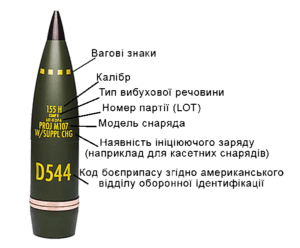 Foreign terms (abbreviations) used when marking
projectiles
AK Device – a marker projectile fitted with a small amount of dye, used to mark the point of impact during registration fire;
ADF – (Auxiliary Detonating Fuze) an American auxiliary detonating fuze located between the charge and the main fuze. It ensures more effective detonation and prevents the projectile from exploding if the main
fuze functions accidentally;
AHEAD – (Advanced Hit Efficiency And Destruction) an improved projectile with high destructive capability;
AP – (Armor Piercing) an armor-piercing projectile with a pointed tip;
AP–I – Armor Piercing Projectiles Include a Incendiary) an armor-piercing incendiary projectile;
APCR – ( Armour–Piercing Composite Rigid) a sub-caliber armor-piercing projectile with a non-separating carrier and a composite armor-piercing tip;
APDS – ( Armor–Piercing Discarding Sabot) a sub-caliber armor-piercing projectile with a discarding sabot;
APDU – (Armor–Piercing Depleted Uraniu) a sub-caliber armor-piercing projectile with a depleted-uranium core;
APFSDS – (Armor–Piercing Fin Stabilized Discarding Sabot) a fin-stabilized sub-caliber armor-piercing projectile with a discarding sabot;
APHE – (Armor Piercing High Explosive) an armor-piercing projectile with an increased amount of explosive;
APHE–T – (Armor Piercing High Explosive Include a Tracer) a tracer armor-piercing projectile with an increased amount of explosive;
APHEBC – (Armor Piercing High–Explosive With Both AP Caps) an armor-piercing projectile with a ballistic cap and an increased amount of explosive;
APT or AP–T – (Armor Piercing Projectiles Include a Tracer) an armor-piercing tracer projectile;
BB - (Base bleed) - base bleed unit. Increases range by 20%–35%
Bdz. – (German: Bodenzünder) the German abbreviation for a base fuze;
BL&P or BL&P. – (Blind Loaded & Plugged) a projectile without explosive; BL&T or BL&T. – (Blind Loaded Shell With a Tracer) a tracer projectile for practice firing;
BOF – (French: Boulet Ogival en Fonte) the French abbreviation for training projectiles;
CCF – (Course Correcting Fuze) a smart fuze that uses in-flight trajectory correction together with the GPS global positioning system to guide a high-explosive ballistic projectile;
CHEM – (Chemical) the British abbreviation for a chemical projectile;
CLGP – (Cannon–Launched, Guided Projectile) a long-range laser-guided projectile;
CNF – (Common Nose Fuze) the British abbreviation for a common shell with a nose fuze;
Common – a bursting projectile. This term was used by the Royal Navy and the US Navy for any armor-piercing projectile;
CP or Common Point – the British abbreviation for projectiles with a cast-steel body fitted with a bursting charge;
CPBC – (Common Pointed Ballistic Cap) the British abbreviation for projectiles with a cast-steel body fitted with a bursting charge and a ballistic cap;
CPC or Common Topped Cappped – the British abbreviation for armor-piercing projectiles intended to engage lightly armored targets. It is fitted with a soft-steel cap and has little armor-piercing power, like a large HE projectile;
DPICM – (Dual Purpose Improved Conventional Munition) US Navy improved dual-purpose munitions that have both fragmentation and armor-piercing properties;
Dunnite or Explosive D – an American explosive, ammonium picrate;
ERGM – (Extended Range Guided Munition) an extended-range guided projectile;
ERFB - a projectile with an increased range;
EXE or Extra Experimental – a British experimental explosive;
Explosive D or Dunnite – an American explosive, ammonium picrate;
FAP – (Frangible Armor Piercing) an armor-piercing projectile with a tungsten tip, designed to penetrate frangible armor and combining armor penetration, blast effect and incendiary action;
FAPDS – (Fragmented Armor Piercing Discarding Sabot) a fragmenting sub-caliber projectile with a sabot;
Gargousse – the French abbreviation for bagged charges;
GAU – (Airborne Guns And Gun Systems) the American designation for aircraft, naval and artillery systems;
GB2 - a chemical agent for engaging personnel;
Granate or Gr. – the German designation for a projectile;
HBX – a binary explosive consisting of a mixture of RDX, TNT, powdered aluminum, wax and calcium chloride;
HC – (High Capacity) the American designation for high-explosive fragmentation projectiles for engaging lightly armored targets;
HCHE – (High Capacity High Explosive) a variant of the HET projectile made of a special grade of steel that can penetrate steel plates up to 20 mm thick before the fuze functions;
HE – (High Explosive) a high-explosive fragmentation projectile for engaging lightly armored targets;
HE–CVT – (High Explosive with a Controlled Variable Time) a high-explosive fragmentation projectile with an adjustable proximity fuze;
HE–I – (High Explosive include an Incendiary) a high-explosive incendiary fragmentation projectile;
HE–IR – (High Explosive with an Infrared Fuze) a high-explosive fragmentation projectile with an infrared fuze;
HE–I–SD – (Self–destructing Incendiary High Explosive Projectile) a high-explosive incendiary fragmentation projectile with remote detonation;
HE–MOM – (High Explosive Multirole OTO Munitions) a multirole high-explosive fragmentation projectile with a proximity fuze and tungsten fragments, made by OTO Melara;
HE–PD – (High Explosive with a Point Detonating contact fuze) a high-explosive fragmentation projectile with a contact detonator;
HE–PF–OM – (High Explosive Pre–Fragmented OTO Munition) a high-explosive fragmentation projectile with tungsten fragments, made by OTO Melara;
HET or HE–T – (High Explosive shell with a Tracer) a high-explosive fragmentation tracer projectile;
HE–T/SD – (Self–Destructing High Explosive with a Tracer) a self-destructing high-explosive fragmentation tracer projectile;
HE/SD – ( Self–Destructing High Explosive) a self-destructing high-explosive fragmentation projectile;
HEAT – (High Explosive Anti–Tank) a high-explosive fragmentation projectile with a shaped-charge effect;
HEAT–FS – (High Explosive Anti–Tank Fuse Sensitivity) a fin-stabilized shaped-charge projectile;
HEDP – (High Explosivee Dual–Purpose) a fragmentation shaped-charge projectile;
HE ER FB-BB (OFd M3-DV) – (High Explosive Extended Range Full Bore projectile with (Base Bleed)) a long-range high-explosive fragmentation projectile with improved aerodynamics, fitted with a base bleed gas generator;
HE ER FB-BT (OFd M3) – (High Explosive Extended Range Full Bore projectile with (Boat Tail)) a long-range high-explosive fragmentation projectile with improved aerodynamics;
HENT – (High Explosive shell with TNT burster) the British abbreviation for a high-explosive fragmentation projectile with a TNT filling;
HESH – (High Explosive Squash Head) a high-explosive squash-head (anti-armor) projectile;
HETF – (High Explosive Projectile with Time Fuze) the British abbreviation for a high-explosive fragmentation projectile with a time fuze;
HE–VT – (High Explosive with a Variable Time fuze) a high-explosive fragmentation projectile with a variable-time proximity fuze;
HMX – (Cyclotetramethylenetetranitramine) cyclotetramethylene tetranitramine, a white crystalline powder used as an oxidizer in rocket propellant and explosives;
H/HD - a chemical toxic agent for contaminating terrain
ILLUM or Illuminating – an illuminating projectile, usually filled with magnesium and equipped with a parachute to slow its descent;
ILLUM–MT – (Illuminating with Mechanical Time fuze) an illuminating projectile with a mechanical time fuze;
K Device – a projectile fitted with a small amount of dye, used to mark the point of impact during registration fire;
Kz – (German: Kopfzünder) the German designation for a projectile nose fuze;
Leucht geschoss or Lg. – the German designation for an illuminating or dazzling projectile;
Leuchtspur – the German designation for a tracer projectile;
LG – (Large Grain) the British name for a coarse-grained explosive;
LRBA – (Long Range Bombardment Ammunition) unguided extended-range sub-caliber projectiles;
LRLAP – (Long Range Land Attack Projectiles) a promising type of extended-range projectile;
mh or mhb or m.Hb – (German: mit Haube) the German designation for projectiles with a ballistic cap;
MCS - modular charge system;
MACS - modular charge system;
Mle – (Modèle) the French abbreviation for "model", usually followed by the year of design. Used in the designations of projectiles, guns and artillery mounts;
MNLF/2P/M08 – (Nitroguanidine, Nitroglycerin and Nitrocellulose) the modern designation of a British explosive for propellant charges;
MPT – (Multi–Purpose Tracer) a high-explosive fragmentation tracer projectile with an incendiary charge instead of a fuze;
NACO – (Navy Cool single-base propellant) the designation of explosives with cooler burning, used by the US Navy;
Nb.gr. – (Nebelgranate) the German designation for a smoke projectile;
OEA – (Obus Explosif en Acier) the French abbreviation for high-explosive fragmentation projectiles;
OEcl – (Obus Eclairant) the French abbreviation for shrapnel projectiles;
OI – (Obus Incendiare) the French abbreviation for incendiary projectiles;
OPf or OPF RC – (French: Obus de Perforation) or (French: Obus de Perforation de Rupture Coiffé) the French abbreviation for armor-piercing projectiles with a pointed ballistic cap;
OPfK – (Obus de Perforation dispositif "K") the French abbreviation for armor-piercing projectiles with a pointed ballistic cap, filled with dye to mark the point of burst;
IM - insensitive munitions. Resistant to possible impacts
Pdr. – (Pound) the British designation of a projectile by weight in pounds. 1 lb = 0.453 kg;
Pfeilgeschoss – the German designation for a fin-stabilized fragmentation projectile;
PFHE – (Proximity Fuzed High Explosive) a high-explosive fragmentation projectile with a proximity fuze;
PPHE – a remotely detonated projectile with pre-formed fragments;
Psgr. – (Panzersprenggranate) the German designation for an armor-piercing projectile;
RA - a rocket-assisted projectile;
RAP – (Rocket Assisted Projectile) a rocket-assisted projectile;
RDX – cyclonite or hexogen, a high-performance explosive;
RDX/BWK–91/9 – a British explosive consisting of 91% RDX and 9% beeswax;
PGK - (Precision Guidance Kit) - precision guidance kit;
RFG – (Reactive Fuel Grain) a fine-grained explosive used in fragmentation and illuminating projectiles;
SAP – (Semi–Armor Piercing) a semi-armor-piercing projectile;
SAL - semi-active laser guidance
SAPBC or CapCPBC – (Semi–Armour Piercing Ballistic) the British abbreviation for semi-armor-piercing projectiles with a cast-steel body fitted with a bursting charge and a ballistic cap;
SAPER – (Semi–Armor Piercing Extended Range) an extended-range semi-armor-piercing projectile;
SAPHE – (Semi–armor piercing high–explosive) a semi-armor-piercing high-explosive projectile;
SAPHEI – (Semi–Armor Piercing High–Explosive Incendiary)a semi-armor-piercing high-explosive incendiary projectile;
SAPHEI–T – (Semi–Armor Piercing High–Explosive Incendiary include a Tracer) a semi-armor-piercing high-explosive incendiary tracer projectile;
SAPOM – (Semi–Armor Piercing OTO Munition) a semi-armor-piercing projectile made by OTO Melara;
SMK – (Smoke) the British abbreviation for a marker smoke projectile;
SMK BE – (Smoke Bottom End) the British abbreviation for a marker smoke projectile with an ejection base;
SP - for self-propelled systems;
SPDB – (Smokeless Powder with Blend of Diphenylamine) the American designation for explosive mixtures stabilized with diphenylamine. A numerical development number may be added to the letter designation;
Spgr. Bdz. orSpr.gr. Bdz.– (Sprenggranate mit Bodenzünder) the German designation for high-explosive fragmentation projectiles with a base fuze;
Spgr. Kz. or Spr.gr. Kz – (Sprenggranate mit Kopfzünder.) the German designation for high-explosive fragmentation projectiles with a nose fuze;
Spgr. Bdz u. Kz or Spr.gr. Bdz u. Kz – (Sprenggranate mit Bodenzünder und Kopfzünder.) the German designation for high-explosive fragmentation projectiles with both nose and base fuzes;
Sprengladung – the German designation for a bursting charge;
SS – (Shrapnel Shell) the British abbreviation for incendiary projectiles;
TNF – (Trinitrophenol) trinitrophenol, picric acid, an explosive known in different countries as melinite, lyddite, pertite, picrinite, ekrazit and shimose;
TNT – (Trinitrotoluene) trinitrotoluene or TNT, a high-brisance explosive;
TP–T – (Surface) a target or practice tracer projectile;
VL - (Visible Light Illumination) illuminating projectile;
WP – (White Phosphorous) smoke projectiles filled with white phosphorus. Used to create small smoke screens
Painting of 155 mm Artillery Projectiles
Color by primaryuse
Ammunition components are painted primarily to prevent rust. Colors are used for camouflage, to identify the primary use of an item and to identify hazardous fillers used in ammunition. These are the colors used to indicate the primary use of ammunition.
Markings on projectiles:
• Yellow - High-explosive fragmentation
• Brown - Reduced explosive effect
• Gray - Chemical
• Light green - Smoke
• Light red - Incendiary
• White - Illuminating/pyrotechnic
• Black - Armor-piercing
• Aluminum (silver) - Countermeasure.
• Blue - Practice
The most commonly used color for painting projectiles is dark olive drab. It is used only for camouflage and has no meaning. Markings on the projectile, such as those in yellow, indicate that it is a high-explosive fragmentation projectile.
Color bands on projectiles.
Bands are usually used to identify the types of components in the ammunition. In some cases, however, the color of the band indicates the primary use.
Band colors and their meanings:
• Yellow. High-explosive fragmentation effect (HE). The explosive filler is used to burst the casing and, for example, to disperse smoke mixture or toxic chemical agents, or to scatter anti-personnel mines.
• Brown. Contains a low-explosive charge. Low-explosive charges are usually used for registration fire or to expel the payload from the projectile.
• Dark green. Contains a toxic chemical agent.
• Dark red. Contains a riot-control chemical agent.
• Violet. Contains an incapacitating chemical agent.
• White. Indicates an illuminating munition.
• Black. On a high-explosive fragmentation projectile, this means an armor-defeating capability.
Combining color codes
On some types of ammunition, several color codes can be used on one projectile
to identify the primary use, component types and hazardous materials. (See the figure) Example:
1. Base color. Light green means the primary use is smoke.
2. A yellow band means the item contains a high-explosive charge.
3. Markings. Light red markings mean the item also has an incendiary effect.
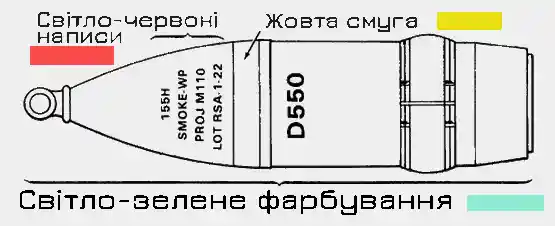
Now, if you combine your knowledge of color codes with what you have learned about markings, you can fully identify this item. It is a 155 mm howitzer smoke projectile filled with white phosphorus (WP), with a high-explosive fragmentation bursting charge.
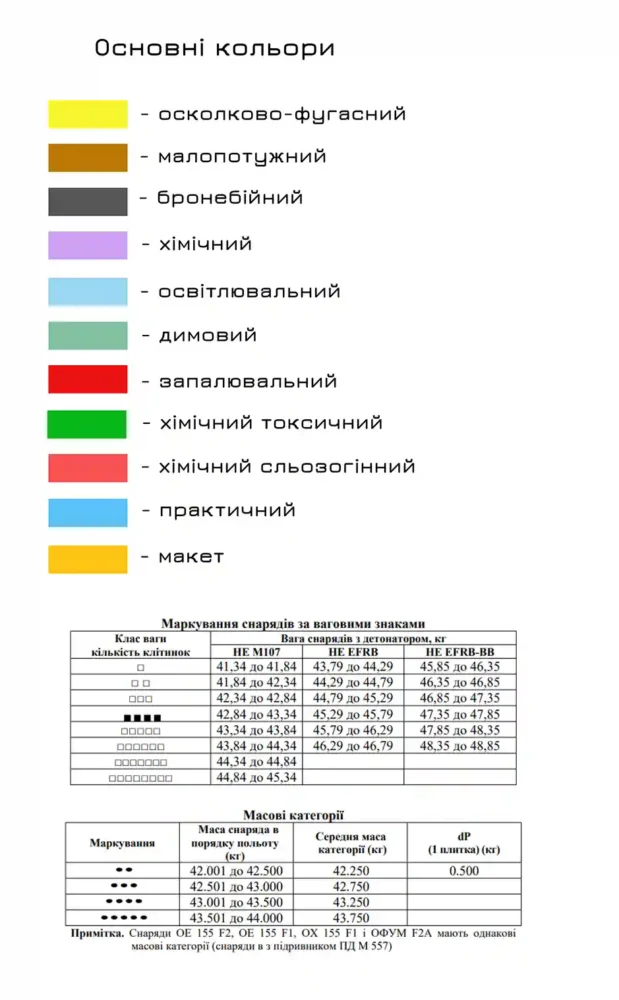
Projectile marking by weight signs
| Weight class (number of squares) | HE M107 | HE EFRB | HE EFRB-BB |
|---|---|---|---|
| □ | 41.34 to 41.84 | 43.79 to 44.29 | 45.85 to 46.35 |
| □ □ | 41.84 to 42.34 | 43.79 to 44.79 | 45.85 to 46.85 |
| □ □ □ | 42.34 to 42.84 | 44.29 to 44.79 | 46.35 to 46.85 |
| □ □ □ □ | 42.84 to 43.34 | 44.79 to 45.29 | 46.85 to 47.35 |
| □ □ □ □ □ | 43.34 to 43.84 | 45.29 to 45.79 | 47.35 to 47.85 |
| □ □ □ □ □ □ | 43.84 to 44.34 | 45.79 to 46.29 | 47.85 to 48.35 |
Weight categories
| Marking | Projectile weight in ascending order (kg) | Average weight of category (kg) | dP (1 tile) (kg) |
|---|---|---|---|
| • | 42.001 to 42.500 | 42.250 | 0.500 |
| •• | 42.501 to 43.000 | 42.750 | 0.500 |
| ••• | 43.001 to 43.500 | 43.250 | 0.500 |
| •••• | 43.501 to 44.000 | 43.750 | 0.500 |
| ••••• | 44.001 to 44.500 | 44.250 | 0.500 |
Note: Projectiles OE 155 F2, OE 155 F1, OX 155 F1 and OFUM F2A have the same weight categories (projectiles fitted with the PD M 557 fuze)
LOT – batch identification number. How to read it

Codes of all manufacturers of military products at this link: MIL-HDBK-1461
DODIC - US Department of Defense identification code

Orienting a 64-00 mils panoramic sight with the PAB-2M aiming circle
1. Setting up the PAB-2M and orienting it is no different from the usual procedure. We finish with the aiming circle "looking" at the base direction of fire (BD), and the red scales zeroed.
Pay attention to the BD. If you have chosen the BD for the gun (in 64-00 mils), you need to convert it to thousandths for the aiming circle. This can be done in Kropyva or by dividing the mils by 1.067 (exactly 1.06666666667).
Example: BD 15-00 mils / 1.067 = 14-06 thousandths.
So the BD on the aiming circle will read 14-06 on the black scales, with the red ones zeroed.
3. We point the aiming circle at the panoramic sight and subtract the red-scale readings from 30 if they are less than 30-00; if the readings are greater than 30-00, we subtract them from 90.
3. We convert the resulting values back to mils using Kropyva, or multiply by 1.067.
Then everything proceeds as usual. We report the data to the gunner after the calculation.
Example 1. Aiming circle reading 5-43.
30-00 — 5-43 = 24-57
24-57 × 1.067 = 26-22 set on the aiming circle
Example 2. Aiming circle reading 35-43
90-00 — 35-43 = 54-57
54-57 × 1.067 = 58-23 set on the aiming circle
Oleh Syrota (Georgich©) for the Armed Forces of Ukraine /
Share your experience of working with 155 mm ammunition.
Send comments and suggestions by email: entropiaw@gmail.com
