
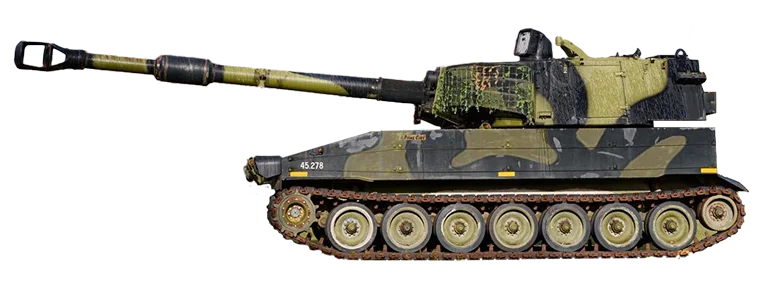
Calibrating the sighting devices of the 155 mm M109A3 self-propelled howitzer
Calibration of the M109A3 howitzer
Calibrating the quadrant
To calibrate the quadrant:
a) place the 155 mm M109A3 self-propelled howitzer on a hard surface;
b) set the quadrant to 0-00, place it on the leveling plate across the barrel and level the M109 using the jacks;
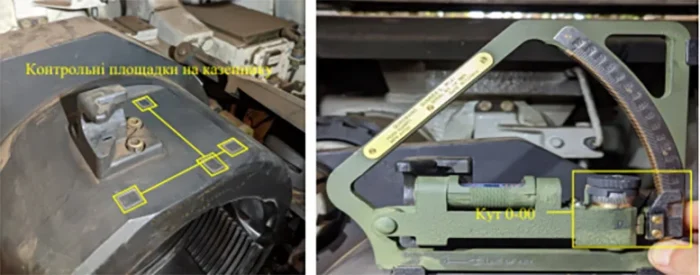
Placing the quadrant on the breech leveling plate
c) place the quadrant on the leveling plate along the barrel and, using the elevation handwheel, bring the quadrant bubble to the middle (between the marks);
d) turn the quadrant through 180°. If the bubble stays exactly in the middle, the quadrant is calibrated (an error of no more than 1/4 of a division of the quadrant vial scale is permitted);
e) if the bubble moves, center it with the quadrant micrometer knob and read the setting;
f) half of the reading is the error correction (positive if the arm is set to zero, and negative if it is set to minus 10 mils);
g) record the error correction and apply it, with the correct sign, to all barrel elevation angles when laying with the quadrant.
Checking the sight zero settings
To check the sight zero settings::
a) set the sight to zero;
b) center the cross-level and longitudinal levels of the sight and the panoramic telescope
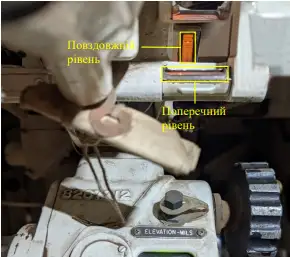
Cross-level and longitudinal levels of the sight and the panoramic telescope
c) set the quadrant to 0-00 and place it on the breech leveling plate along the barrel;
d) after these operations the quadrant bubble should be centered (between the marks);
e) if the quadrant bubble has moved, center it with the quadrant micrometer knob and determine the deviation
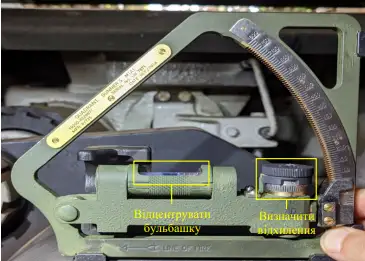
Centering the quadrant bubble and determining the deviation
f) set a barrel elevation of 100 mils on the sight and, using the elevation handwheel, bring the longitudinal level bubble of the sight to the middle. Set the same angle on the quadrant and determine the deviation. Repeat the steps above at barrel elevations from 200 to 800 mils and calculate the average deviation;
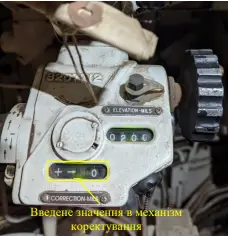
g) enter the calculated average deviation into the correction mechanism
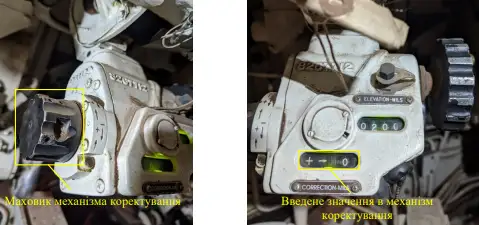
Average deviation entered in the correction mechanism
Checking the zero line of sight
To check the zero line of sight against a distant aiming point on the terrain:
a) place the M109 howitzer on a hard surface;
b) stretch threads across the marks on the muzzle face of the barrel
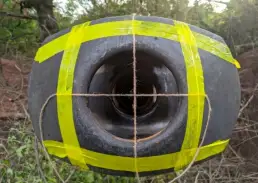
Threads stretched across the marks on the muzzle face of the barrel
c) remove the firing mechanism from the breech block;
d) aligning the hole in the breech block with the center of the thread cross on the muzzle face, lay the barrel on the aiming point (the distance to the aiming point must be at least 1,500 m)
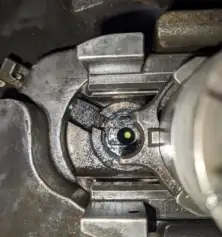
Laying the barrel on the aiming point through the hole in the breech block and the center of the thread cross on the muzzle face
e) set the sight vertical using the cross-level and lay the panoramic telescope reticle on the point on which the barrel is laid
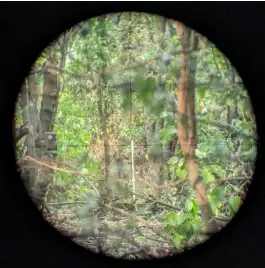
Laying the panoramic telescope on the aiming point
f) as a result of these operations the angle-measuring (upper) scale of the panoramic telescope should read 32-00
Angle 32-00 on the angle-measuring (upper) scale of the panoramic telescope
g) if after laying the panoramic telescope the angle on the angle-measuring (upper) scale is not 32-00, you must:
1) unscrew the protective cover of the panoramic telescope shaft lock
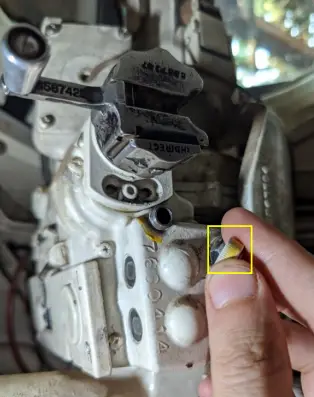
The protective cover of the panoramic telescope shaft lock unscrewed
2) press the panoramic telescope shaft lock with a screwdriver and, turning the azimuth handwheel, set 32-00 on the angle-measuring (upper) scale of the panoramic telescope
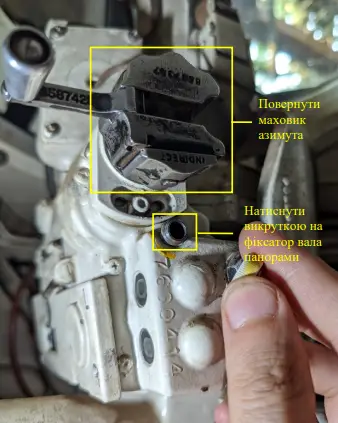
Setting the angle 32-00 on the angle-measuring (upper) scale of the panoramic telescope
3) release the panoramic telescope shaft lock and screw the protective cover back on.
Also on this site
- Calibrating the sighting devices of the FH70 gun
- Orienting the panoramic sight to mils 64-00 using the PAB-2M aiming circle
- How to enter the correction when firing illuminating projectiles
- Why is it so important to fire at higher angles?
- Range tables for specific projectiles
- Mortar-style firing: the effect of traverse on accuracy
- Cognitive information — all articles of the section
Orienting a 64-00 mils panoramic sight with the PAB-2M aiming circle
1. The preliminary setup and orientation of the PAB-2M aiming circle is no different from the usual one. We end up with the aiming circle pointed in the main direction of fire (MDF) and the angle-measuring (red) scales zeroed.
How to enter the correction when firing illuminating projectiles
During night combat operations, artillery units, in addition to fire missions to engage targets, perform the following tasks:
Why is it so important to fire at higher angles?
This material briefly explains how the projectile’s landing angle affects the effectiveness of engaging the enemy through fragment dispersion.
Oleh Syrota (Georgich©) for the Armed Forces of Ukraine /
Share your experience of working with 155 mm ammunition.
Send comments and suggestions by email: entropiaw@gmail.com
