
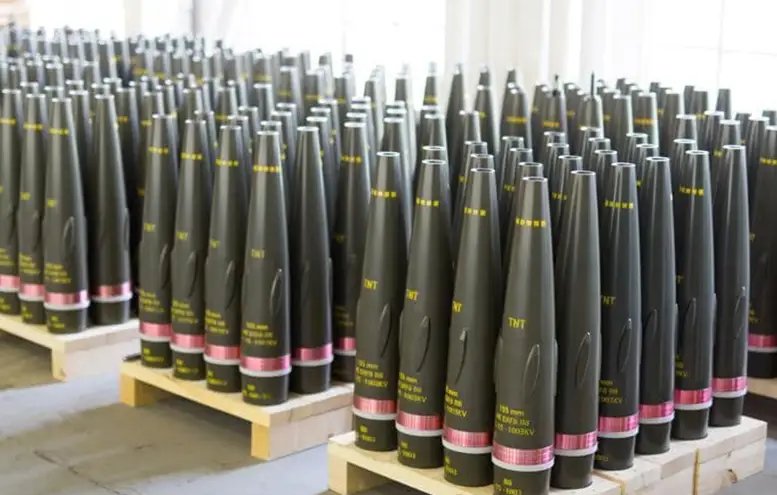
155 mm extended-range high-explosive fragmentation projectiles
155 mm high-explosive fragmentation projectiles
Used by:
- NORICUM GH N-45;
- CITEFA CALA 30/2;
- SRC International GC 45;
- NORINCO Type WA 021 and Type GM-45;
- Patria Vammas 155 GH 52 Howitzer;
- Giat Industries TR and 155/52 guns and the M114F howitzer;
- FH-70;
- Soltam Model 839P, 845P, upgraded M-46 and M114S;
- Otobreda 155/39;
- KH179;
- RDM M139 and M114/39;
- STK FH-88 and FH-2000;
- LIW G5;
- SITECSA 155/45 ST 012, M114 155/45 and M114 155/39;
- SANTA BARBARA SB 155/39 and 155/52 APU SBT-1 howitzers;
- Bofors FH-77B;
- Extended Range Gun (Taiwan);
- XM777 Lightweight Towed Howitzer;
- M46/84 (Federal Republic of Yugoslavia).
Self-propelled 155 mm howitzers:
- TAMSE VCA 155;
- NORINCO PLZ45 self-propelled howitzer;
- Giat Industries GCT and CAESAR 155/52;
- PzH 2000;
- Rheinmetall M109A3G and M44T;
- Majnoon (Iraq);
- Soltam Rascal and Slammer;
- Otobreda Palmaria and M109L;
- K9 Thunder (South Korea);
- ZTS ZUZANA (Slovakia);
- LIW G6;
- XT-69 (Taiwan);
- AS90 and Braveheart;
- M109A4, M109A5 and M109A6 Paladin;
- XM2001/XM2002 Crusader AFAS.
Development
The 155 mm Extended Range Full Bore (ERFB) projectile is the logical result of ballistic developments that trace their origin back to the German “Paris Gun” of the First World War. The basic profile of the modern ERFB was already visible in the 21 cm projectiles used by the German 21 cm K (E) railway gun in the Second World War. However, it was only thanks to the efforts of Dr. Gerald Bull and his team at Space Research Corporation (SRC) that the full potential of the concept was realized and the ERFB brought to its modern form, increasing the range of modern 155 mm artillery by at least a third.
In the early 1970s, after the High Altitude Research Project (HARP) was closed, Canada's Space Research Corporation carried out a series of studies for the US Navy aimed at increasing the range of coastal artillery. Although these studies did not lead to new munitions, the experience gained directly influenced the development of the 155 mm ERFB projectile (Mk 10 Mod.2) and the 155 mm GC 45 gun-howitzer. The success of this 45-caliber gun-howitzer and its ammunition led to numerous international collaborations, such as with Austria's NORICUM, Belgium's PRB SA and South Africa's Armscor.
In 1996 India signed a contract with Denel (South Africa) for the supply of 50,000 155 mm ERFB projectiles worth approximately 840 million rand (US$24.1 million), including 40,000 high-explosive fragmentation projectiles at a price of $390 each.
Description
The 155 mm ERFB projectile has a basic design that includes:
- A long aerodynamic body with a smooth, streamlined profile that forms a practically continuous ogive from the nose to the copper or brass driving band and the plastic obturator near the base.
- Four steel lugs to ensure stability during firing.
- A hollow base with a conical tail section to reduce aerodynamic drag.
- A body made of high-quality steel, usually AISI 9260.
- An explosive filling, such as 8.2 kg of Composition B or 8.6 kg of TNT.
- A fuze cavity that is closed with a plug during transport.
Base Bleed (BB) modification
The 155 mm ERFB projectile can be fitted with a Base Bleed (BB) unit, which provides an additional increase in range. The BB unit contains a slow-burning propellant charge that reduces turbulence behind the projectile, lowering base drag by 50–70% and increasing range by up to 25%.
Advantages
- ERFB-BB projectiles have a maximum dispersion of less than 0.5% of range, and ERFB projectiles 0.35%.
- Using BB increases the firing range without reducing accuracy.
South African 155 mm ERFB projectiles can be modified in the field by removing the conical tail sections and fitting Base Bleed (BB) units, turning them into 155 mm ERFB-BB projectiles. The process is carried out using a projectile clamping table. The same table is also used to replace damaged obturators. The table folds flat and weighs 25 kg.
To make full use of the range of the 155 mm HE ERFB and ERFB-BB projectiles, high-energy charges are normally used, such as the NATO/US M3A1 (zones 3, 4 and 5), M4A2 (zones 3, 4, 5, 6 and 7), M119A1 (zone 8), M203 (zone 9) or M11 (zone 10), with the M11 used only with barrels of 45 calibers or longer.
Typical range comparisons for 155 mm HE ERFB projectiles fired from 39- and 45-caliber barrels:
- M119A1 charge: 19,200 m (39 calibers), 21,100 m (45 calibers)
- M203 charge: 25,900 m (39 calibers), 26,500 m (45 calibers)
- M11 charge: not available for 39 calibers, 30,000 m (45 calibers)
Typical range comparisons for 155 mm HE ERFB-BB projectiles fired from 39- and 45-caliber barrels:
- M119A1 charge: 24,500 m (39 calibers), 26,200 m (45 calibers)
- M203 charge: 32,500 m (39 calibers), 32,600 m (45 calibers)
- M11 charge: not available for 39 calibers, 39,600 m (45 calibers)
Typical muzzle velocities for 155 mm HE ERFB and ERFB-BB projectiles fired from a 45-caliber barrel:
- M3A1 zone 3: 266 m/s
- M3A1 zone 4: 302.1 m/s
- M3A1 zone 5: 359.9 m/s
- M4A2 zone 6: 458.1 m/s
- M4A2 zone 7: 541.9 m/s
- M119 zone 8: 658 m/s
- M203 zone 9: 795.5 m/s
- M11 zone 10: 897 m/s
The charge system for the LIW 155 mm G5 and G6 gun-howitzers originally included a three-charge system with fabric bags. It was later replaced by a modular system using combustible cases developed by SOMCHEM, with a built-in charge retainer. This system can be used with ERFB projectiles (above base Charge 2), ERFB-BB projectiles and all 155 mm NATO projectiles.
The lowest charge in the SOMCHEM modular system is the 155 mm Modular Charge 1 M51. The combustible case of this charge is red and contains single-base granular propellant. The igniter consists of a combination of 20 g of G12 powder and 40 g of CBI. The charge weighs about 2.3 kg, is 211 mm long and 164 mm in diameter.
The next charge is the 155 mm Modular Charge 2 M52. The combustible case is blue and contains triple-base propellant cords. The diameter at the front of the case is reduced so that it can be secured in the rear of the increment charge. The igniter consists of 20 g of G12 powder and 40 g of CBI. The charge weighs about 5.6 kg, is 373 mm long and 164 mm in diameter.
The modular system continues with the 155 mm Modular Increment M52. One or two such increments can be added to the standard Charge 2. Charge 2 plus one increment can be used with boat-tail ERFB projectiles and all 155 mm NATO projectiles. Charge 2 plus two increments can be used with ERFB, ERFB-BB and all NATO projectiles. Each increment is contained in a green combustible case holding triple-base propellant cords. The igniter contains 60 g of G12 powder. The charge weighs about 4 kg, is 289 mm long and 164 mm in diameter.
The top charge of the modular system is the 155 mm Modular Charge 3 M53. It is placed in a purple (jacaranda-colored) combustible case containing triple-base tubular propellant. The igniter consists of G12 powder. The charge weighs about 17.1 kg, is 930 mm long and 164 mm in diameter.
All charges are ignited by the M82 tube percussion primer, which contains 1.4–1.5 g of powder. The primer is 49.37 mm long and 15.24 mm in diameter.
Ballistic performance when firing from a 45-caliber barrel:
- Charge 1: muzzle velocity 350 ±5 m/s, maximum range 9,100 m
- Charge 2: muzzle velocity 483 ±5 m/s, maximum range 13,400 m
- Charge 2 + 1 increment: muzzle velocity 645 ±5 m/s, maximum range 19,000 m
- Charge 2 + 2 increments: muzzle velocity 795 ±5 m/s, maximum range 25,400 m
- Charge 2 + 2 increments + BB: muzzle velocity 789 ±5 m/s, maximum range 31,000 m
- Charge 3, standard projectile: muzzle velocity 897 ±5 m/s, maximum range 30,200 m
- Charge 3 + BB: muzzle velocity 895 ±5 m/s, maximum range 39,000 m
This modular system was replaced by a system of up to six M62A1 modular charges, each of identical composition and compliant with the requirements of the NATO Joint Ballistics MoU. The charges are produced by SOMCHEM and can be used with guns of up to 52 calibers.
Combustible single-piece cartridge cases (CCC) have been developed for use with 155 mm ERFB projectiles. For example, the C30 charge produced by Chartered Ammunition Industries of Singapore contains 14 kg of triple-base propellant, is 770 mm long and 160 mm in diameter. It provides a range of 30,000 m when fired from a 39-caliber barrel and 40,000 m from a 45-caliber barrel.
Another charge developed for 39- and 45-caliber barrels to fire ERFB projectiles is the No. 16 propelling charge, produced by Eurometaal NV (Netherlands). It is a separate-loading bag charge with CH21 single-base propellant, a central igniter core and 250 g of potassium sulfate to reduce flash. The charge weighs 13.12 kg, of which 12.12 kg is CH21 propellant, and is 764 mm long.
For training purposes Denel developed the 155 mm Prac M1A1 shell. This projectile contains inert material together with three 400 g explosive capsules that detonate on impact to produce a signal flash. The projectile may have a conical tail or a Base Bleed unit, depending on requirements.
Specifications of the South African HE M1 projectile:
- Weight:
- ERFB projectile: 42.84–45.34 kg
- ERFB-BB projectile: 45.27–47.77 kg
- Explosive filling (nominal): 8.71 kg RDX/TNT (50/50)
- Length:
- ERFB: 843 mm
- ERFB-BB: 861 mm
- Diameter:
- Over the lugs: 154.69 mm
- Over the driving band: 157.86 mm
- Muzzle velocity:
- ERFB: 897 m/s
- ERFB-BB: 895 m/s
- Maximum range:
- ERFB: 30,000 m
- ERFB-BB: 39,000 m
- Chamber pressure (typical): 3,500 bar
- Operating temperature range: -20 to +60 °C
Authorized fuzes:
- Impact (PD): M557, M78 series, M739, Fuchs M841
- Mechanical time (MTSQ): M564, M582
- Proximity (Prox): M514 series, Fuchs 8513
- Electronic: NINA, ZELAR, Fuchs M8611
Equivalent projectiles in other countries:
- Argentina:
- Manufacturer: CITEFA
- Type: PALA 37/CH (ERFB) and PALA 37/BB (ERFB-BB) long-range artillery projectiles. Weight 45.5 kg, filling 8.8 kg of RDX. Maximum range 39,000 m.
- Austria:
- Manufacturer: Hirtenberger AG
- Type: 155 mm ERFB, ERFB-BB. Standard specifications. Production has ended, but they may remain in service.
- China (NORINCO):
- Type: 155 mm ERFB, ERFB-BB. Designed for the 155 mm Type WA 021 howitzer and compatible with other systems. Fitted with the M739 fuze.
- France (Giat Industries):
- Type: 155 mm HE ERFB BB NR 265 B1, HE ERFB BT NR 173 B1. The ERFB-BB projectile weighs 47.2 kg, with a filling of 8.2 kg of TNT or 8.8 kg of RDX/TNT.
- Iraq:
- Manufacturer: state factories
- Type: 155 mm ERFB-BT, ERFB-BT-BB. Details unknown, import possible.
- South Korea (Poongsan Corporation):
- Type: 155 mm HE-ERFB K307 (ERFB-BB). Maximum range 40,000 m, weight 47.17 kg. Fitted with M557 or M739A1 fuzes.
- Netherlands (Eurometaal NV):
- Type: 155 mm ERFB, ERFB-BB. Standard specifications.
- Singapore (Chartered Ammunition Industries):
- Type: 155 mm ERFB, ERFB-BB. Filling of 8 kg of TNT with additives.
- Slovakia (Technopol, Konstrukta Defence, Vihorlat):
- Type: 155 mm HE projectile with lugs and BB. Maximum range 39,000 m.
- South Africa (NASCHEM, SOMCHEM):
- Type: 155 mm HE M1, HE M1A2, VLAP. ERFB projectile weight 44.5 kg, ERFB-BB 46 kg.
- Spain (EXPAL SA, FOREX SA):
- Type: 155 mm ERFB Mk 10 Mod 2, ERFB/BB Mk 10 Mod 2B.
- Switzerland (NORICUM):
- Type: SEN-155 mm HE/BT and HE/BB.
- Yugoslavia (Yugoimport SDPR):
- Type: 155 mm ERFB, ERFB-BB.
Also on this site
Cognitive information
Painting of 155 mm artillery projectiles
Ammunition components are painted primarily to prevent rust. Colors are used for camouflage, for recognizing the main use of the item and for identifying hazardous fillers used in the munitions. These are the colors used to indicate the main use of ammunition.
Markings and inscriptions on projectiles
A–3 – an American explosive consisting of a mixture of 91% RDX and 9% plasticizing oil, also known as microcrystalline wax;
Orienting a 64-00 mils panoramic sight with the PAB-2M aiming circle
1. The preliminary setup and orientation of the PAB-2M aiming circle is no different from the usual one. We end up with the aiming circle pointed in the main direction of fire (MDF) and the angle-measuring (red) scales zeroed.
How to enter the correction when firing illuminating projectiles
During night combat operations, artillery units, in addition to fire missions to engage targets, perform the following tasks:
Why is it so important to fire at higher angles?
This material briefly explains how the projectile’s landing angle affects the effectiveness of engaging the enemy through fragment dispersion.
Conversion of propellant charges
able for converting bagged propellant charges into the MACS modular system
LOT – batch identification number. How to read it

Codes of all manufacturers of military products at the link: MIL-HDBK-1461
DODIC - US Department of Defense identification code

Calculating the length of a leg of a right triangle
Oleh Syrota (Georgich©) for the Armed Forces of Ukraine /
Share your experience of working with 155 mm ammunition.
Send comments and suggestions by email: entropiaw@gmail.com
