
Modular charge system
MODULAR CHARGE SYSTEM
Video
Demonstration video of the design and operation of the DM72 (DM52) modular charge system
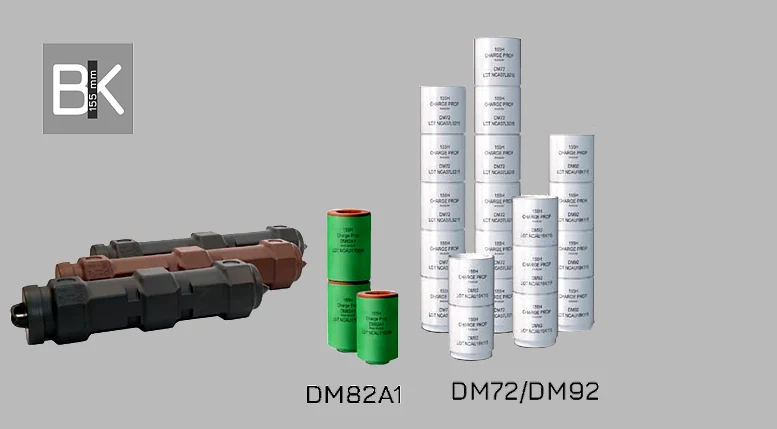
- Modular charge system, using the DM82 and DM72/92/52 as examples:
COMPATIBLE WITH ALL NATO 39- AND 52-CALIBER STANDARDS.
The 155 mm artillery modular charge system was developed in close cooperation with Rheinmetall Waffe Munition and was adopted by the German procurement agency BWB in 1996 for use in all standard NATO 39- and 52-caliber gun configurations with matching projectiles that comply with the Joint Ballistics Memorandum of Understanding (JBMoU). The DM82A1 low-zone module and the DM92 high-zone module perform across the whole temperature range from -46°C to +63°C. The modular charge system is in service with more than ten user countries (NATO and others) and is exported to other customers. More than 1.5 million modules have been produced and used to date.
GENERAL INFORMATION ON METAL-CASE CHARGES:
- Fully compliant with JBMoU requirements
- Extended range of more than 40 km with ER projectiles
- Two-module charge design: DM82A1 low zone and DM72/92 high zone (high stowage capacity, improved logistics)
- A unique ignition booster design ensures safe ignition and prevents pressure waves and negative pressure differentials under any load conditions and temperatures
- Low barrel wear and low toxicity
- Minimal standard deviations of muzzle velocity at all charge levels
- Residue-free combustion
ENVIRONMENTAL ASPECTS:
Besides its proven compatibility with several weapon systems, the Nitrochemie modular charge system stands out for its environmental reliability and durability in extreme environmental conditions.
Extremely demanding logistic and tactical trials of intensified use were further extended to include climatic cycles (+35 °C to 71 °C) and (-37 °C to -46 °C).
COMPLIANCE WITH “INSENSITIVE MUNITIONS” REQUIREMENTS:
The modular charge system was tested in accordance with STANAG requirements for IM munitions, including the impact of a shaped charge of M77 submunitions and an 87 mm RPG-7 shaped charge. All tests demonstrated Type IV–V reactions.
BALLISTIC REQUIREMENTS FOR 39-CALIBER GUNS (FH70, M109, M777):
- Average muzzle velocity 810 m/s (39-caliber gun, 5 modules, L15A1 projectile, 21°C)
- Demonstrated system compatibility: FH70, M109, M777A2, AS90
- Demonstrated projectile compatibility: the American M107 family, the German DM family, the South African Assegai family, Scandinavian Nammo projectiles, Turkish MOD274, the Spanish ER02A1 family, and American Excalibur.
KEY FEATURES:
- - Bi-modular design
- - Non-toxic, includes a copper-fouling remover
- - Low-sensitivity (IM) propellant
- - Low flame temperature (2,670 K)
- - Impetus of 1,007 J/g
- - Heat of explosion of 3,400 J/g
- - Barrel wear-reducing elements
- - Central igniter
- - Residue-free combustion
- - Complies with the NATO memorandum - JBMoU
Also on this site
- MCS and BMCS modular charge systems: what is the difference
- Conversion of propellant charges
- Propellant charges — all pages of the section
- Modular charge M231 (MACS)
- M232 charge (BMCS)
- Cognitive information — all articles of the section
Informative content
Painting of 155 mm artillery projectiles
Ammunition components are painted primarily to prevent rust. Colors are used for camouflage, for recognizing the main use of the item and for identifying hazardous fillers used in the munitions. These are the colors used to indicate the main use of ammunition.
Markings and inscriptions on projectiles
A–3 – an American explosive consisting of a mixture of 91% RDX and 9% plasticizing oil, also known as microcrystalline wax;
Orienting a 64-00 mils panoramic sight with the PAB-2M aiming circle
1. The preliminary setup and orientation of the PAB-2M aiming circle is no different from the usual one. We end up with the aiming circle pointed in the main direction of fire (MDF) and the angle-measuring (red) scales zeroed.
How to enter the correction when firing illuminating projectiles
During night combat operations, artillery units, in addition to fire missions to engage targets, perform the following tasks:
Why is it so important to fire at higher angles?
This material briefly explains how the projectile’s landing angle affects the effectiveness of engaging the enemy through fragment dispersion.
Conversion of propellant charges
able for converting bagged propellant charges into the MACS modular system
LOT – batch identification number. How to read it

Codes of all manufacturers of military products at this link: MIL-HDBK-1461
DODIC - US Department of Defense identification code

Calculating the length of a leg of a right triangle
Oleh Syrota (Georgich©) for the Armed Forces of Ukraine /
Share your experience of working with 155 mm ammunition.
Send comments and suggestions by email: entropiaw@gmail.com
