
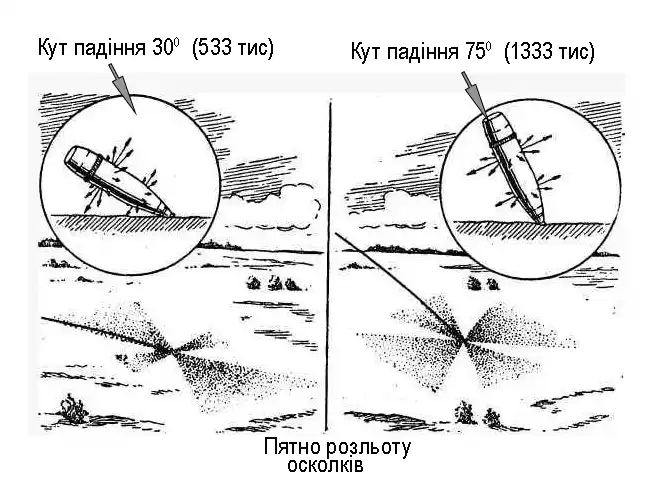
Why is it so important to fire at higher angles?
Firing effectiveness
This article examines the effect of an artillery projectile's angle of fall on the effectiveness of engaging the enemy with fragmentation. The analysis is based on the results of mathematical calculations and experimental research. Particular attention is paid to substantiating the importance of choosing the correct propellant charge.
Fragmentation fields and the factors that determine their effectiveness
When a fragmentation munition detonates, a fragment field forms, described by the following characteristics:
- Direction of fragment travel
- Velocity of fragments
- Density of the fragment flux (the number of fragments passing through a unit of area per unit of time)
The density and velocity of fragments are decisive indicators of target-engagement effectiveness. The target is, as a rule, at a random angle to the axis of the munition, so assessing the probability of hitting it requires knowing the number and distribution of fragments in a given direction. These parameters are determined by the fragment dispersion law, which is described by the functional relationship:
N(α) = N₀ × f(α)
where:
N(α) — the number of fragments in the direction at an angle α to the axis of the munition,
N₀ — the total number of fragments,
f(α) — a function that defines the density and velocity of fragment dispersion.
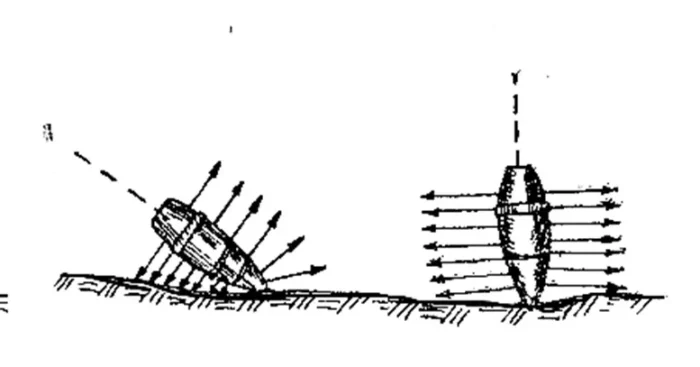
The effect of the angle at which the projectile meets the surface on engagement effectiveness
One of the most significant factors affecting engagement effectiveness is the angle at which the projectile meets the obstacle (surface). The optimal angles for engaging armored or protected targets are from 50° (780 mils) to 90° (1,404 mils). A larger angle of impact increases the effectiveness of fragmentation thanks to a more even and wider distribution of fragments over the affected area.
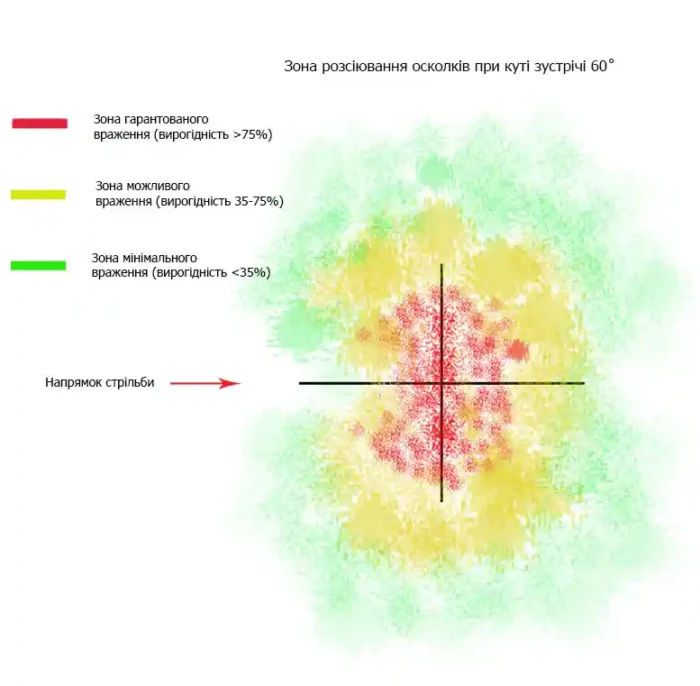
The figure shows that the larger the angle of impact, the greater the fragmentation effect against enemy personnel. This principle is reflected in the relevant firing rules for artillery systems with variable propellant charges.
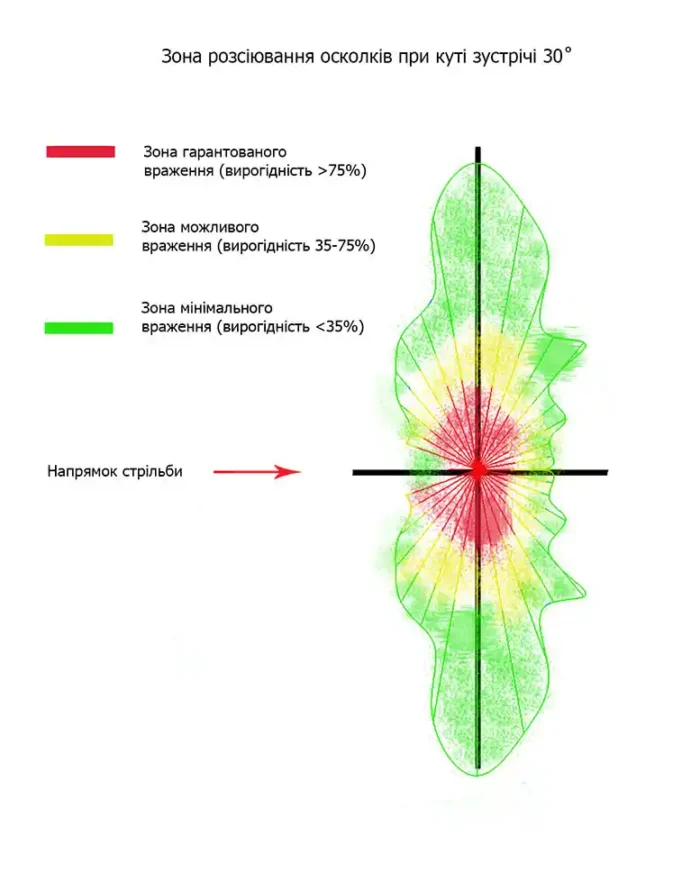
Experimental studies have shown that the effectiveness of fragmentation drops sharply at angles of fall of less than 30°. At angles of fall of about 20° the fragmentation effect is at a minimum.
Important conclusions:
- At low angles of fall (less than 30°) the effective fragments mostly fly perpendicular to the direction of fire, which makes fire with overs or shorts ineffective (except for direct hits).
- The effectiveness of fragment damage falls sharply down to an angle of fall of 20°, after which it remains practically unchanged at a minimum level.
Relationship between the elevation angle (angle of departure) and the angle of fall of the projectile
It should be noted that there is no direct linear relationship between the elevation angle (the projectile's angle of departure) and the angle of fall onto the surface. The relationship is complex and is determined by:
- the type of propellant charge,
- the caliber and type of projectile,
- the characteristics of the gun,
- atmospheric conditions.
In practice it has been established that the angle of fall usually exceeds the angle of departure by 25–80%. For small elevation angles (the most commonly used in the field) this value is in the range of 25–45%.
Examples (based on practical measurements):
- M777 gun, elevation 89, M107 projectile, charge 4 M232A1 – angle of fall 8°
- M777 gun, elevation 131, M107 projectile, charge 7 M4A2 – angle of fall 10°
- FH70 gun, elevation 198, M107 projectile, charge 7 M4A2 – angle of fall 17°
- 2S1 self-propelled gun, elevation 157, OF-462 projectile, full charge – angle of fall 17°
These data confirm that firing at an elevation of less than 240 (in the corresponding units) is ineffective, since it results in low angles of fall of the projectile and, accordingly, a significant reduction in fragmentation effect.
Also on this site
- Range tables for specific projectiles
- Mortar-style firing: the effect of traverse on accuracy
- How to enter the correction when firing illuminating projectiles
- High-explosive fragmentation projectiles with improved range
- Extended-range guns — a new trend
- Orienting the panoramic sight to mils 64-00 using the PAB-2M aiming circle
- Cognitive information — all articles of the section
Orienting a 64-00 mils panoramic sight with the PAB-2M aiming circle
1. The preliminary setup and orientation of the PAB-2M aiming circle is no different from the usual one. We end up with the aiming circle pointed in the main direction of fire (MDF) and the angle-measuring (red) scales zeroed.
How to enter the correction when firing illuminating projectiles
During night combat operations, artillery units, in addition to fire missions to engage targets, perform the following tasks:
Conversion of propellant charges
able for converting bagged propellant charges into the MACS modular system
Oleh Syrota (Georgich©) for the Armed Forces of Ukraine /
Share your experience of working with 155 mm ammunition.
Send comments and suggestions by email: entropiaw@gmail.com
