
Mortar-style firing: the effect of traverse on accuracy
Mortar-style firing
Mortar-style firing from 155 mm guns: accuracy, traverse and lateral deviations
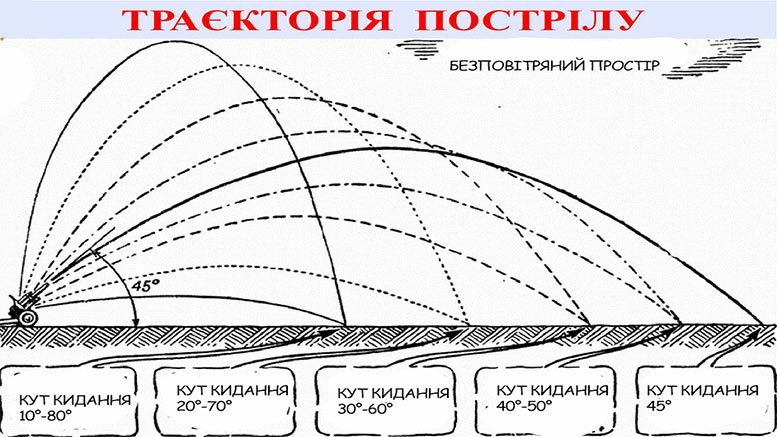
The high-angle (mortar) trajectory in 155 mm howitzer fire is a mode used to engage targets behind terrain, in ravines, on reverse slopes and in dense urban areas. In this mode the elevation angle exceeds 60°, and the projectile follows a steep trajectory with a high apex.
This creates a specific problem: even a small traverse of the barrel in azimuth, for example 00-01 (1/60 of a degree), can cause a significant deviation of the point of impact in the lateral plane. This is especially critical at ranges from 8 to 15 km.
Why does the high-angle trajectory amplify the error?
In mortar-style fire the projectile flies along an arc-shaped trajectory. Its point of impact depends not only on the initial direction but also on the geometry of the arc — the steeper the angle, the greater the effect of even a microscopic traverse. Suppose the traverse was 00-01:
00-01 = 1 / 60 of a degree ≈ 0.01667° ≈ 0.000291 rad
According to the formula:
L = D × tan(α)
where:
- L — lateral deviation in meters,
- D — range to the target in meters,
- α — angular traverse in radians.
For a range of 10 km this gives only ~2.91 m, if firing along a flat trajectory. But in reality, in a high-angle flight, according to field observations, the deviation reaches 58–60 m (00-06).
This is because the point of impact is formed along a high arc, and a shift of even 0.0003 rad at the horizon is already tens of meters across the front.
Practical deviation values for a 00-01 traverse
In combat conditions, with a high-angle trajectory and ranges up to 15 km, the lateral deviation for a 00-01 traverse can be 20 times larger than in the theoretical model. The table is below:
| 1. Range (km) | 2. Theoretical deviation at 01-00 (m) | 3. Realistic deviation on a high-angle trajectory (m) |
|---|---|---|
| 8 | 2.33 | 46.6 |
| 9 | 2.62 | 52.4 |
| 10 | 2.91 | 58.2 |
| 11 | 3.20 | 64.0 |
| 12 | 3.49 | 69.8 |
| 13 | 3.78 | 75.6 |
| 14 | 4.07 | 81.4 |
| 15 | 4.36 | 87.2 |
Conclusions
- High-angle fire demands extremely accurate traverse of every gun, especially in battery fire.
- Fire control systems must take into account the flight geometry, elevation, wind by height and the Coriolis effect.
- For accurate engagement it is important to apply individual direction corrections for each SPG.
This ballistic feature is relevant for artillery systems such as the **M777**, **KRAB**, **AHS Kryl**, **Bohdana** and other high-precision platforms. Practical experience shows that even a 00-01 error when firing at high angles at 10–15 km is already a **potential miss** at the level of the target.
Also on this site
- Why is it so important to fire at higher angles?
- Range tables for specific projectiles
- How to enter the correction when firing illuminating projectiles
- Orienting the panoramic sight to mils 64-00 using the PAB-2M aiming circle
- Camouflaging the 2S22 Bohdana gun
- High-explosive fragmentation projectiles with improved range
- Cognitive information — all articles of the section
Orienting a 64-00 mils panoramic sight with the PAB-2M aiming circle
1. The preliminary setup and orientation of the PAB-2M aiming circle is no different from the usual one. We end up with the aiming circle pointed in the main direction of fire (MDF) and the angle-measuring (red) scales zeroed.
How to enter the correction when firing illuminating projectiles
During night combat operations, artillery units, in addition to fire missions to engage targets, perform the following tasks:
Why is it so important to fire at higher angles?
This material briefly explains how the projectile’s landing angle affects the effectiveness of engaging the enemy through fragment dispersion.
Oleh Syrota (Georgich©) for the Armed Forces of Ukraine /
Share your experience of working with 155 mm ammunition.
Send comments and suggestions by email: entropiaw@gmail.com
