
M825A1 projectile design 

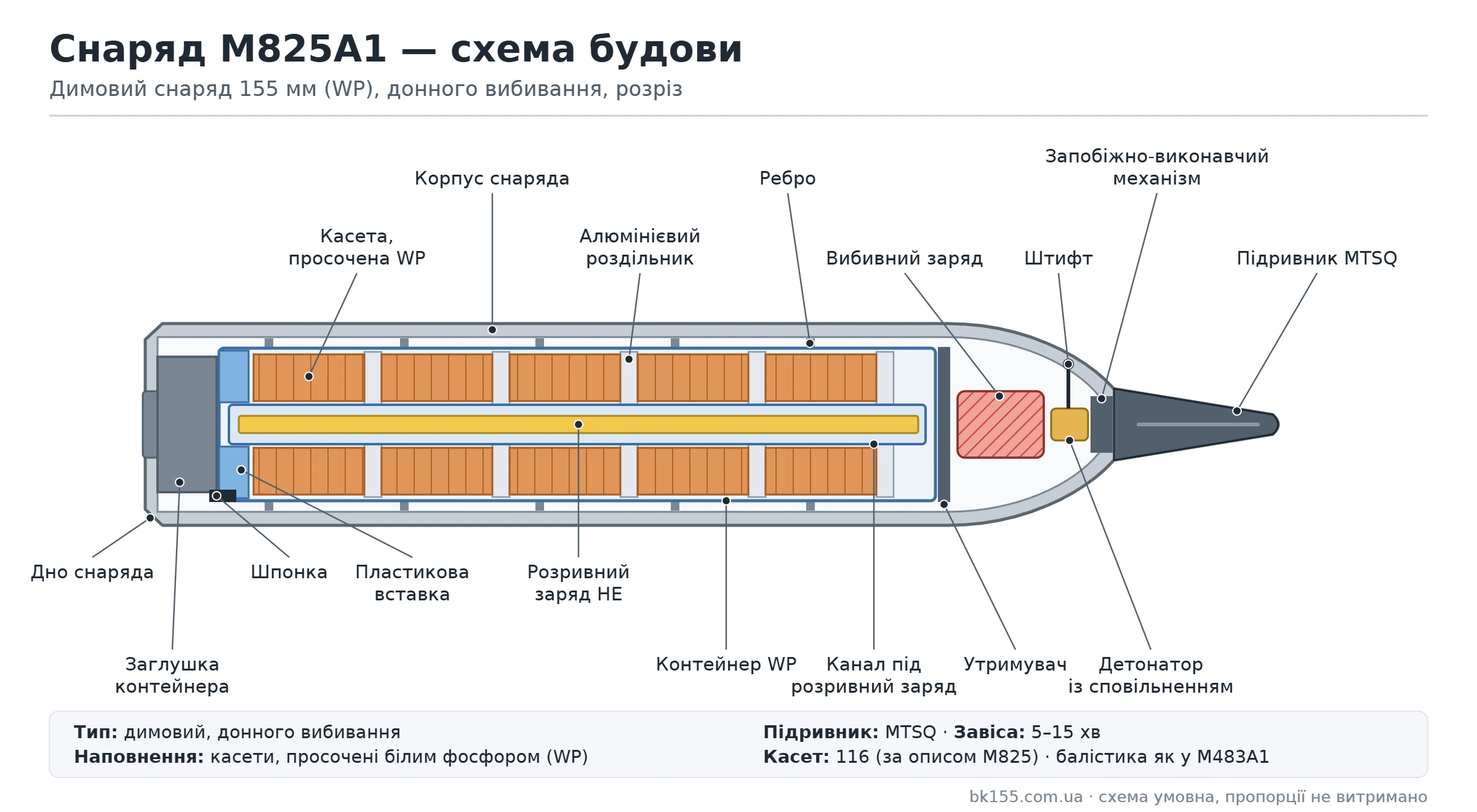
The diagram shows a section from nose to base. The labels:
- in the nose section — the MTSQ fuze, the safe-and-arm mechanism (Safe & Arm) and a pin;
- next — the expelling charge, a delay detonator and a holder;
- most of the volume is taken up by the WP container: it holds canisters interleaved with aluminum separators, and the container itself has ribs;
- along the axis of the container runs a channel with a bursting charge (HE burster);
- in the rear section — a key, a plastic insert and a plug that closes the container.
The diagram is schematic: the number of canisters and the proportions are not to scale.
How the projectile works
The sequence of actions is shown in the animation.
- The projectile flies toward the target; ballistically it is similar to the M483A1 projectile.
- At the set moment the fuze functions.
- The expelling charge pushes the contents out through the base of the projectile.
- The canisters fall to the ground in an elliptical pattern.
- Each canister becomes a separate source of smoke, and together they produce a screen lasting 5–15 minutes.
How a smoke screen is laid
Smoke is laid in two ways: quick smoke and immediate smoke.
Quick smoke
This builds a screen from 100 to 1,500 meters long, depending on the munition chosen. The mission can be planned in advance or fired at a target of opportunity. If the target is longer than 250 meters, it is better to plan it ahead: a lot of ammunition is needed, and the target itself may have to be divided into sections.
Fire can be adjusted (adjust-fire) or delivered directly for effect (FFE). For accurate FFE on a planned target, the wind direction at the screen location must match the direction given in line 00 of the current met message (computer met message), and the five requirements for accurate firing from computed data must be met.
| Quick smoke: mission parameters | |
|---|---|
| Target | planned or unplanned, length 100–1,500 m |
| Number of howitzers | from 2 to 16 |
| Munitions | M825, HC or WP |
| Sheaf | linear |
| Screen duration | 5–15 min |
| Control | requires approval from the maneuver unit commander |
Immediate smoke
Immediate smoke can be laid as a separate mission. A platoon usually fires. The first volley is fired with WP projectiles with the fuze set to quick (instantaneous action), with a mix of WP and HC. If the volleys continue, all howitzers switch to HC. When M825 projectiles are used, all howitzers fire M825 for both the first and all following volleys. How many volleys are fired, and which howitzers fire WP and which fire HC, is determined by the unit SOP. When immediate smoke is requested, a mix of WP and HC is usually used for suppression after the first rounds.
| Immediate smoke: mission parameters | |
|---|---|
| Target | a point or a small area up to 150 m (point suppression) |
| Number of howitzers | one platoon |
| Munitions | first volley — WP and/or HC, following volleys — HC; or all volleys M825 |
| Sheaf | parallel |
| Screen duration | from 30 s to 5 min |
| Control | per SOP and/or with approval from the maneuver unit commander |
What the fire direction center needs
Depending on atmospheric conditions and the desired type of smoke, the fire direction center (FDC) may compute two sets of settings: one for the first rounds that build the screen, and a second for the sustaining rounds that maintain it for the required time.
For the screen to be effective, the fire direction officer needs additional information. From the observer this is:
- the grid coordinates of the center of the desired screen (the FDC calculates the offset aim points itself, based on the type of ammunition and the wind speed and/or direction);
- the length of the screen;
- the direction of the maneuver target (MT) — from the point where the maneuvering unit is most vulnerable to enemy observation toward the target;
- the wind direction relative to the maneuver target line: headwind, tailwind, left crosswind or right crosswind;
- the duration of the screen in minutes.
About the source
The article is based on the American reference DOD 101 (Federation of American Scientists), the section “Smoke Projectiles”. That page was last updated in January 2012, so it describes the practice of American field artillery of that era; terms and abbreviations are kept as in the original. The design diagram is redrawn with reference to the USAFAS illustration from the same reference, and the animation was created for bk155.com.ua from its description. Both are schematic.
Also on this site
- Smoke and chemical projectiles — all pages of the section
- Projectiles M110 (WP Smoke, H/HD)
- Projectile M116 (HC Smoke)
- Projectile DM105 (HC Smoke)
- Projectile LU214
- 155 mm ERFB Smoke WP extended-range projectile
- Markings and inscriptions on projectiles
Orienting a 64-00 mils panoramic sight with the PAB-2M aiming circle
1. The preliminary setup and orientation of the PAB-2M aiming circle is no different from the usual one. We end up with the aiming circle pointed in the main direction of fire (MDF) and the angle-measuring (red) scales zeroed.
How to enter the correction when firing illuminating projectiles
During night combat operations, artillery units, in addition to fire missions to engage targets, perform the following tasks:
Why is it so important to fire at higher angles?
This material briefly explains how the projectile’s landing angle affects the effectiveness of engaging the enemy through fragment dispersion.
Oleh Syrota (Georgich©) for the Armed Forces of Ukraine /
Share your experience of working with 155 mm ammunition.
Send comments and suggestions by email: entropiaw@gmail.com
f FacebookKHMS 88
