
Projectile DM106 illuminating
Contents
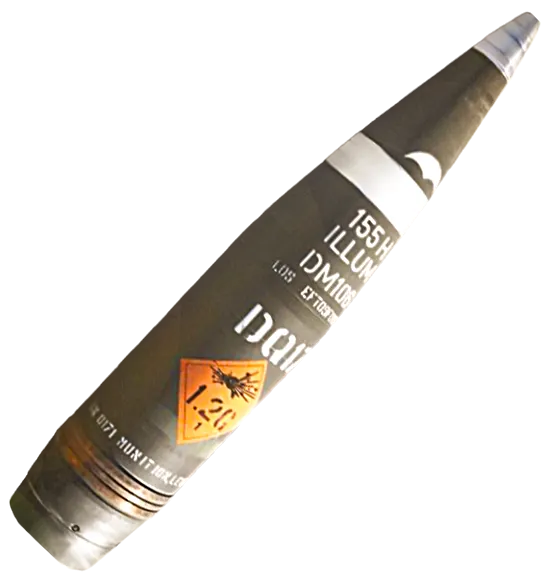
DM106 — illuminating projectile
155 mm illuminating projectile DM 106 is designed to illuminate terrain at night or in poor lighting, providing support for ground forces' operations. It is one of three projectiles developed under a trilateral agreement between Germany, Italy and the United Kingdom to create the 155 mm FH-70 towed howitzer and its associated ammunition.
Development
The projectile was developed by the German company Rheinmetall W & M GmbH (now Rheinmetall DeTec). The illuminating unit inside the projectile was created by the Italian company Simmel SpA (now Simmel Difesa SpA). This projectile became the standard for illuminating munitions in many NATO countries.
Design and principle of operation
Projectile DM 106 is a separate-loading base-ejection projectile. The body is made of high-quality forged steel. It is usually equipped with a mechanical time fuze mounted on the nose.
Internal structure:
- Illuminating unit: contains a powerful illuminating charge providing intense light for at least 60 seconds.
- Main parachute: provides a slow and stable descent of the illuminating unit at a speed of less than 5 m/s.
- Braking devices (spin retarders): reduce the rotation speed of the projectile after the contents are ejected to stabilize the descent.
- Ejection mechanism: a base ejection charge that is activated by the fuze and ejects the illuminating unit and parachute at the set height.
Principle of operation:
- Launch: The projectile is fired from a howitzer and flies along a ballistic trajectory.
- Fuze functioning: At the set height (approximately 600 m above the ground) the mechanical time fuze functions.
- Ejection of the contents: The fuze ignites the ejection charge, which creates internal pressure, shearing the pins that hold the base of the projectile. This allows the illuminating unit and parachute to be ejected.
- Parachute deployment: The drogue parachute and main parachute deploy, slowing the descent of the illuminating unit and stabilizing it.
- Illumination of the terrain: The illuminating unit ignites and illuminates an area up to 800 m in diameter, providing conditions for observation and adjustment of fire.
Charge system
The DM 106 projectile was created for a charge system known as the “three-bag system”, which consists of various combinations of base and additional charges to adjust the firing range.
Bags and charges:
- Bag 1 (Charge 2 L2A1): consists of Charge 1 and Increment charge 2 combined together.
- Bag 2 (Charge 7 L8A1): includes Charge 3 L4A1 and Increment charges 4–7.
- Bag 3 (Charge 8 L10A1): a unitary charge for achieving maximum ranges.
Firing ranges from the FH-70 howitzer:
- Charge 2: 3,900 – 5,900 m
- Charge 3: 4,800 – 7,500 m
- Charge 4: 6,200 – 9,500 m
- Charge 5: 8,500 – 12,500 m
- Charge 6: 11,200 – 16,800 m
- Charge 7: 14,200 – 20,900 m
- Charge 8: 17,000 – 24,700 m
The maximum muzzle velocity when using charge 8 is 827 m/s.
Other charge systems
A transition is possible to modular charge systems (MCS) to improve effectiveness and standardization:
- Germany: adopted the modular system MPCS DM 72 from Rheinmetall DeTec.
- Norway and Malaysia: also use this system.
- United Kingdom: introduced the South African bi-modular system M90 from SOMCHEM.
Authorized fuzes
- Mechanical time fuze (MT): L92A2 and other compatible models.
Equivalent projectiles
Italy
- Manufacturer: Simmel Difesa SpA
- Types:
- 155 mm illuminating DM 106A1
- 155 mm illuminating P4
- Description: Similar to the DM 106 in design and function, used for the same purposes.
Use on the battlefield
The DM 106 projectile is used for:
- Illumination of the terrain: Provides visibility at night or in bad weather.
- Support of operations: Allows infantry and armored vehicles to carry out tasks in conditions of limited visibility.
- Adjustment of fire: Makes it easier to observe and lay artillery on the target.
- Psychological effect: Can demoralize the enemy by suddenly illuminating their positions.
Advantages
- High illumination: Light intensity of at least 1.8 million candelas.
- Long burn time: At least 60 seconds of continuous illumination.
- Compatibility: Can be used with a wide range of 155 mm artillery systems.
- Reliability: Simple design ensures stable operation in various conditions.
Technical specifications
Technical specifications
- Caliber: 155 mm
- Projectile length with fuze: 875 mm
- Projectile weight (nominal): 43.3 kg
- Illumination: at least 1.8 million candelas
- Illuminant burn time: at least 60 seconds
- Descent speed: less than 5 m/s
- Operating temperature range: from -32°C to +52°C
- Fuze type: mechanical time (for example, L92A2)
- Primary ejection charge: 90 g of black powder
Compatible artillery systems
Self-propelled howitzers:
- TAMSE VCA 155
- PzH 2000
- Rheinmetall M109A3G and M44T
- Soltam Slammer
- Otobreda Palmaria and M109L
- K9 Thunder (South Korea)
- AS90 and Braveheart
- M109A5 and M109A6 Paladin
- XM2001/XM2002 Crusader AFAS
Towed howitzers:
- FH-70 and FH-70 R
- GH N-45
- CITEFA CALA 30/2
- Patria Vammas 155 GH 52
- Soltam M-46
- Otobreda 155/39 TM
- RDM M139 and M114/39
- SANTA BARBARA SB 155/39 and 155/52 APU SBT-1
- M114 155/45 and M114/39
- Bofors FH-77B
- M198 (with the M199 gun)
- XM777 Lightweight Towed Howitzer
Usage notes
Ballistic characteristics are the same as DM 105
How to enter the correction for illuminating projectiles:
Read: How to enter the correction when firing illuminating projectiles
Oleh Syrota (Georgich©) for the Armed Forces of Ukraine /
Share your experience of working with 155 mm ammunition.
Send comments and suggestions by email: entropiaw@gmail.com
