
Propellant charge DM (DM82A1, DM72, DM92) 

Contents
DM82A1, DM72, DM92 — Nitrochemie / Rheinmetall bi-modular charge system
The propellant charge DM is a bi-modular charge system for 155 mm guns, developed by Nitrochemie together with Rheinmetall Waffe Munition. It consists of the lower module DM82A1 (zones 1–2) and the upper modules DM72 and DM92 (zones 3–6). In its operating principle the system is close to BC-E and TC-F.
DM variants:
- DM82A1 (or DM82) is the lower module, zones 1 and 2: one or two modules.
- DM72 is the upper module, zones 3–6: from three to six modules.
- DM92 is the upper module, zones 3–6. In the manufacturer's brochure the range diagrams are given specifically for DM92, while the characteristics of DM72 and DM92 are given together.
The modules operate in a temperature range from −46 to +63 °C. With extended-range (ER) projectiles the system makes it possible to fire beyond 40 km.
Advantages of the DM bi-modular system:
- Full compliance with JBMoU requirements.
- Bi-modular design: high storage capacity and better logistics.
- The original ignition booster ensures safe ignition and prevents pressure waves and negative pressure differentials under any loading conditions and temperatures.
- Excellent LOVA/IM characteristics (reduced sensitivity to external stimuli).
- Low barrel wear and low toxicity of the components.
- Small muzzle velocity scatter at all charge levels.
- Residue-free burning and reduced muzzle flash.
Range diagram of DM charges
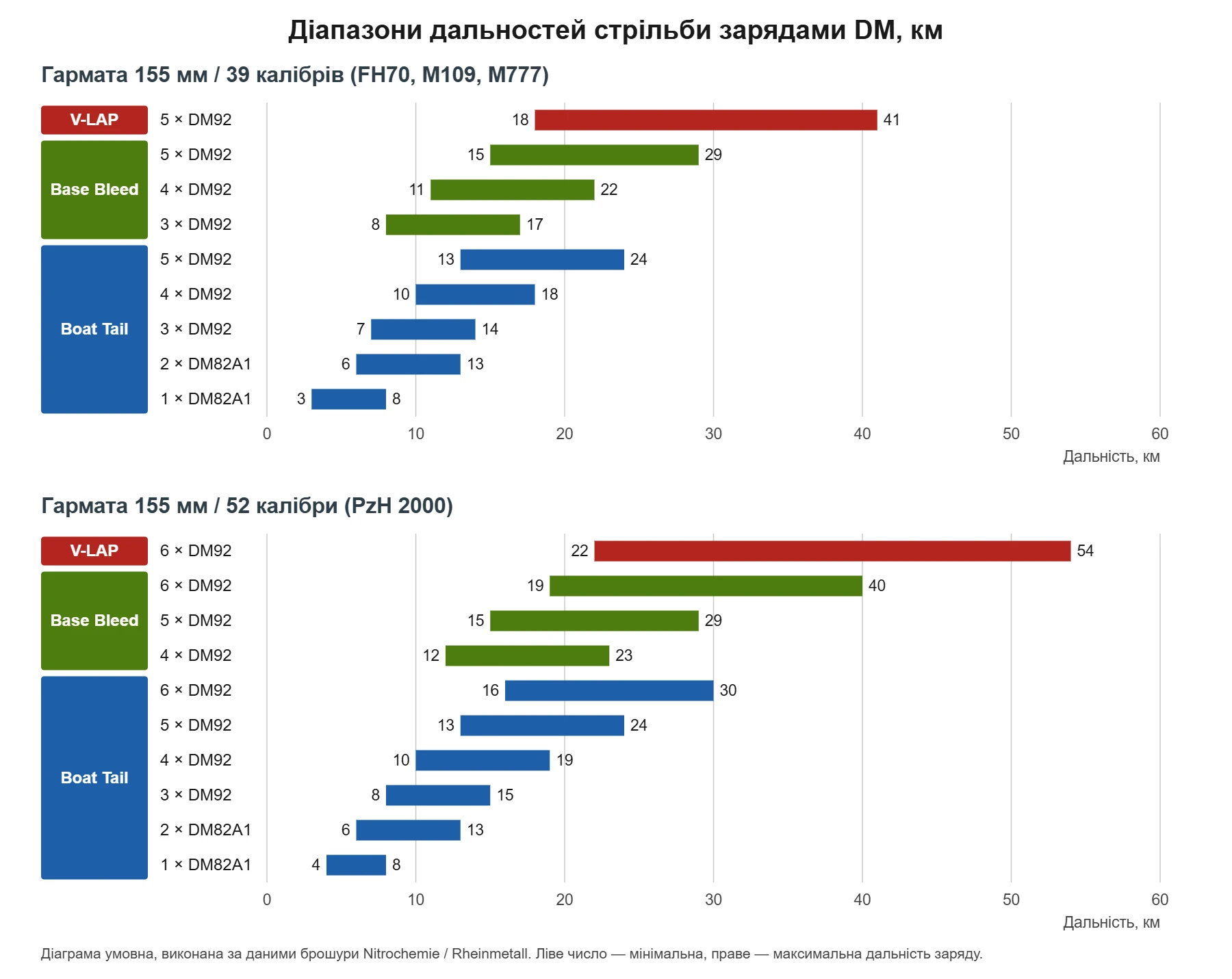
The diagram is schematic and is based on data from the Nitrochemie / Rheinmetall brochure. For each charge it shows the range band with three types of projectile: Boat Tail, Base Bleed and V-LAP. The bands of neighbouring charges overlap. The longest range in the brochure is 54 km: six DM92 modules with a V-LAP projectile in a 52-caliber gun (PzH 2000).
DM charge zones and range bands
Charge zones. The muzzle velocities for zones 1–4 and the weight of all zones are given by analogy with BC-E and TC-F: the DM manufacturer does not publish them in open sources. The velocities of zones 5 and 6 are from the manufacturer's brochure.
| Zone | Composition | Muzzle velocity, m/s | Velocity source | Charge weight, kg | Propellant, kg |
|---|---|---|---|---|---|
| Zone 1 | 1 × DM82A1 | ≈315 | by analogy with BC-E | ≈1,9 | ≈1,5 |
| Zone 2 | 2 × DM82A1 | ≈470 | by analogy with BC-E | ≈3,8 | ≈3,0 |
| Zone 3 | 3 × DM72 / DM92 | ≈560 | by analogy with TC-F | ≈8,4 | ≈6,9 |
| Zone 4 | 4 × DM72 / DM92 | ≈690 | by analogy with TC-F | ≈11,2 | ≈9,2 |
| Zone 5 | 5 × DM72 / DM92 | 810 | Nitrochemie brochure, 39-cal. gun, L15A1 projectile, 21 °C | ≈14,0 | ≈11,5 |
| Zone 6 | 6 × DM72 / DM92 | 945 | Nitrochemie brochure, 52-cal. gun (PzH 2000), L15A1 projectile, 21 °C | ≈16,8 | ≈13,8 |
The sign “≈” marks a value given by analogy, not DM manufacturer data. The weight is calculated by multiplying the module weight by the number of modules. A velocity of 810 m/s is the average for a 39-caliber gun, 945 m/s for a 52-caliber gun.
Range bands:
| Gun | Charge | Boat Tail, km | Base Bleed, km | V-LAP, km |
|---|---|---|---|---|
| 39 cal. | 1 × DM82A1 | 3–8 | — | — |
| 39 cal. | 2 × DM82A1 | 6–13 | — | — |
| 39 cal. | 3 × DM92 | 7–14 | 8–17 | — |
| 39 cal. | 4 × DM92 | 10–18 | 11–22 | — |
| 39 cal. | 5 × DM92 | 13–24 | 15–29 | 18–41 |
| 52 cal. | 1 × DM82A1 | 4–8 | — | — |
| 52 cal. | 2 × DM82A1 | 6–13 | — | — |
| 52 cal. | 3 × DM92 | 8–15 | — | — |
| 52 cal. | 4 × DM92 | 10–19 | 12–23 | — |
| 52 cal. | 5 × DM92 | 13–24 | 15–29 | — |
| 52 cal. | 6 × DM92 | 16–30 | 19–40 | 22–54 |
The range depends on the projectile type: Boat Tail, Base Bleed and V-LAP are the three projectile types for which the manufacturer gave range bands; the longest ranges in the brochure are given by V-LAP. For DM82A1 the brochure gives only the Boat Tail variant.
Resistance to external stimuli (IM)
DM charges were tested against STANAG requirements for insensitive munitions (IM), including attack by the shaped-charge jet of an M77 submunition and an 87 mm RPG-7 grenade. In all tests the manufacturer recorded reactions of types IV–V. Below are the results for DM72 in its packaging:
| Test | Standard | Minimum requirement | Desired requirement | Result DM72 / DM92 |
|---|---|---|---|---|
| Fuel fire | STANAG 4240 | IV | V | V |
| Slow heating | STANAG 4382 | III | V | V |
| Bullet impact | STANAG 4241 | III | V | V |
| Shaped-charge jet impact | MIL-STD-2105B, para. 5.2.6 | III | V | IV–V |
| RPG-7 shaped-charge jet impact | against RPG-7 | III | V | V |
| Sympathetic detonation from an adjacent charge | against RPG-7 | III | IV | no reaction |
| Drop test | STANAG 4375 | no reaction | no reaction | no reaction |
Logistic and tactical rough-handling tests covered hot cycles A1 (+35 to +71 °C), cold cycles C2 (−37 to −46 °C) and thermal shock at −51 and +71 °C. The modules were tested in metal or plastic containers of the CT NC series. According to the manufacturer, the tests were carried out by several independent government bodies of NATO and other countries.
Charges and conversion
Modular charge system
Modular Charge System (MCS) and Bi-Modular BMCS
Conversion of propellant charges
Conversion of DM charges
Propellant charge conversion table
Propellant charges
Propellant charge BC-E (BMCS)
Propellant charge TC-F (BMCS)
Modular charge M231 (MACS)
Propellant charge M232 (MACS)
Projectile L15A1
Technical specifications of DM
- Manufacturer: Nitrochemie (Germany, Switzerland); developed together with Rheinmetall Waffe Munition
- Purpose: DM82A1 is the lower module (zones 1–2); DM72 and DM92 are the upper modules (zones 3–6)
- Modules per charge: 1–2 (DM82A1) and 3–6 (DM72 / DM92)
- Total module weight: ≈1.9 kg (DM82A1) and ≈2.8 kg (DM72 / DM92) — by analogy with BC-E and TC-F
- Propellant weight: ≈1.5 kg and ≈2.3 kg — by analogy with BC-E and TC-F
- Diameter: ≈158 mm — by analogy with BC-E and TC-F
- Length: ≈155 mm (DM82A1) and ≈177 mm (DM72 / DM92) — by analogy with BC-E and TC-F
- Operating temperature: from −46 °C to +63 °C
- Upper pressure limit in propellant testing: 391 MPa at +63 °C
- Packaging: CT NC series (Nitrochemie)
- Residue-free burning
Usage notes on DM
Do not assemble DM modules together with modules of other systems, in particular M231 and M232 (MACS). The brochure contains no separate prohibition for DM, but the manufacturer of BC-E and TC-F expressly forbids combining them with other types of charges.
39-caliber guns (FH70, M109, M777). Average muzzle velocity — 810 m/s (5 modules, L15A1 projectile, 21 °C). Confirmed compatibility with the systems: FH70, M109, M777A2, AS90, 2S22 BOHDANA. Confirmed compatibility with projectiles: the US M107 family, the German DM family, the South African Assegai, various Nammo projectiles, the Turkish MOD274, the Spanish ER02A1 family, the US Excalibur.
52-caliber guns (PzH 2000). Average muzzle velocity — 945 m/s (6 modules, L15A1 projectile, 21 °C). Upper pressure limit in propellant testing — 391 MPa at +63 °C. Confirmed compatibility with the systems: PzH 2000, CAESAR, Firtina, Archer, SIAC, KRAB, 2S22 BOHDANA. Confirmed compatibility with projectiles: the US M107 family, the British L15 family, the German DM family, Assegai, the French LU211, various Nammo projectiles, MOD274, the ER02A1 family, Vulcano (Diehl / Leonardo).
The charge is assembled from the same modules: DM82A1 modules go in zones 1–2, DM72 or DM92 in zones 3–6. The range bands of neighbouring zones overlap (see the diagram above).
Conversion of propellant charges
Modular charge system. Video
A demonstration video of the modular charge system, using the DM72 propellant charge as an example.
What is the difference between the Modular Charge System (MCS) and the Bi-Modular BMCS
Oleh Syrota (Georgich©) for the Armed Forces of Ukraine /
Share your experience of working with 155 mm ammunition.
Send comments and suggestions by email: entropiaw@gmail.com
f FacebookKHMS 88
