
PGK kit: GPS course correction for 155 mm projectiles
Contents
What the PGK kit is
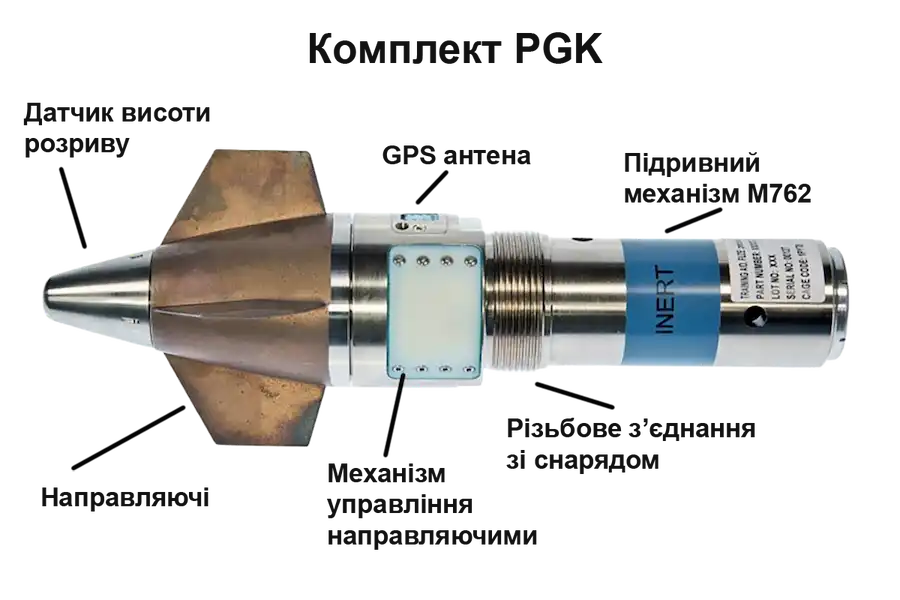
The PGK kit (Precision Guidance Kit, designated XM1156 before it entered service) is a module the size of a fuze that is screwed into the fuze well of a 155 mm projectile in place of the standard fuze. After that, an ordinary high-explosive fragmentation projectile corrects its flight by GPS signal and lands closer to the target. The munition itself does not change; only the nose section is new.
The production kit is designated M1156. Its technical characteristics as a fuze are given on the M1156 PGK fuze page, and the site classes it among the GPS-guided fuzes. This article covers something else: how the PGK kit works in flight, which projectiles and guns it is used with, and what is known about its testing and deliveries.
Who developed the PGK kit
The kit was developed by the American company Alliant Techsystems (now part of Northrop Grumman; production is in Plymouth, Minnesota). It received the contract for the system development and demonstration phase in May 2007. The first firings by military crews took place in October 2012 at the Fort Bliss range. By April 2018, more than 25,000 kits had been produced.
Why a projectile needs correction
An unguided projectile follows a ballistic trajectory. Dispersion is affected by wind, air temperature, barrel wear and charge-to-charge variation, so at long range the miss distance can amount to hundreds of metres.
The PGK kit does not replace the projectile. In flight it determines its position by GPS, compares it with the calculated trajectory to the target and corrects the course with small control surfaces, the canards.
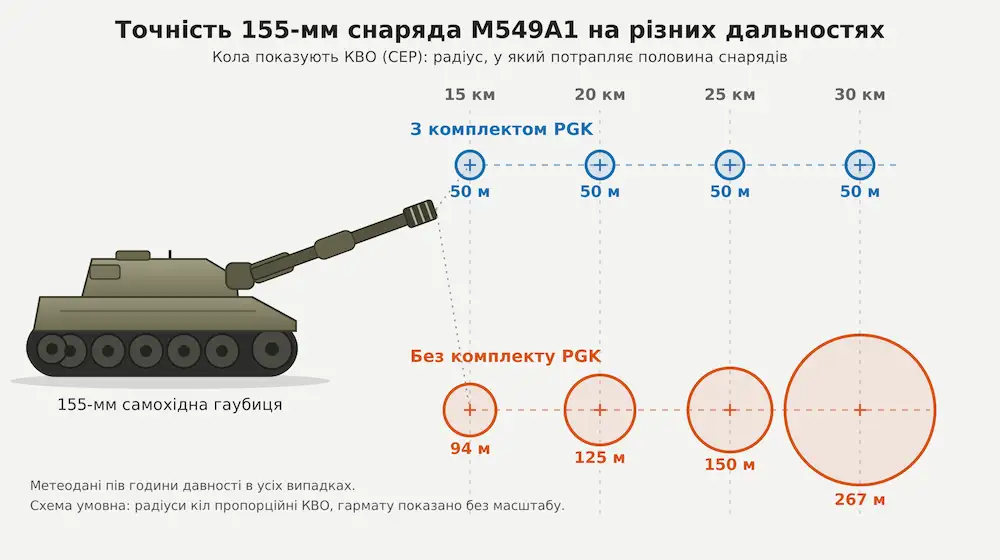
In a 2007 program briefing the dispersion figures were compared: an unguided 155 mm projectile had a CEP (circular error probable) of about 183 m, while the PGK requirement was no worse than 50 m. In a 2010 briefing, for the M549A1 projectile without PGK the CEP is given as 94 to 267 m depending on range (15–30 km), and with PGK as 50 m at all ranges. The program's target accuracy is 30 m or better, and Northrop Grumman now states less than 30 m.
How the PGK kit works
A crew's work with the PGK kit consists of four steps:
- The crew receives a fire mission and installs the kit on the projectile.
- Through the EPIAFS inductive setter, mission data is entered into the kit: gun and target positions, trajectory data, GPS crypto keys, precise time and fuzing parameters. The setter connects to the firing platform through the PIK integration kit and a DAGR receiver.
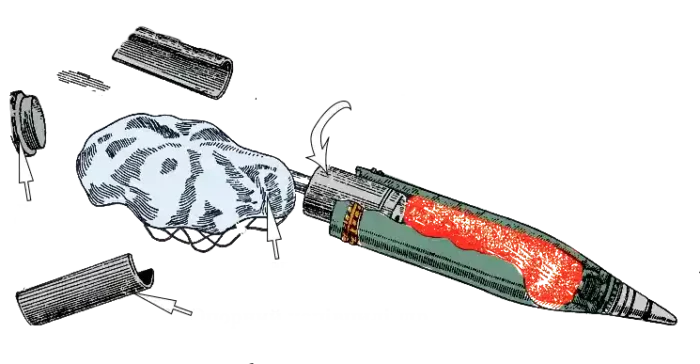
- The protective cover is removed, the projectile is loaded and fired.
- After the initial unguided portion of flight, the kit receives the GPS signal (with a SAASM module), estimates the deviation from the calculated trajectory and steers the flight with four canards.
Photo: bk155.com.ua
The module generates its own power: it has no battery, and the stated shelf life is 20 years. Safety is based on the proven design of the M762 safe-and-arm mechanism, and the electronic architecture is redundant.
As a fuze it performs the usual functions: impact detonation and proximity (radio) detonation at a set height of burst. A mode is also provided in which the projectile does not detonate if it has not come close enough to the target.
Compatible projectiles and guns
In phase 1 the program covered three 155 mm high-explosive fragmentation projectiles:
| Projectile | Weight | Max. range without PGK | Warhead |
|---|---|---|---|
| M107 | 43.1 kg | 17.5 km | 6.8 kg |
| M795 | 46.7 kg | 22.5 km | 10.8 kg |
| M549A1 (rocket-assisted) | 43.5 kg | 30 km | 6.8 kg |
With the PGK kit the range is reduced by no more than 10%. Firing ranges for specific projectiles can be found in the range tables.
Platforms: the M109A6 Paladin self-propelled howitzer and the towed M777A2. The M777A2 requires the EPIAFS setter and the corresponding integration kit. The PGK is 68.6 mm (2.70 in) longer than the MOFA multi-option fuze and is compatible only with projectiles that have a deep fuze well.
Later phases of the program provided for compatibility with 105 mm projectiles, cluster projectiles and new artillery platforms, including the M119A3 howitzer.
How the PGK kit was tested
According to program data, in qualification testing to MIL-STD-331C the kit went through transportation and vibration, storage in extreme heat and cold, thermal shock and a 2.1 m drop. After that, all kits were fired from M549A1 and M795 projectiles in hot and cold conditions.
Results: safety — 100% (15 of 15), reliability — 100% (14 of 14; one round was not counted because the M549A1 rocket motor did not function). The accuracy requirement of less than 50 m CEP was met.
Where the PGK kit is used
According to open sources, kits were ordered or approved for sale to Australia (a request for 4,002 kits, 2013), the Netherlands (3,500, 2018) and Finland (about 5,500 M1156A1 kits, 2024). Sales of kits to Denmark and an order by Norway were reported in 2024. In September 2026 Northrop Grumman received a contract from the US Army worth almost $863 million for production of the M1156 and its variants.
Ukrainian media wrote in July 2022 that the next US aid package of $400 million might include M1156 kits. M777A2 howitzers require the EPIAFS setter and an integration kit, and the first M777s delivered to Ukraine had neither GPS nor such a kit. There is no confirmed data in open sources on the number of kits or their combat use.
Summary
The PGK kit turns existing 155 mm high-explosive fragmentation projectiles into corrected ones: it is enough to replace the fuze, and no new munition is needed. By program requirements the accuracy is no worse than 50 m CEP, with a target of 30 m or better. M777A2 howitzers additionally need the EPIAFS setter and an integration kit.
Sources
- XM1156 PGK presentation at the NDIA Fuze Conference, 2010
- XM1156 PGK presentation at the NDIA Fuze Conference, 2008
- XM1156 PGK program overview, PM CAS, 2007
- The Defense Post: Northrop Grumman contract for M1156 kits
- M1156 precision guidance kit — Wikipedia
- Militarnyi: a new type of 155 mm projectiles for Ukraine
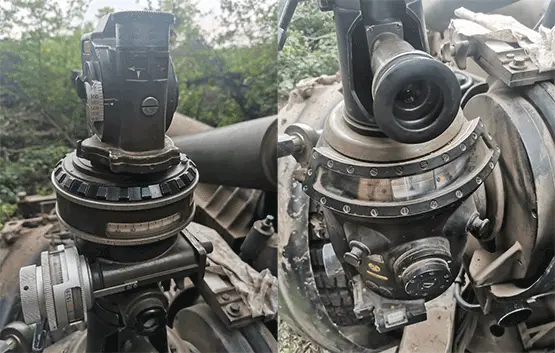
Orienting a 64-00 mils panoramic sight with the PAB-2M aiming circle
1. The preliminary setup and orientation of the PAB-2M aiming circle is no different from the usual one. We end up with the aiming circle pointed in the main direction of fire (MDF) and the angle-measuring (red) scales zeroed.
How to enter the correction when firing illuminating projectiles
During night combat operations, artillery units, in addition to fire missions to engage targets, perform the following tasks:
Firing at high sight settings: why it is more effective
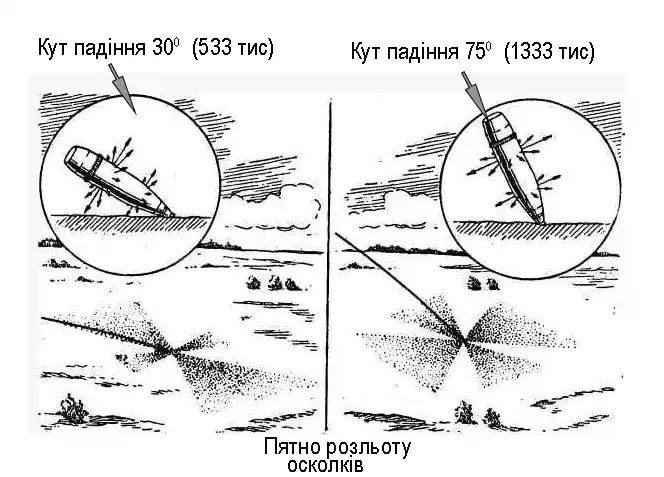
Why firing at high sight settings is more effective: how the angle of fall of a 155 mm projectile changes fragment dispersion, when ricochet works and why an airburst is better.
Oleh Syrota (Georgich©) for the Armed Forces of Ukraine /
Share your experience of working with 155 mm ammunition.
Send comments and suggestions by email: entropiaw@gmail.com
f FacebookKHMS 88
 e