
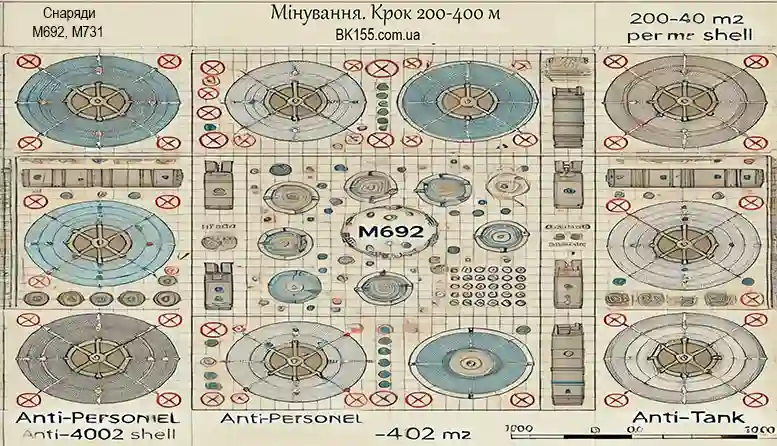
RAAM and ADAM artillery mine-laying systems. M718, M741, M692 and M731 projectiles
RAAM and ADAM mininge
Modern combat operations demand fast and effective ways of creating obstacles in the enemy's path. The RAAM (Remote Anti-Armor Mine) and ADAM (Area Denial Artillery Munition) artillery mining systems are state-of-the-art technologies that make it possible to quickly emplace minefields at long range using conventional artillery. Their main advantage is the ability of remote mining, which does not require engineers to be physically present in the conflict zone, significantly reducing the risks for personnel.
RAAM and ADAM were created for a wide range of tasks: from slowing the advance of enemy forces and blocking key routes to protecting strategic positions. Their integration with artillery systems provides flexibility in use, allowing the command to adapt tactical decisions to the situation on the battlefield. These systems are an integral part of modern military strategy aimed at maintaining the mobility of friendly forces and disrupting the enemy.
This article examines the principles of operation, tactical advantages, technical characteristics and practical aspects of using the RAAM and ADAM systems. Special attention is paid to their contribution to increasing the effectiveness of artillery support and to their role in modern military operations.
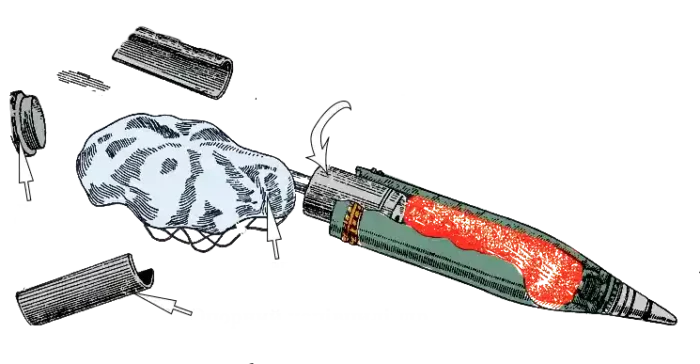
ADAM and RAAM are delivered by a 155 mm howitzer. The firing system needs no special modifications or adaptations. The mines are placed inside the projectile and are ejected while the projectile is in the air. The effective firing range for the M109 howitzer is 17,500 meters, and for the M198 — 17,740 meters.
Employment of ADAM and RAAM
The M692 (long-duration) and M731 (short-duration) are ADAM projectiles that deliver anti-personnel mines with different self-destruct (SD) times. Each ADAM projectile contains 36 mines. The M731/M731A1 projectile contains M72 AP mines with a self-destruct time of 4 hours; the M692/M692A1 projectile contains M67 AP mines with a self-destruct time of 48 hours. The self-destruct time is set during manufacture and cannot be changed.
The wedge-shaped ADAM mine is a fragmentation mine that deploys up to seven tension-activated trip wires at a distance of 6 meters from the mine. After impact with the ground the wires are tensioned and the mine becomes fully armed. The ADAM mine has a metal casing filled with 21 grams of Composition A5 as the main charge. A liquid-explosive charge is located at the bottom of the sphere after impact with the ground. If the mine is tilted or moved, or if one of its wires is activated, it functions.
A pressure of at least 0.4 atmosphere makes the canister rise to a height of 0.6 to 2.4 meters and detonate. The lethal radius is 6 to 10 meters.
The M741 (short-duration) and M718 (long-duration) RAAM projectiles are anti-tank mines delivered by artillery. Each RAAM projectile contains nine mines. The M741/M741A1 projectiles contain M70 AT mines with a self-destruct time of 4 hours; the M718/M718A1 projectiles contain M73 AT mines with a self-destruct time of 48 hours. The self-destruct time is set during manufacture and cannot be changed. The RAAM mine uses an SFF warhead, has a magnetic fuze, weighs 1.7 kg and has a small cylindrical body (12 cm in diameter and 6 cm high).
The new models of ADAM and RAAM mines (marked with the suffix A1) have an arming time of 45 seconds; the old models have an arming time of 2 minutes. The new RAAM model has a built-in feature that prevents the mines from being deactivated when engineer mine-clearing devices are used.
Use
The ADAM and RAAM systems were developed to provide flexible and rapid emplacement of mines. These systems allow the maneuver commander to place mines directly in front of the enemy, behind them or on enemy positions. This is one of their biggest advantages. Their speed allows missions to be carried out quickly and gives the commander the ability to influence a rapidly changing battlefield effectively. They also allow minefields to be placed while maintaining the maximum distance from the target. Emplacing them does not require deploying any forces (ground or air) forward.
The ADAM and RAAM systems can be used for the following purposes:
- Defense:
- Developing targets for long-range anti-tank weapons.
- Closing gaps and lanes in obstacles.
- Delaying or disrupting the actions of attacking forces.
- Preventing the enemy from using selected areas without restriction.
- Disrupting the movement and use of second-echelon reserves.
- Disrupting enemy logistics, including medical, and assembly areas.
- Reinforcing existing obstacles.
- Complicating or delaying river crossings.
- Offense:
- Strengthening flank reconnaissance and security forces to protect the flanks.
- Suppressing and disrupting enemy security elements after contact.
- Complicating the withdrawal of enemy forces.
Employment
ADAM and RAAM mining missions are requested through the normal artillery support channels. For example, the brigade artillery chief, who calculates in advance the use of remote-mining projectiles and forms the command for their employment. The actual quantity may vary depending on the unit and the task; a basic representative set for an infantry battalion consists of approximately 32 ADAM and 24 RAAM mines (short self-destruct time) per artillery volley.
WARNING: Projectiles with a long self-destruct time are normally used for planned targets based on a specific mission.
There are two critical aspects of using ADAM and RAAM minefields:
- Designing the minefield to achieve the required effect.
- Providing the technical resources to form the minefield.
Below are general recommendations for designing a minefield to achieve the desired effect and for determining the size needed to assess the impact on maneuver.
ADAM and RAAM minefields can be emplaced to achieve disruption, fixing, turning and blocking of enemy personnel and equipment. The brigade (battalion) engineer is responsible for deciding the required location, density, size, placement and duration of the minefield on the basis of the tactical obstacle plan assigned by the chief of staff.
Density and size of RAAM and ADAM minefields
Table: Characteristics of RAAM and ADAM minefields
| Obstacle effect | RAAM Area1 | RAAM Linear2 | ADAM Area1 | ADAM Linear2 | Width (meters) | Depth (meters) |
|---|---|---|---|---|---|---|
| Disrupt | 0.001 | 0.2 | 0.0005 | 0.1 | 200 | 200 |
| Fix | 0.002 | 0.8 | 0.001 | 0.4 | 400 | 400 |
| Turn | 0.002 | 0.4 | 0.0005 | 0.1 | 200 | 200 |
| Block | 0.004 | 0.6 | 0.002 | 0.8 | 400 | 400 |
1Area — number of mines per square meter.
2Linear — number of mines per meter.
 1 Area density = mines per square meter.

2 Linear density = mines per meter.
Minefield calculation details
The fire support element (FSE) determines all the technical aspects of delivering the minefield, such as the number of projectiles needed for each mining point, the number of target points, the size of the safety zone and the time required to emplace the mines. A wide range of factors affects the determination of the number of projectiles, the size of the safety zone and the emplacement time. These factors include:
- Distance to the target.
- The angle from the battery to the minefield.
- Method of fire (adjustment or meteorological data with VE taken into account).
The FSE must assess whether the mining mission is feasible. This depends on the availability of projectiles, the indirect fire pattern and the availability of artillery tubes.
The engineer focuses on two aspects:
- The safety zone.
- The minefield emplacement time.
The engineer also takes into account mobility on the battlefield and the effect of the minefield on maneuver. The safety zone is shown on the tactical map to identify the minefield marking requirements if a unit leaves the area before the SD time expires.
Density
Density is usually expressed as linear or areal. For conventional mines, linear density is normally used, expressed as the average number of mines per meter of minefield front. SCATMINE systems (the name of the main remote-mining system) use areal density, expressed as the average number of mines per square meter.
Because SCATMINE systems normally use a pre-set combination of anti-tank (AT) and anti-personnel (AP) mines, the areal density accounts for both types. For example, a scattered minefield with an areal density of 0.006 mines/m² may have an AT mine density of 0.004 mines/m² and an AP mine density of 0.002 mines/m². Because of the variety of minefield configurations that different types of devices can create, the exact density of a scattered minefield cannot be determined. However, an estimate of the average density can be calculated using the following formulas:
- Linear density equals the number of mines divided by the minefield front:
- Areal density equals the number of mines divided by the minefield area:
- Converting areal density to linear density is done by multiplying the areal density by the minefield depth:
Note: Converting areal density to linear density is not always accurate because of the space between the strips of the minefield.
Table: Characteristics of anti-personnel SCATMINE mines (AP SCATMINE)
| Mine | Delivery system | DODIC | Arming time | Fuze | Warhead | AHD | SD time | Explosive weight | Mine weight | Number of mines |
|---|---|---|---|---|---|---|---|---|---|---|
| M67 | 155 mm artillery (ADAM) | D502 | Up to 1 min after ground contact | Tripwire | Fragmentation | 20% | 4 h | 21 g Comp A5 | 540 g | 36 per M731 projectile |
| M72 | 155 mm artillery (ADAM) | D501 | Up to 1 min after ground contact | Tripwire | Fragmentation | 20% | 48 h | 21 g Comp A5 | 540 g | 36 per M692 projectile |
AHD (Anti-Handling Device): Anti-handling protection (in percent).
SD Time: Self-destruct time.
DODIC: US DoD identifier for each type of ammunition.
Based on materials from the official website of the US Marine Corps: marines.mil
Remote mining with RAAM and ADAM projectiles.
Extended, detailed article
To see all the columns, scroll the table sideways →
| Range (m) | FUZE M564 | Angle of fall | HB | TB | RB | Time of flight (sec) | Angle of site (mil) | Velocity (m/s) | MO | Angle compensation | ||
|---|---|---|---|---|---|---|---|---|---|---|---|---|
| +1 mil | -1 mil | |||||||||||
| 0 | 0.0 | 4 | 0 | 0 | 0 | 0 | 316 | 0 | 0 | 0.000 | 0.000 | |
| 500 | 25.4 | 4 | 0 | 26 | 39.4 | 308 | 3 | 0.001 | 0.000 | |||
| 1000 | 51.7 | 5 | 1 | 10.06 | 18 | 53 | 19.1 | 301 | 13 | 0.002 | -0.002 | |
| 1500 | 78.9 | 7 | 1 | 2 | 0.07 | 19 | 83 | 12.3 | 296 | 30 | 0.005 | -0.005 |
| 2000 | 107.0 | 9 | 2 | 0.07 | 21 | 113 | 9.0 | 290 | 54 | 0.010 | -0.010 | |
| 2500 | 136.2 | 9 | 2 | 3 | 0.08 | 22 | 146 | 6.9 | 285 | 87 | 0.017 | -0.016 |
| 3000 | 166.6 | 11 | 2 | 4 | 0.08 | 23 | 180 | 5.6 | 280 | 129 | 0.026 | -0.024 |
| 3500 | 198.4 | 12 | 2 | 5 | 0.09 | 25 | 217 | 4.6 | 276 | 181 | 0.038 | -0.035 |
| 4000 | 231.7 | 14 | 3 | 7 | 0.09 | 26 | 256 | 3.9 | 272 | 244 | 0.054 | -0.049 |
| 4500 | 267.0 | 16 | 3 | 8 | 0.10 | 27 | 297 | 3.3 | 268 | 319 | 0.075 | -0.068 |
| 5000 | 304.5 | 18 | 4 | 10 | 0.11 | 29 | 341 | 2.9 | 265 | 410 | 0.103 | -0.093 |
Standards for the density of area mining with cargo artillery projectiles
Also on this site
Cargo projectiles — all pages of the section
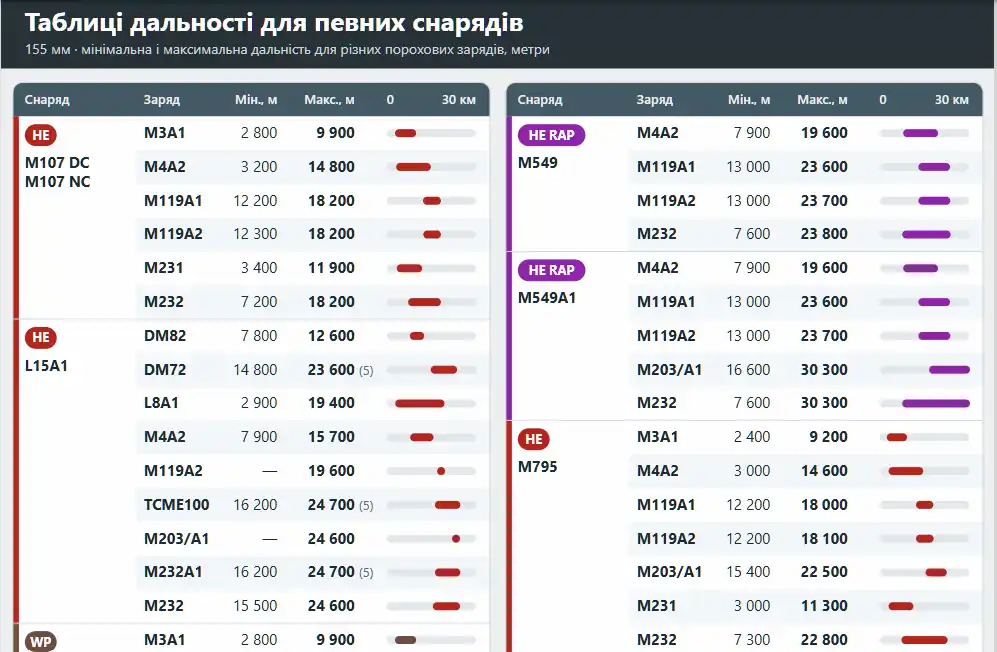
Range tables for specific projectiles
Cognitive information — all articles of the section
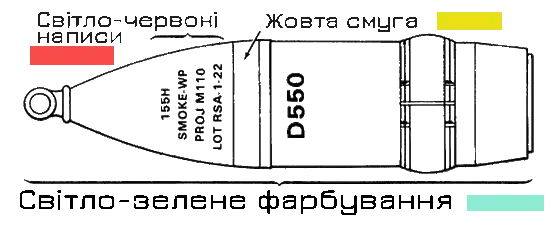
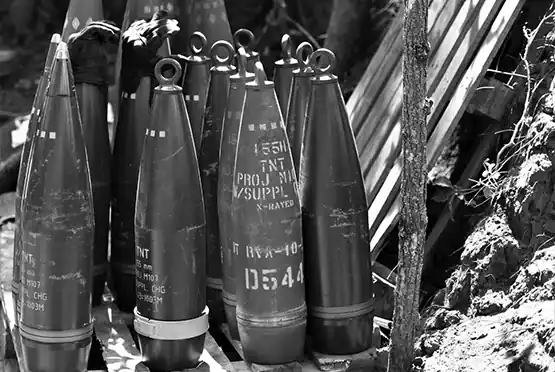
Painting of 155 mm artillery projectiles
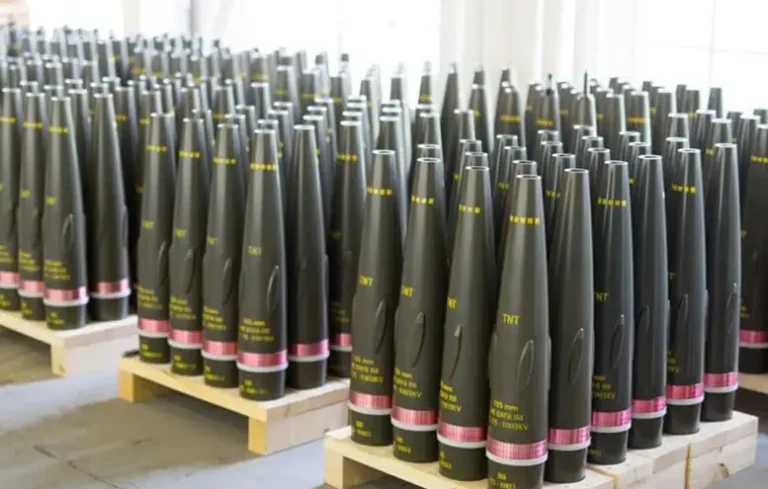
Ammunition components are painted primarily to prevent rust. Colors are used for camouflage, for recognizing the main use of the item and for identifying hazardous fillers used in the munitions. These are the colors used to indicate the main use of ammunition.
Markings and inscriptions on projectiles
A–3 – an American explosive consisting of a mixture of 91% RDX and 9% plasticizing oil, also known as microcrystalline wax;
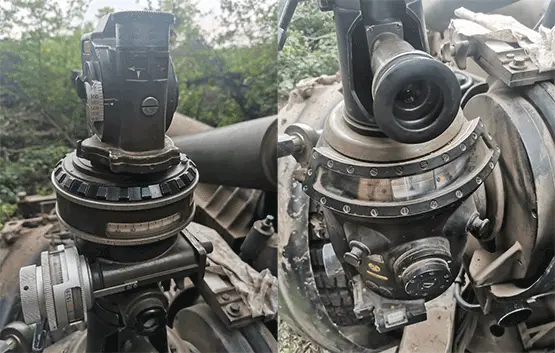
Orienting a 64-00 mils panoramic sight with the ПАБ-2М aiming circle
1. The preliminary setup and orientation of the PAB-2M aiming circle is no different from the usual one. We end up with the aiming circle pointed in the main direction of fire (MDF) and the angle-measuring (red) scales zeroed.
Oleh Syrota (Georgich©) for the Armed Forces of Ukraine /
Share your experience of working with 155 mm ammunition.
Send comments and suggestions by email: entropiaw@gmail.com
