
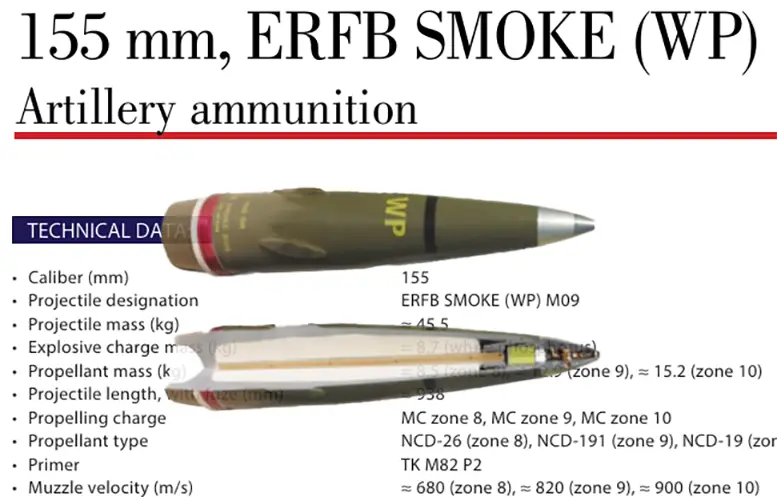
155 mm ERFB Smoke WP extended-range projectile
155 mm ERFB Smoke WP projectilee
Development
The 155 mm ERFB Smoke WP projectile is a bursting projectile developed together with the 155 mm HE ERFB projectiles, as they have practically the same body. The 155 mm ERFB and ERFB-BB versions are produced in Europe by Eurometaal, while those previously made in South Africa are now available on request. Chartered Ammunition Industries of Singapore also produces the 155 mm ERFB Smoke WP, as do the Austrian company NORICUM and the Malaysian company Enigma Technical Solutions.
Description
The 155 mm ERFB Smoke WP projectile has the same general shape and dimensions as other 155 mm ERFB projectiles and uses a one-piece high-quality steel body. The streamlined ogive almost reaches the copper or gilding-metal rotating band and the plastic obturator ring near the base. The drag-reduction unit is a steel part with an external cavity on the ERFB version, whereas on the ERFB-BB the base is occupied by a steel base-bleed unit.
The fuze cavity in the nose is normally closed with a transport plug during storage, transport and handling. On the 155 mm Smoke WP versions of the ERFB projectiles, the fuze cavity takes the form of a steel adapter screwed into the nose of the body, in which a steel or light-alloy fuze tube is fitted that runs the full length of the body.
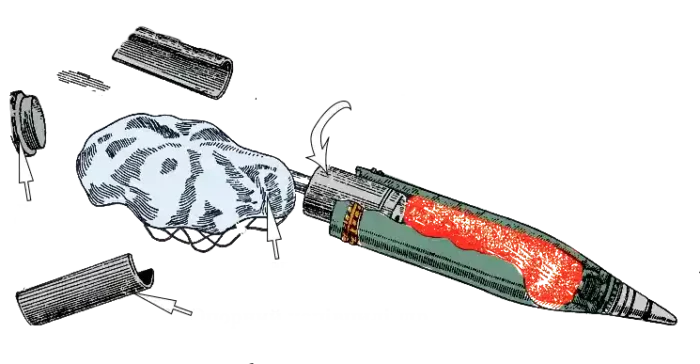
The tube contains an explosive, usually 234 g of Composition B5, which when detonated by a PD fuze (usually the PD M572) ruptures the steel body of the projectile, dispersing its filling, usually 7.6 kg of WP. On contact with air the WP ignites, forming a dense white cloud of smoke that lasts about 60 seconds.
South African 155 mm ERFB projectiles can be modified in the field by removing the tail section from the ERFB projectiles and fitting a base-bleed unit to produce ERFB-BB projectiles. The procedure is carried out on a projectile clamping table. The same table can also be used to remove damaged obturators and fit new ones. The table can be folded flat and weighs 25 kg.
To make full use of their range, the 155 mm ERFB and ERFB-BB Smoke WP projectiles are normally fired using high-energy charges such as the NATO M3A1 (zones 3, 4 and 5), M4A2 (zones 3, 4, 5, 6 and 7), M119A1 (zone 8), M203 (zone 9) or M11 (zone 10), the latter being limited to barrels of 45 calibers and longer.
Used by the following guns:
Towed 155 mm howitzers: NORICUM GH N-45; CITEFA CALA 30/2; SRC International GC 45; NORINCO Type WA 021 and Type GM-45; Patria Vammas 155 GH 52 Howitzer; Giat Industries TR and 155/52 guns and the M114F howitzer; FH-70; Soltam Model 839P, 845P, upgraded M-46 and M114S; Otobreda 155/39; KH179; RDM M139 and M114/39; STK FH-88 and FH-2000; LIW G5; SITECSA 155/45 ST 012, M114 155/45 and M114 155/39; SANTA BARBARA SB 155/39 and 155/52 APU SBT-1 howitzers; Bofors FH-77B; Extended Range Gun (Taiwan); XM777 Lightweight Towed Howitzer; M46/84 (Federal Republic of Yugoslavia).
Self-propelled 155 mm howitzers: TAMSE VCA 155; NORINCO PLZ45 self-propelled gun-howitzer; Giat Industries CAESAR 155/52; PzH 2000; Rheinmetall M109A3G and M44T; Majnoon (Iraq); Soltam Rascal and Slammer; Otobreda Palmaria and M109L; K9 Thunder (South Korea); ZTS ZUZANA (Slovakia); LIW G6; XT-69 (Taiwan); AS90 and Braveheart; M109A4, M109A5 and M109A6 Paladin; XM2001/XM2002 Crusader AFAS.
The propellant charge system for the LIW 155 mm G5 and G6 gun-howitzers originally included a system of three fabric bag charges. This system was replaced by a modular system using combustible cases, developed by SOMCHEM, with a built-in charge retention device. The system can be used with ERFB and (above base Charge 2) ERFB-BB projectiles, as well as all 155 mm NATO projectiles.
The smallest charge in the Denel modular charge system is the 155 mm modular charge 1 M51. The combustible container for this charge is red and contains single-base granular propellant. The igniter consists of 20 g of G12 powder and 40 g of CBI. The charge weighs about 2.3 kg, is 211 mm long and 164 mm in diameter.
The next charge is the 155 mm modular charge 2 M52. The combustible case is blue and contains triple-base propellant cords. The diameter at the front of the case is reduced so that the charge is securely retained in the rear of the Charge 2 add-on element (see below). The igniter consists of 20 g of G12 powder and 40 g of CBI. The charge weighs about 5.6 kg, is 373 mm long and 164 mm in diameter.
The modular system continues with the 155 mm M52 modular charge increment. One or two such increments can be added to the standard Charge 2. Charge 2 with one increment can be used with boat-tail ERFB projectiles and all 155 mm NATO projectiles. Charge 2 with two increments can be used with ERFB, ERFB-BB and all 155 mm NATO projectiles. Each increment is contained in a green combustible case with triple-base propellant cords. The igniter consists of 60 g of G12 powder. The charge weighs about 4 kg, is 289 mm long and 164 mm in diameter.
The top charge of the modular system is the modular charge 3 M53. The charge is placed in a purple (jacaranda-colored) combustible case with triple-base tubular propellant. The igniter consists of G12 powder. The charge weighs about 17.1 kg, is 930 mm long and 164 mm in diameter.
All the charges are ignited by an M82 Tube Percussion primer, which contains 1.4–1.5 g of powder. The primer is 49.37 mm long and 15.24 mm in diameter across the rim.
With this system the following ballistic performance can be achieved when firing from a 45-caliber barrel:
- Charge 1 — muzzle velocity (MV) 350 ±5 m/s, maximum range 9,100 m.
- Charge 2 — MV 483 ±5 m/s, maximum range 13,400 m.
- Charge 2 + 1 increment — MV 645 ±5 m/s, maximum range 19,000 m.
- Charge 2 + 2 increments — MV 795 ±5 m/s, maximum range 25,400 m.
- Charge 2 + 2 increments + BB — MV 789 ±5 m/s, maximum range 31,000 m.
- Charge 3, standard projectile — MV 897 ±5 m/s, maximum range 30,200 m.
- Charge 3 + BB — MV 895 ±5 m/s, maximum range 39,000 m.
This modular charge system was replaced by a system of six modular combustible M62A1 charges, which have an identical composition and comply with the NATO Joint Ballistic Memorandum of Understanding. The charges are produced by SOMCHEM and can be used with weapons of up to 52 calibers. The use of other similar modular charge systems is also possible.
Single combustible cartridge cases (CCC) have also been developed for use with 155 mm ERFB projectiles. An example is the C30 charge produced by Chartered Ammunition Industries of Singapore. The C30 contains 14 kg of triple-base propellant, is 770 mm long and 160 mm in diameter. It provides a range of 30,000 m when used with a 39-caliber barrel and 40,000 m with a 45-caliber barrel.
Another charge developed for 39- and 45-caliber barrels used to fire 155 mm ERFB projectiles is the No. 16 propelling charge produced by Eurometaal NV (Netherlands). It is a separate charge in the form of a single bag with CH21 single-base nitrocellulose propellant, with a 50 g igniter that leaves no residue, in a red fabric bag sewn to the base.
The charge has a central igniter tube and a flash reducer with 250 g of potassium sulfate. The inner surface of the bag contains a liner to reduce wear and remove copper fouling. The complete charge weighs 13.12 kg, of which 12.12 kg is CH21 propellant. The length of the charge is 764 mm.
The typical range of the 155 mm ERFB Smoke WP when fired from a 45-caliber barrel is 30,000 m. When firing the 155 mm ERFB-BB Smoke WP projectile from a 45-caliber barrel, a range of up to 39,000 m is possible.
Technical specifications
Weight:
- ERFB projectile with fuze — 47.7 kg
- ERFB-BB projectile with fuze — 50 kg
- M1 WP ERFB, nominal weight — 47.7 kg
- ERFB SMOKE (WP) M09 (Malaysia) - 45.5 kg
- Filling — 7.6 kg WP
Length with fuze:
- ERFB — 938 mm
- ERFB-BB — 958 mm
Diameter:
- Across the lands — 154.69 mm
- Across the rotating band — 157.86 mm
Chamber pressure (typical): 3,500 bar
Muzzle velocity:
- ERFB — 897 m/s
- ERFB-BB — 895 m/s
Maximum range:
- ERFB — 30,000 m
- ERFB-BB — 38,000 m
Operating temperature range: from -20 to +60°C
Authorized fuzes:
- Impact (PD): M557, M78 series, M572, M739, Fuchs PD M841
- Mechanical time (MTSQ): M564, M582A1
- Proximity (Prox): M514 series, Fuchs M8513
- Electronic: NINA, ZELAR, Fuchs M8611 and others
Similar projectiles:
China PRC
Manufacturer: China North Industries Corporation (NORINCO)
Type: 155 mm ERFB Smoke WP
Description: Equipped with the PD M739 fuze. Produces smoke for 55–65 seconds. Projectile weight — 46.5 kg, muzzle velocity — 795.5 m/s. Maximum range — 26,000 m (ERFB).
Netherlands
Manufacturer: Eurometaal NV
Type: 155 mm ERFB and ERFB-BB Smoke WP
Description: Meets the specified characteristics. Available for production. Propellant charge No. 16 is also manufactured.
Singapore
Manufacturer: Chartered Ammunition Industries
Type: 155 mm ERFB-HB-WP, ERFB-BB-WP
Description: Standard characteristics. The unitary C30 charge bag is also produced. The range of the ERFB-HB-WP from 39-caliber barrels is 24,400 m, and of the ERFB-BB-WP — 30,500 m.
South Africa
Manufacturer: Denel (Pty) Limited (SWARTKLIP)
Type: 155 mm ERFB or ERFB-BB M1 WP
Description: Meets the specified characteristics. Designed for LIW 155 mm G5 and G6 artillery systems. Production as required.
Switzerland
Manufacturer: NORICUM
Type: SEN-155 mm WP-Smoke
Description: Offered by T & T Technology Trading Limited. Weight with the tail piece — 48 kg, with BB — 50 kg. Fitted with a PD M739 or ET DM 52 fuze.
Source: Janes
Also on this site
- Smoke and chemical projectiles — all pages of the section
- Projectile ERFB Smoke (WP)
- Projectiles M110 (WP Smoke, H/HD)
- M825 projectile
- 155 mm smoke projectiles: how they work and how they lay a screen
- High-explosive fragmentation projectiles with improved range
- Cognitive information — all articles of the section
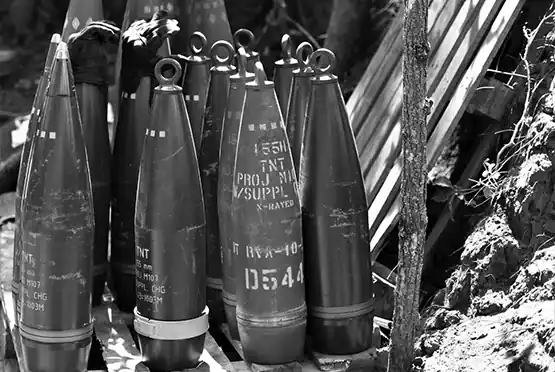
Markings and inscriptions on projectiles
A–3 – an American explosive consisting of a mixture of 91% RDX and 9% plasticizing oil, also known as microcrystalline wax;
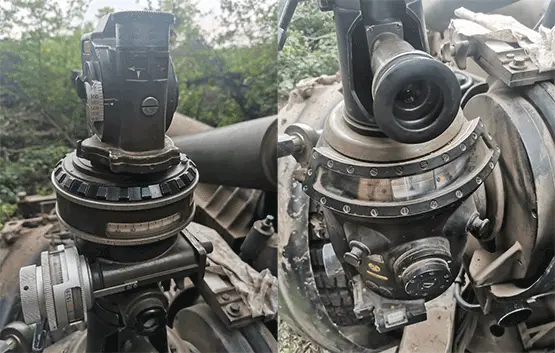
Orienting a 64-00 mils panoramic sight with the ПАБ-2М aiming circle
1. The preliminary setup and orientation of the PAB-2M aiming circle is no different from the usual one. We end up with the aiming circle pointed in the main direction of fire (MDF) and the angle-measuring (red) scales zeroed.
How to enter the correction when firing illuminating projectiles
During night combat operations, artillery units, in addition to fire missions to engage targets, perform the following tasks:
Oleh Syrota for the Armed Forces of Ukraine /
Share your experience of working with 155 mm ammunition. Send comments and suggestions by email: entropiaw@gmail.com
