
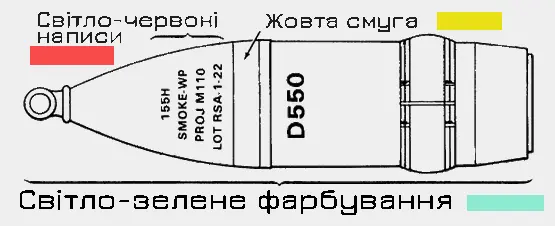
Painting of 155 mm artillery projectiles
Color by main use 

Ammunition components are painted primarily to prevent rust. Colors are used for camouflage, for recognizing the main use of the item and for identifying hazardous fillers used in the munitions. These are the colors used to indicate the main use of ammunition.
Inscriptions on projectiles:
• Yellow - High-explosive fragmentation
• Brown - Reduced explosiveness
• Gray - Chemical
• Light green - Smoke
• Light red - Incendiary
• White - Illuminating and pyrotechnic
• Black - Armor-piercing
• Aluminum (silver) - Countermeasure.
• Blue - Practice
The most commonly used color for painting projectiles is dark olive. It is used only for camouflage and means nothing. But inscriptions on the projectile, for example in yellow, indicate that it is a high-explosive fragmentation projectile.
Colored bands on projectiles
Bands are usually used to identify the types of components in the munitions. However, in some cases the color of the band indicates the main use.
Band colors and their meaning:
• Yellow. High-explosive fragmentation effect (HE). Chemical elements are used to burst the body and, for example, to disperse a smoke mixture, toxic chemicals or scatter anti-personnel mines.
• Brown. Contains a low-explosive charge. Low-explosive charges are usually used for registration or for removing the payload from the projectile.
• Dark green. Contains a toxic chemical agent.
• Dark red. Contains a riot-control chemical agent.
• Violet. Contains an incapacitating chemical agent.
• White. Indicates an illuminating munition.
• Black. On a high-explosive fragmentation projectile this means armor-defeating capability.
Combining color codes
Some types of munitions can carry several color codes on one projectile
to identify the main use, the type of components and hazardous materials. (See the figure) Example:
1. Base color. Light green means the main use is smoke.
2. A yellow band means the item contains a high-explosive charge.
3. Markings. Light-red marks mean the item also has an incendiary effect.
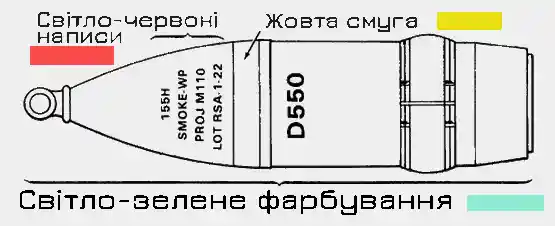
Now, if you combine your knowledge of the color codes with what you have learned about markings, you can fully identify this item. It is a 155 mm howitzer smoke projectile filled with white phosphorus (WP), and it is a high-explosive fragmentation bursting projectile.
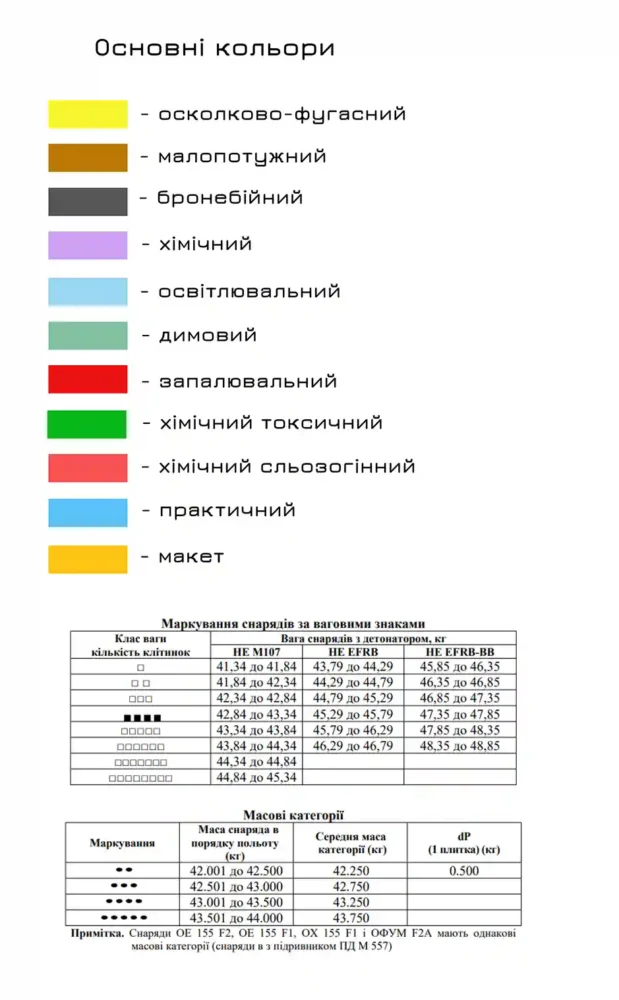
Marking of projectiles by weight marks and colors
Related articles:
- Markings and inscriptions on projectiles
- Smoke and chemical projectiles — all pages of the section
- Illuminating projectiles — all pages of the section
- Cargo projectiles — all pages of the section
- High-explosive fragmentation projectiles — all pages of the section
- All EU-made 155 mm projectiles
- 155 mm smoke projectiles: how they work and how they lay a screen
- Cognitive information — all articles of the section
Informative content
Markings and inscriptions on projectiles
A–3 – an American explosive consisting of a mixture of 91% RDX and 9% plasticizing oil, also known as microcrystalline wax;
Orienting a 64-00 mils panoramic sight with the PAB-2M aiming circle
1. The preliminary setup and orientation of the PAB-2M aiming circle is no different from the usual one. We end up with the aiming circle pointed in the main direction of fire (MDF) and the angle-measuring (red) scales zeroed.
How to enter the correction when firing illuminating projectiles
During night combat operations, artillery units, in addition to fire missions to engage targets, perform the following tasks:
Why is it so important to fire at higher angles?
This material briefly explains how the projectile’s landing angle affects the effectiveness of engaging the enemy through fragment dispersion.
Conversion of propellant charges
able for converting bagged propellant charges into the MACS modular system
Modular charge system
Demonstration video of the design and operation of the DM72 (DM52) modular charge system
LOT – batch identification number. How to read it

Codes of all manufacturers of military products at this link: MIL-HDBK-1461
DODIC - US Department of Defense identification code

Calculating the length of a leg of a right triangle
Oleh Syrota (Georgich©) for the Armed Forces of Ukraine /
Share your experience of working with 155 mm ammunition.
Send comments and suggestions by email: entropiaw@gmail.com
f FacebookKHMS 88
