
How to enter the correction when firing illuminating projectiles
During night combat operations, artillery units, in addition to fire missions to engage targets, perform the following tasks:
- illuminating terrain and targets;
- placing light markers;
- blinding enemy observation posts, command posts and fire assets.
Contents:
- How an illuminating projectile works;
- Optimal flare burn height;
- How to apply a correction
How an illuminating projectile works.


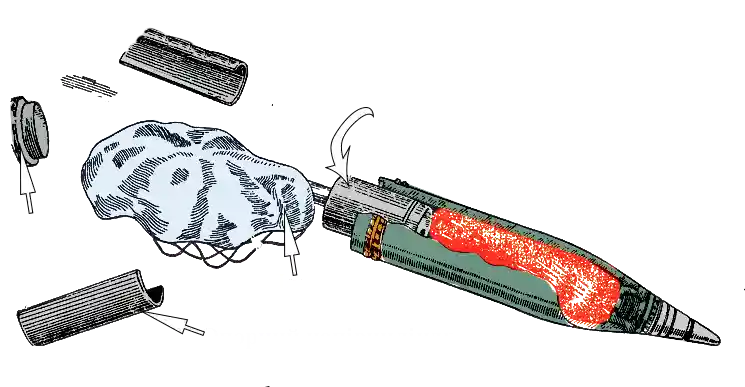
At the range corresponding to the time-fuze setting, the stream of fire from the fuze ignites the expelling charge. The powder gases of the expelling charge press on the diaphragm, the diaphragm presses on the cup cover, and the cup presses on the cylinders, under which the thread of the projectile base shears off. At the same time, the stream of fire from the expelling charge ignites the igniter composition of the illuminating element through the hole in the diaphragm.
After the parachute and the illuminating element are ejected from the projectile body, the half-cylinders fly apart, the parachute opens and the illuminating element attached to the parachute slowly descends (on the parachute), lighting the terrain.
Optimal flare burn height
The tabulated burst height of the projectile for all ranges and all charges is 400 m when firing 122 mm and 152 mm howitzers, and 600 m when firing 155 mm howitzers. One illuminating element gives a luminous intensity from 400,000 candela (122 mm, 155 mm) up to 800,000 candela (LU 216 ILLUM IR projectile) and illuminates an area in the form of a circle with a diameter of 1,000 m to 2,400 m (LU 216 ILLUM projectile). The illumination duration is from 50–55 seconds to 80 seconds with modern NATO projectiles. The flare's rate of descent is approximately 7 m/s.
How to apply a correction
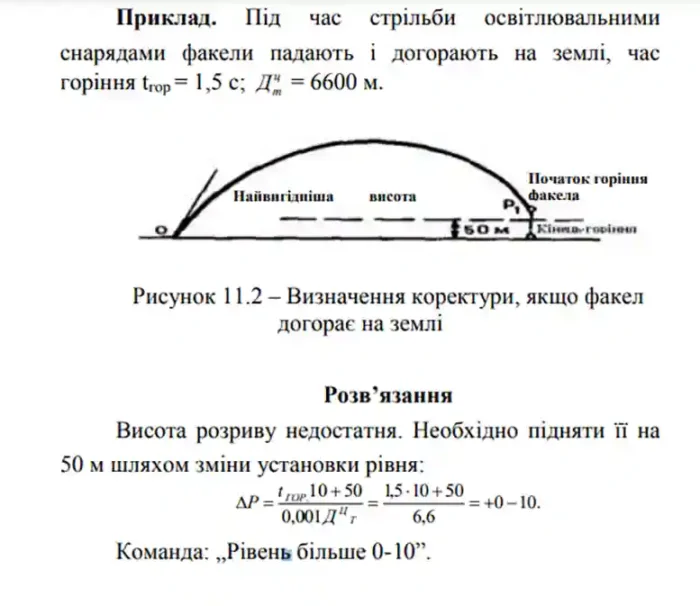
We assume that the optimal height at which the flare burns out is 50 m above the surface. The correction to change the flare burn-out height is applied:
- when firing illuminating projectiles — by the level;
- when firing illuminating mortar rounds — by the fuze setting
If the flare burns down on the ground:
- determine with a stopwatch the burn-down time of the flare (Tb), multiply it by 10 when firing illuminating projectiles;
- add 50 m to the result and obtain the height correction in meters:
hfl = tburn×10 + 50 m
- convert the resulting correction into level divisions. The level setting is increased.
ΔP = hfl / 0.001Dt
Where:
tburn — flare burn time;
hfl — height correction in meters;
ΔP — level correction in mils
Dt — topographic range to the target
Example of calculating the level correction:
- Topographic range to the target Dt - 6,600 m
- Flare burn time on the ground tburn — 1.5 sec
hfl = 1.5 × 10 + 50 = 65 m (the flare must be raised by this many meters)
ΔP = 65 / 0.001 × 6,600 = 0-10 mils (the level setting must be increased by this amount)
If the flare went out at a height of more than 50 m.
For this calculation you need to know the angle of site at which the flare went out. But considering that in modern warfare against the Russian invaders correction is done from a drone, whose operator cannot report at what angle to the horizon the flare went out, he must intuitively estimate the approximate fall time of the already extinguished flare, taking into account a descent rate of 7 m/s.
Then subtract 7 seconds from the obtained time (the time it takes the flare to travel the last 50 m) and apply the resulting value in the formula given earlier with the opposite sign (the level setting will have to be decreased).
Also on this site
- M118 projectile (illuminating)
- M485 projectiles
- Why is it so important to fire at higher angles?
- Mortar-style firing: the effect of traverse on accuracy
- Orienting the panoramic sight to mils 64-00 using the PAB-2M aiming circle
- Calibrating the sighting devices of the M109A3 howitzer
- Cognitive information — all articles of the section
Orienting a 64-00 mils panoramic sight with the PAB-2M aiming circle
1. The preliminary setup and orientation of the PAB-2M aiming circle is no different from the usual one. We end up with the aiming circle pointed in the main direction of fire (MDF) and the angle-measuring (red) scales zeroed.
Why is it so important to fire at higher angles?
This material briefly explains how the projectile’s landing angle affects the effectiveness of engaging the enemy through fragment dispersion.
Conversion of propellant charges
able for converting bagged propellant charges into the MACS modular system
Oleh Syrota (Georgich©) for the Armed Forces of Ukraine /
Share your experience of working with 155 mm ammunition.
Send comments and suggestions by email: entropiaw@gmail.com
f FacebookKHMS 88
