
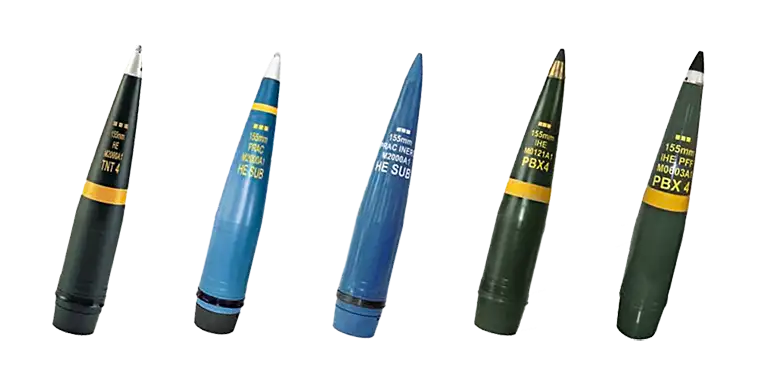
The Assegai projectile family M2000, M0121, M0603, M0256, M2005, M2002
The Assegai projectile family
The Assegai projectile family was developed by Rheinmetall to meet modern artillery needs and complies with the principles of the JBMoU agreement. The main characteristics of this family include:
- A ballistically matched series of projectiles: all models provide a similar trajectory, which simplifies their use in combat.
- Design based on JBMoU principles: this means compliance with international standards of interchangeability and standardization.
- Interchangeable Boat Tail and Base Bleed: on most projectiles (except the VLAP) these elements can be changed to optimize ballistic performance.
- Compatibility with different gun calibers: the projectiles can be used with weapons of 39 to 52 calibers.
Projectiles of the Assegai family:
- M2000 High Explosive (HE): a standard high-explosive fragmentation projectile for engaging targets.
- M2000 Practice: a training projectile for practice and for working out firing technique.
- M2000 Practice Inert: an inert version of the training projectile without explosive.
- M0121 Insensitive Munition High Explosive (IHE): an insensitive explosive for increased safety of use.
- M0603 IHE Preformed Fragmented (PFF): a projectile with pre-formed fragments for increased lethality.
- M0256 IHE PFF Velocity Enhanced Long Range Artillery Projectile (VLAP): a high-velocity, extended-range projectile with pre-formed fragments.
- M2005 HE VLAP: a high-velocity high-explosive fragmentation projectile for engaging targets at long range.
- M2002 Screening Smoke: a smoke projectile for creating smoke screens.
- M2004 Red Phosphorous Smoke: a projectile that produces smoke using red phosphorus.
- M2003 Illuminating: an illuminating projectile for lighting up the battlefield.
- M0236 Infrared Illuminating: an infrared illuminating projectile for improved visibility at night and in low light.
Typical performance of these projectiles is achieved at a temperature of 21°C using the JBMoU modular charge system, except for the VLAP model, which has specific characteristics.

The data below shows the main technical performance characteristics of the projectiles.
| Caliber | Type | Muzzle velocity (m/s) | Chamber pressure (MPa) | Maximum range (km) | 50% zone in range (%) | 50% zone in azimuth (mil) | Range PE (%) | Azimuth PE (mil) |
|---|---|---|---|---|---|---|---|---|
| 52-caliber | Boat tail | 937 | 323 | 30 | ≤0.6 | ≤2.0 | ≤0.3 | ≤1.0 |
| Base bleed | 953 | 348 | 40 | ≤0.6 | ≤2.0 | ≤0.3 | ≤1.0 | |
| VLAP | 950 | 348 | 54 | ≤1.2 | ≤2.5 | ≤0.6 | ≤1.25 | |
| 39-caliber | Boat tail | 811 | 282 | 24.7 | ≤0.6 | ≤2.0 | ≤0.3 | ≤1.0 |
| Base bleed | 829 | 309 | 30.8 | ≤0.6 | ≤2.0 | ≤0.3 | ≤1.0 | |
| VLAP | 830 | 309 | 41 | ≤1.2 | ≤2.5 | ≤0.6 | ≤1.2 |
The tables scroll ⇔
Physical characteristics of Assegai projectiles
| Characteristic | Boat tail | Base bleed |
|---|---|---|
| Nominal weight without fuze (kg) | 42.7 | 42.4 |
| Length (mm) | 783 | 792 |
| Design pressure (MPa) | 450 | 450 |
| Driving band diameter (mm) | 157.94 | 157.94 |
| Fuze cavity | STD NATO | STD NATO |
| Qualification temperatures (°C) | -46 to +63 (operating), -51 to +71 (storage) | -46 to +63 (operating), -51 to +71 (storage) |
The tables scroll ⇔
Technical data of Assegai high-explosive and training projectiles
| Projectile | M2000 HE | M2000 Practice | M0121 IHE | M0603 IHE PFF | M2005 VLAP | M0256 IHE PFF VLAP | M2000 Practice Inert |
|---|---|---|---|---|---|---|---|
| Explosive weight | 8.3 kg | 50 g | 8.8 kg | 8.8 kg | 4.3 kg | 3 kg | 0.0 kg |
| Burn time (s) | - | - | - | - | 180 | 70 | 90 |
| Pyrotechnic composition weight (kg) | - | - | - | - | 5.5 (5 containers) | 3.8 (RP pellets) | - |
| Performance | - | - |
Also on this site
- High-explosive fragmentation projectiles with improved range
- High-explosive fragmentation projectiles — all pages of the section
- Extended-range guns — a new trend
- Range tables for specific projectiles
- All EU-made 155 mm projectiles
- Why is it so important to fire at higher angles?
- Cognitive information — all articles of the section
Orienting a 64-00 mils panoramic sight with the PAB-2M aiming circle
1. The preliminary setup and orientation of the PAB-2M aiming circle is no different from the usual one. We end up with the aiming circle pointed in the main direction of fire (MDF) and the angle-measuring (red) scales zeroed.
How to enter the correction when firing illuminating projectiles
During night combat operations, artillery units, in addition to fire missions to engage targets, perform the following tasks:
Why is it so important to fire at higher angles?
This material briefly explains how the projectile’s landing angle affects the effectiveness of engaging the enemy through fragment dispersion.
Oleh Syrota (Georgich©) for the Armed Forces of Ukraine /
Share your experience of working with 155 mm ammunition.
Send comments and suggestions by email: entropiaw@gmail.com
