
Propelling Charges 
List of propellant charges
– Propellant charge M4A2
– Propellant charge M3A1
– Propellant charge M119A2
– Propellant charge M119A1
– Propellant charge M203, M203A1
– Propellant charge L8A1
– Propellant charge L10A1
– Propellant charges KTA 5927, KTA 5928, KTA 5932, KTA 5933
– Propellant charge IPC35
– Propellant charge M231, VS-E, DM82, TCME 101
– Propellant charge M232, M232A1, TC-F, TCME 100, DM72, DM92
– Propellant charge M91
– Propellant charge M92
Conversion of propellant charges
Conversion of propellant charges – All information
Modular charge system. Video
Propelling Charge M4A2
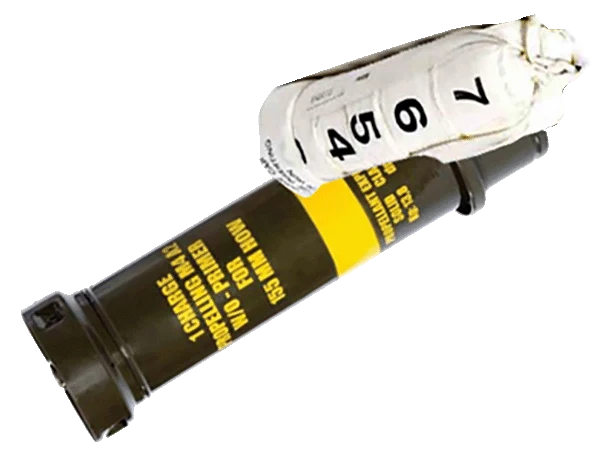
Description
The 155mm M4A2 powder charge is a propellant charge used in 155mm artillery systems. The M4A2 charge is part of a modular system that provides the propulsive force necessary to fire 155mm projectiles over various ranges. Here are the key details:
1. Type and Composition:
- The M4A2 is a semi-fixed charge, which means it can be adjusted by adding or removing increments to achieve the desired range.
- It consists of a single-base propellant made primarily of nitrocellulose.
- The charge is divided into separate bags or increments, which are configured according to the firing requirement.
2. Function and Purpose:
- The M4A2 is primarily designed for range versatility. It can be adjusted by varying the number of increments, enabling the gun crew to tailor the amount of propellant used to suit the target range.
- It is suitable for both short-range and medium-range engagements.
- This charge is used in conjunction with a variety of 155mm projectiles, including High-Explosive (HE), Smoke, Illumination, and more specialized rounds.
3. Application and Usage:
- The M4A2 charge is used with 155mm howitzers such as the M109 self-propelled howitzer and M777 towed howitzer.
- It is typically used in field artillery, supporting both direct and indirect fire missions.
4. Components:
- The M4A2 powder charge contains propellant increments made of nitrocellulose-based powder grains.
- It is usually ignited by a primer, which initiates combustion in the propellant, rapidly generating gases that propel the projectile out of the barrel.
5. Performance and Characteristics:
- The M4A2 offers moderate muzzle velocities, allowing for the effective engagement of targets at variable distances.
- It provides a balance between propellant weight and the capability to adjust range, making it suitable for a wide range of tactical situations.
6. Safety Considerations:
- Handling and storage of the M4A2 require careful attention to safety regulations, as it contains an explosive propellant.
- Proper procedures must be followed to prevent premature ignition or accidental detonation.
The M4A2 powder charge, with its flexible design, is a fundamental part of modern artillery, providing artillery units with the adaptability needed to meet diverse combat requirements.
Technical characteristics
- Загальна вага: 6,35 кг
- Вага порохового заряду: 6,08 кг
- Довжина: 53,34 см
- Температурний режим: -40 °C / +52 °C
- Максимальна дальність з М107: 14 600 м
Specifics of use
The 155mm powder charge is sensitive to moisture. It can be dried with warm air without direct sunlight exposure or indoors.
Pre-Use Inspection:
Before use, inspect the reliability of the propellant bundle bindings. There are frequent cases where charges fall apart during firing due to unreliable bindings.
Comparison of Charges M3A1, M4A2, and M4A1 for Firing with the M126 Gun on the M109 SPH:
Charge 1 M3A1: 207.3 m/s – range 3,900 m
Charge 2 M3A1: 236.2 m/s – range 4,900 m
Charge 3 M3A1: 275.8 m/s – range 6,500 m
Charge 4 M3A1: 317 m/s – range 8,200 m
Charge 5 M3A1: 374.9 m/s – range 9,800 m
Charge 3 M4A2: 269.7 m/s – range 6,200 m
Charge 4 M4A2: 313.9 m/s – range 8,000 m
Charge 5 M4A2: 373.4 m/s – range 9,800 m
Charge 6 M4A2: 461.8 m/s – range 12,000 m
Charge 7 M4A2: 562.4 m/s – range 14,600 m
Charge 3 M4A1: 274.3 m/s – range 6,300 m
Charge 4 M4A1: 316.4 m/s – range 8,000 m
Charge 5 M4A1: 374.6 m/s – range 9,700 m
Charge 6 M4A1: 463.3 m/s – range 12,000 m
Charge 7 M4A1: 563.9 m/s – range 14,600 m
Conversion of Propelling Charge
Powder Charge Conversion – All Information
M4A1 Propelling Charge
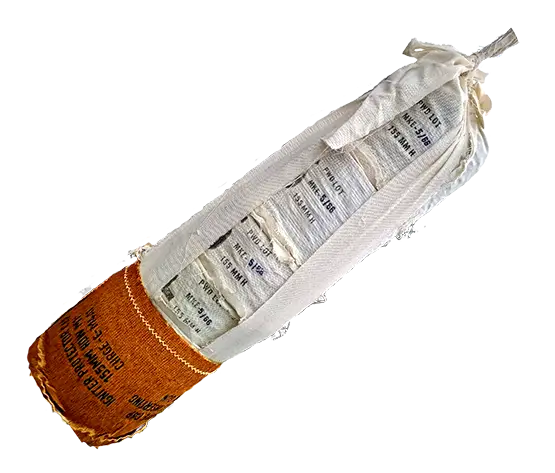
Description
The 155mm M4A1 powder charge, with configurations of charges 3-7, is used in 155mm howitzers, including the M114, M109, M198, FH70, FH77, M777, and others.
Differences from M4A2:
- The M4A1 differs from the M4A2 primarily in the igniter charge, which contains 85 grams of propellant (compared to 100 grams in the M4A2).
- Additionally, the M4A1 lacks a flash reducer, unlike the M4A2.
These modifications slightly impact the ignition characteristics and performance, which may affect how the charges behave under different firing conditions.
The M4A1 powder charge is a 155mm artillery propellant charge designed for use with various artillery systems, providing the necessary propulsion for different types of 155mm projectiles. Here is a detailed overview:
1. Type and Composition:
- The M4A1 is a semi-fixed charge with modular increments that allow for flexibility in adjusting the range and projectile velocity.
- It uses a single-base propellant composed mainly of nitrocellulose, similar to other charges like the M4A2, but with certain differences in grain geometry or additives to meet specific performance requirements.
2. Function and Purpose:
- The M4A1 is used to control the range and muzzle velocity of artillery projectiles. This is accomplished by varying the number of increments added to the charge.
- The charge is suitable for firing High-Explosive (HE), Smoke, Illumination, and other types of specialty rounds.
- Versatility is a key advantage of the M4A1, making it suitable for both medium and long-range artillery missions.
3. Application and Usage:
- The M4A1 powder charge is primarily used in 155mm howitzers such as the M109 self-propelled howitzer and M777 towed howitzer.
- It is particularly useful for operations where there is a need to vary firing distances, allowing artillery units to quickly adjust their firing profile to target different ranges effectively.
4. Components:
- The M4A1 consists of increment bags filled with nitrocellulose-based powder.
- The charge is ignited using a primer, which starts the rapid combustion of the propellant, generating the gas pressure needed to fire the projectile.
5. Performance Characteristics:
- Compared to the M4A2, the M4A1 has slightly different performance metrics in terms of muzzle velocity and maximum range, as shown in comparison data:
- Charge 3: 274.3 m/s, range 6,300 m
- Charge 4: 316.4 m/s, range 8,000 m
- Charge 5: 374.6 m/s, range 9,700 m
- Charge 6: 463.3 m/s, range 12,000 m
- Charge 7: 563.9 m/s, range 14,600 m
6. Safety Considerations:
- The M4A1 must be handled with strict adherence to safety protocols due to the presence of explosive materials.
- It is important to store the charge in dry and temperature-controlled environments, as exposure to moisture can degrade performance.
7. Key Differences from M4A2:
- The M4A1 and M4A2 are similar in their fundamental design but may vary in terms of the propellant composition, grain size, and performance characteristics. The M4A1 generally offers slightly higher muzzle velocities and is optimized for achieving greater ranges with particular projectiles.
The M4A1 powder charge remains a critical component of 155mm artillery systems, providing the flexibility and firepower needed for effective field artillery operations across a wide range of scenarios.
Technical characteristics
- Overall weight: 6.35 kg
- Propellant charge weight: 6.08 kg
- Length: 53.34 cm
- Temperature range: -40 °C / +52 °C
Comparison of Charges M3A1, M4A2, and M4A1 for Firing with the M126 Gun on the M109 SPH:
Charge 1 M3A1: 207.3 m/s – range 3,900 m
Charge 2 M3A1: 236.2 m/s – range 4,900 m
Charge 3 M3A1: 275.8 m/s – range 6,500 m
Charge 4 M3A1: 317 m/s – range 8,200 m
Charge 5 M3A1: 374.9 m/s – range 9,800 m
Charge 3 M4A2: 269.7 m/s – range 6,200 m
Charge 4 M4A2: 313.9 m/s – range 8,000 m
Charge 5 M4A2: 373.4 m/s – range 9,800 m
Charge 6 M4A2: 461.8 m/s – range 12,000 m
Charge 7 M4A2: 562.4 m/s – range 14,600 m
Charge 3 M4A1: 274.3 m/s – range 6,300 m
Charge 4 M4A1: 316.4 m/s – range 8,000 m
Charge 5 M4A1: 374.6 m/s – range 9,700 m
Charge 6 M4A1: 463.3 m/s – range 12,000 m
Charge 7 M4A1: 563.9 m/s – range 14,600 m
Specifics of use
Sensitive to moisture. It can be dried with warm air without direct sunlight exposure or indoors.
Before use, check the reliability of the propellant bundle bindings. There are frequent cases where charges fall apart during firing due to unreliable bindings.
Comparison Table of Charges M3A1 and M4A2 for Firing with the M126 Gun on the M109 SPH:
- Charge 1 M3A1: 207.3 m/s – range 3,900 m
- Charge 2 M3A1: 236.2 m/s – range 4,900 m
- Charge 3 M3A1: 275.8 m/s – range 6,500 m
- Charge 4 M3A1: 317 m/s – range 8,200 m
- Charge 5 M3A1: 374.9 m/s – range 9,800 m
- Charge 3 M4A2: 269.7 m/s – range 6,200 m
- Charge 4 M4A2: 313.9 m/s – range 8,000 m
- Charge 5 M4A2: 373.4 m/s – range 9,800 m
- Charge 6 M4A2: 461.8 m/s – range 12,000 m
- Charge 7 M4A2: 562.4 m/s – range 14,600 m
Conversion of Propelling Charge
Powder Charge Conversion – All Information
M3A1 Propelling Charge
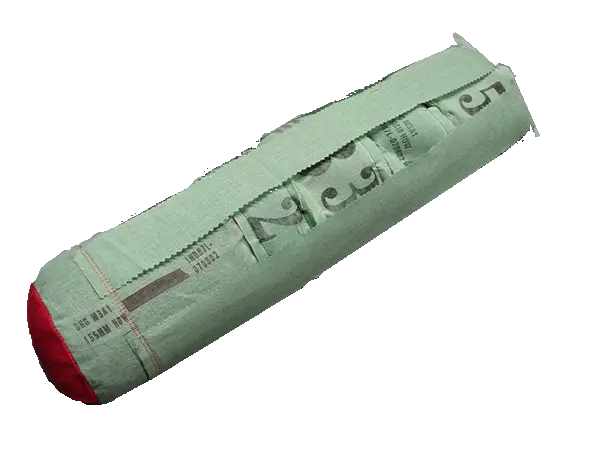
Description
The 155mm M3A1 powder charge (green bag) is a close equivalent to the M4A2 – Charge 5. It includes potassium sulfate as an additive to reduce flash. It is used in 155mm howitzers, such as the M114, M109, M198, FH70, FH77, and others.
Unlike other propellant charges, the M3A1 is configured with a base charge and four uneven propellant bags.
It is typically packed in a container containing two sets.
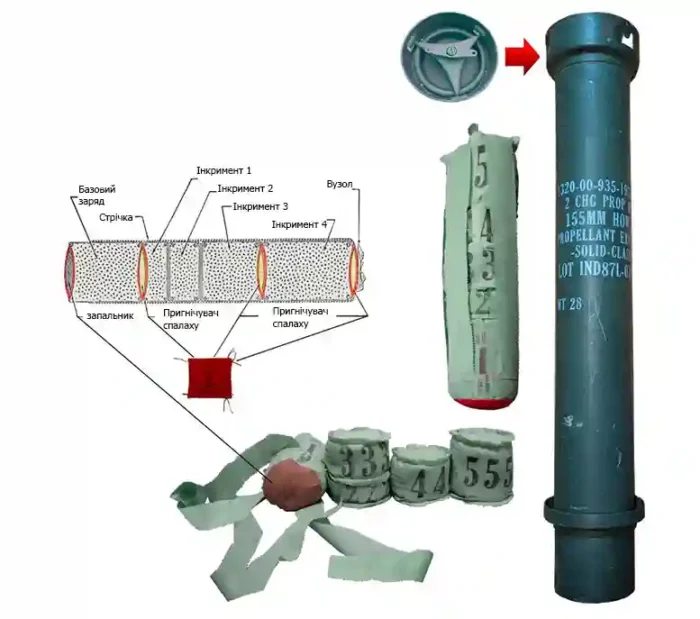
Type and Composition:
- The M3A1 is a semi-fixed charge consisting of modular increments that allow for flexibility in adjusting the range and projectile velocity.
- It uses a single-base propellant made primarily of nitrocellulose.
2. Function and Purpose:
- The M3A1 is designed to control the range and muzzle velocity of artillery projectiles by adjusting the number of increments in the charge.
- It is suitable for firing various types of 155mm projectiles, including High-Explosive (HE), Smoke, Illumination, and other specialized rounds.
- The M3A1 charge is typically used for short to medium-range engagements.
3. Application and Usage:
- The M3A1 powder charge is used with 155mm howitzers, such as the M114, M109, and other similar artillery systems.
- The charge provides versatility in field artillery operations, allowing for adjustments to accommodate different tactical scenarios.
Technical characteristics
- Overall weight: 5.21 kg
- Length: 40.6 cm
- Temperature range: -40 °C / +52 °C
Comparison of Charges M3A1 and M4A2 for Firing with the M126 Gun on the M109 SPH:
- Charge 1 M3A1: 207.3 m/s – range 3,900 m
- Charge 2 M3A1: 236.2 m/s – range 4,900 m
- Charge 3 M3A1: 275.8 m/s – range 6,500 m
- Charge 4 M3A1: 317 m/s – range 8,200 m
- Charge 5 M3A1: 374.9 m/s – range 9,800 m
- Charge 3 M4A2: 269.7 m/s – range 6,200 m
- Charge 4 M4A2: 313.9 m/s – range 8,000 m
- Charge 5 M4A2: 373.4 m/s – range 9,800 m
- Charge 6 M4A2: 461.8 m/s – range 12,000 m
- Charge 7 M4A2: 562.4 m/s – range 14,600 m
Specifics of use
The shell is sensitive to moisture. It can be dried with warm air without direct sunlight exposure, or indoors.
Before use, check the reliability of the powder bundle attachments. There are frequent cases where charges fall out during firing due to insecure attachment.
Comparative table for configuration and substitution with other propellant charges:
It is strictly prohibited to load two sets simultaneously!
There has been a documented case of irreversible damage to the FH70 gun when two sets of charges were loaded simultaneously. Example:
The gun barrel also sustained micro-cracks.
Comparative table of charges M3A1, M4A2, and M4A1 when fired with the M126 gun on the M109 SPG:
M3A1 Charge:
Charge 1: 207.3 m/s – Range 3900 m
Charge 2: 236.2 m/s – Range 4900 m
Charge 3: 275.8 m/s – Range 6500 m
Charge 4: 317 m/s – Range 8200 m
Charge 5: 374.9 m/s – Range 9800 m
M4A2 Charge:
Charge 3: 269.7 m/s – Range 6200 m
Charge 4: 313.9 m/s – Range 8000 m
Charge 5: 373.4 m/s – Range 9800 m
Charge 6: 461.8 m/s – Range 12,000 m
Charge 7: 562.4 m/s – Range 14,600 m
M4A1 Charge:
Charge 3: 274.3 m/s – Range 6300 m
Charge 4: 316.4 m/s – Range 8000 m
Charge 5: 374.6 m/s – Range 9700 m
Charge 6: 463.3 m/s – Range 12,000 m
Charge 7: 563.9 m/s – Range 14,600 m
Conversion of Propelling Charge
Projectile charge Conversion – All Information
M119A2 Propelling Charge
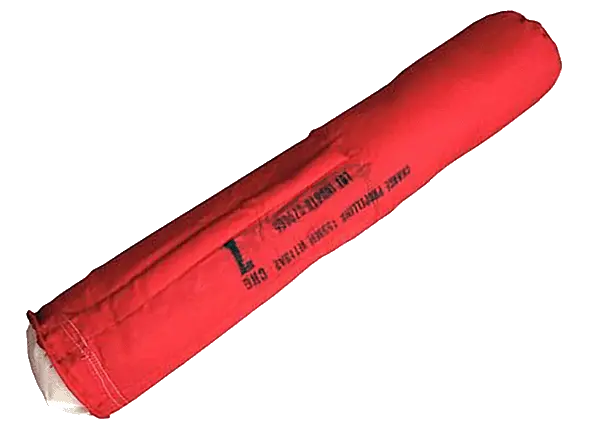
Description
The M119A2 propellant charge is a modular propellant system used for 155-mm artillery systems. It is designed to provide consistent and reliable propulsion for projectiles across various range settings.
Characteristics:
- Type: Modular, adjustable charge for 155-mm howitzers.
- Configuration: The M119A2 charge comes in seven propellant charges packed in a red bag, without the possibility of repackaging. It is designed for use as a complete unit.
- Additives: Each charge includes 85 grams of lead foil, which helps eliminate copper oxide deposits, and 113 grams of potassium sulfate, which reduces the visibility of the muzzle flash.
- Usage: The M119A2 is used for both extended and regular-range firing, depending on the configuration of the individual propellant increments used.
Range and Compatibility:
The M119A2 charge is compatible with various 155-mm projectiles and allows adjustments to match the ballistic requirements of different projectiles, such as high-explosive or smoke shells. It can be used for firing with artillery guns like the M109 or towed howitzers, including the FH-70. The complete unit charge provides flexibility in the field for different firing scenarios, optimizing for the required range while maintaining accuracy and stability.
Safety precautions when using the M119A2 propellant charge include ensuring proper seating and secure attachment to avoid incidents of unplanned charge release or malfunction. Proper adjustments and calibration should also be carried out to match the desired elevation and trajectory.
Technical characteristics
- Total weight: 10.7 kg
- Propellant charge weight: 9.5 kg
- Length: 74 cm
- Temperature range: -40°C to +52°C
Specifics of use
Similar charges to M119A2 and their differences:
- M119A1: Potential overflight
- M232A1/A2 charge 4: Contains an improved flash reducer, allowing firing with M549 and M549A1 projectiles.
The M119A1 charge is equipped with a pull strap, which needs to be removed before loading.
For different systems and projectiles, you may need to experiment with range. Make conclusions from the first few shots and make corrections to ΔV in Kropyva accordingly.
M119A2 can be problematic at low angles, causing gun displacement.
Conversion of Propelling Charge
Projectile charge Conversion – All Information
M119A1 Propelling Charge
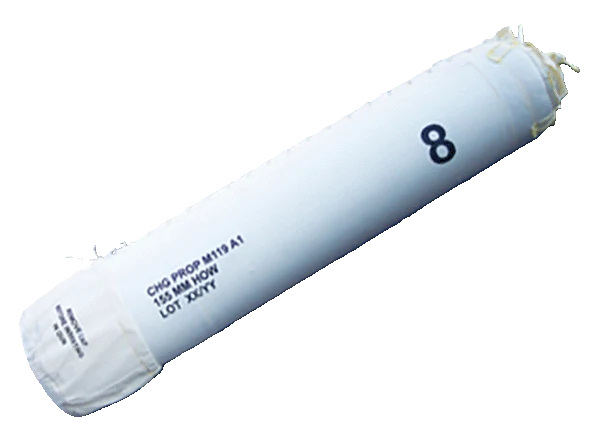
Description
The M119A1 propellant charge is used in 155-mm artillery systems and has characteristics similar to the M119A2, with some notable differences.
Characteristics:
- Type: Single, non-modular charge for 155-mm howitzers.
- Configuration: The M119A1 charge consists of eight propellant charges packed in a white bag, without the possibility of repackaging. It is equipped with a pull strap, which must be removed before loading.
- Additives: Each charge includes 85 grams of lead foil to help eliminate copper oxide deposits and 113 grams of potassium sulfate to reduce the visibility of the muzzle flash.
- Potential Overflight: There is a risk of overflight with the M119A1 charge compared to the M119A2, so careful adjustments must be made when using it.
- Usage: It is compatible with various artillery systems and can be used with different projectiles.
Additional Information:
The M119A1 charge is generally used for providing propulsion for 155-mm shells, such as high-explosive and smoke projectiles. Users need to be cautious about potential overflight and make corrections based on the first few rounds fired, especially in digital fire control systems like Kropyva. Proper inspection of the pull strap is required to avoid any mishaps during loading.
Technical characteristics
- Total weight: 10 kg
- Propellant charge weight: 9.3 kg
- Length: 74 cm
- Temperature range: -40°C to +52°C
Specifics of use
Similar charges to M119A1 and their differences:
M119A2: Potential overflight
M232A1/A2 charge 4:
Similar in characteristics to M119A2. It contains an improved flash reducer, allowing firing with M549 and M549A1 projectiles.
For different systems and projectiles, you may need to experiment with range. Make conclusions from the first few shots and adjust ΔV in Kropyva accordingly.
M119A2 can be problematic at low angles, causing gun displacement.
Conversion of Propelling Charges
Projectile charge Conversion – All Information
M203 and M203A1 Propelling Charges
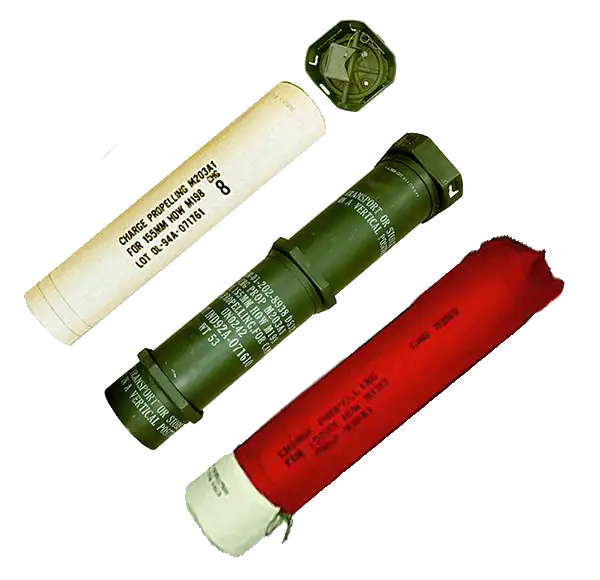
Description
The M203 and M203A1 propellant charges are used in 155-mm artillery systems, designed to provide reliable propulsion for projectiles across various range requirements. They are particularly compatible with extended-range projectiles.
Characteristics:
- Type: Non-modular, single propellant charges for 155-mm howitzers.
- Configuration: Both M203 and M203A1 charges come in a fixed configuration, without the ability to adjust or repackage them for variable ranges.
- Additives: These charges may contain additives similar to those found in other propellant charges, such as lead foil to remove copper oxide deposits and potassium sulfate to reduce the visibility of the muzzle flash.
M203A1:
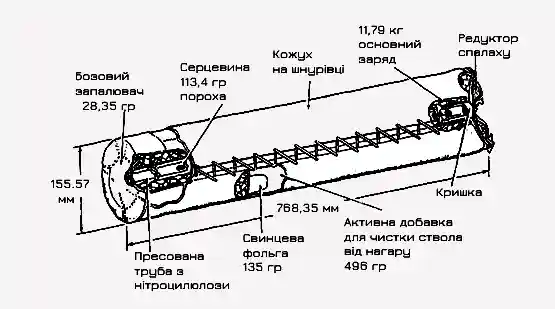
The M203A1 is a unitary zone 8 propellant charge for 155-mm howitzers, allowing firing at distances up to 24.7 km with a 39-caliber gun. The charge consists of a combustible case, an igniter, and a bundle of propellant sticks. The case is made of kraft paper, which burns up after firing. The igniter contains black powder and CBI to ignite the propellant sticks. The sticks have a low burning temperature, which extends the barrel life and reduces the flash visibility. To protect the barrel from copper oxide, the bundle of propellant sticks is wrapped in lead foil. The M203A1 is a modern and efficient charge for artillery.
M203:
The basic M203 charge was structurally similar to the M119 and contains granular propellant in a “red bag” with a central igniter. The charge casing is sewn from fabric and has lacing along its length, providing rigidity and structural stability to the assembled charge.
Differences:
- M203: The original version of the charge, used for standard firing requirements. It provides consistent propulsion but lacks the advanced features of newer models.
- M203A1: An improved version of the M203, offering better performance, stability, and compatibility with extended-range and modern projectiles. It is suitable for firing projectiles like M549 and M549A1 due to enhancements such as improved flash reducers.
Usage:
- The M203 and M203A1 charges are used for providing propulsion for 155-mm projectiles, including high-explosive and extended-range shells.
- When using these charges, gunners may need to experiment with range adjustments depending on the artillery system and projectile type. Observations from initial shots should be used to adjust firing parameters such as ΔV in fire control systems like Kropyva.
Range and Compatibility:
These charges are suitable for use in towed and self-propelled artillery systems, including guns like the FH70 and M109. They provide the necessary flexibility and performance to meet varying operational needs, particularly for extended-range missions.
Technical characteristics
M203:
Explosive weight: 11.8 kg
Length: 76.4 cm
Temperature range: -46°C / +52°C
M203A1:
Explosive weight: 12.7 kg (encased in a rigid combustible end cap)
Length: 76.9 cm
Temperature range: -46°C / +52°C
M203 Propellant Charge Design:
Specifics of use
The M203 and M203A1 charges are non-repackable.
Not used with projectiles:
M107, M449, M449A1, M483A1, M692/M731, M718/M741, M485A1, M485A2, M110(M110E1), M110A1(M110E2), M110A2(M110E3), M116, M116B1, M116A1, M804, M804A1, M109A2/A3/A4/A5/A6, M109A1, M864.
The M203A1 charge has increased moisture resistance.
Conversion of Propelling Charges
Projectile charge Conversion – All Information
L8A1 Propelling Charge
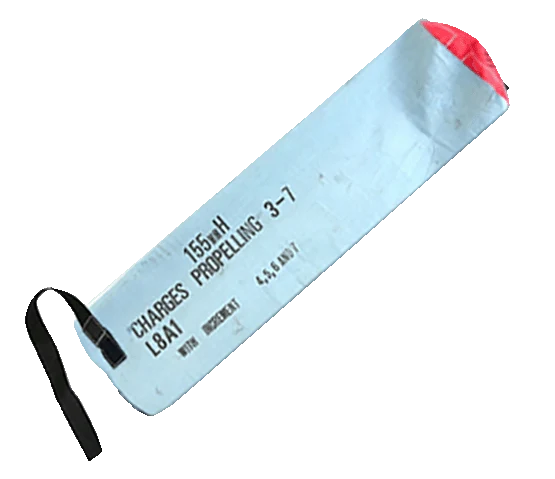
Description
Technical characteristics
- Explosive weight: 9.7 kg
- Length: 74.3 cm
- Temperature range: -40°C to +52°C
Specifics of use
The L8A1 charge is non-repackable, with characteristics similar to the M119A2 charge.
It is sensitive to moisture.
Propelling Charge L10A1
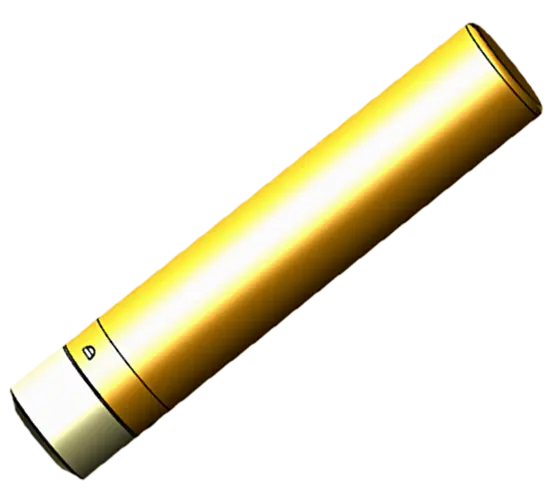
Description
L10A1 is a high-tech propellant charge produced by the British manufacturer BAE Systems, similar in characteristics to the M203A1, for 155-mm howitzers, providing high accuracy and range.
The L10A1 consists of three main components: a combustible case, an igniter, and a bundle of propellant sticks. The combustible case is made from environmentally friendly kraft paper, which completely burns during the shot. The igniter is made from a special composition that ensures reliable ignition of the propellant sticks. The propellant sticks have an optimal shape and size, allowing for a maximum firing range of 24.7 km with 39-caliber guns and 30 km with a rocket-assisted projectile. Additionally, they have a low burning temperature, reducing thermal stress on the barrel and improving its longevity. To protect the barrel from corrosion, the bundle of propellant sticks is wrapped in lead foil.
Technical characteristics
- Total weight: 13.4 kg
- Explosive weight: 12.3 kg
- Length: 76.3 cm
- Temperature range: -46°C to +52°C
Specifics of use
The L10A1 charge is non-repackable, with characteristics similar to the M203A1 charge.
Not used with projectiles:
M107, M449, M449A1, M483A1, M692/M731, M718/M741, M485A1, M485A2, M110(M110E1), M110A1(M110E2), M110A2(M110E3), M116, M116B1, M116A1, M804, M804A1, M109A2/A3/A4/A5/A6, M109A1.
The L10A1 charge has increased moisture resistance.
IPC35 Propelling Charge
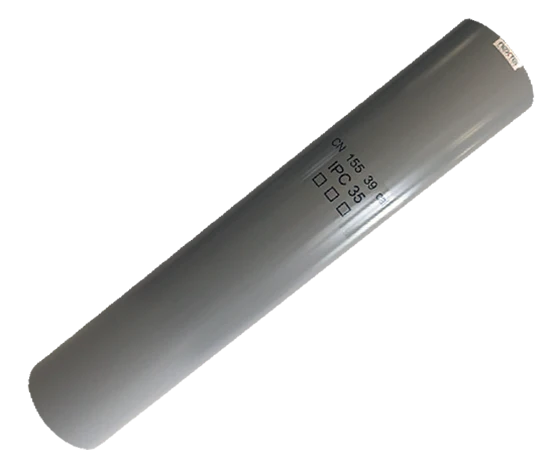
Description
The 155-mm propellant charge IPC35, produced by the French manufacturer Nexter, is specifically designed for 155-mm/39 caliber guns. It consists of a combustible casing containing three propellant bags. The propellant charge is a comprehensive solution, serving as an alternative to the set of American charges like M4A2, M119, and M203. It is a more cost-effective alternative to modular charge systems like MACS when the key features of the modular concept are not needed.
The IPC35 meets the ballistic requirements of the Joint Ballistics Memorandum of Understanding (JBMoU), similar to those of modular MACS systems. This charge can also be used with 45 and 52 calibers without any restrictions.
The IPC35 consists of three propellant bags. The combustible case is made of environmentally friendly kraft paper, which completely burns during firing. The igniter is made of a special composition that ensures reliable ignition of the propellant charges, allowing a maximum firing range of 24.7 km with 39-caliber guns and 30 km with a rocket-assisted projectile. Additionally, they have a low burning temperature, which reduces thermal stress on the barrel and improves its longevity. The casing also includes chemical elements that remove carbon deposits and copper during firing.
Technical characteristics
- Type: Monolithic combustible casing with three charges
- Total weight: 14 kg
- Length: 780 mm
- Maximum firing range with LU211 BB (with base bleed): 30 km
- Temperature range: -33°C to +63°C
- Storage temperature range: -33°C to +71°C
Propelling Charges KTA 5927, KTA 5928, KTA 5932, KTA 5933
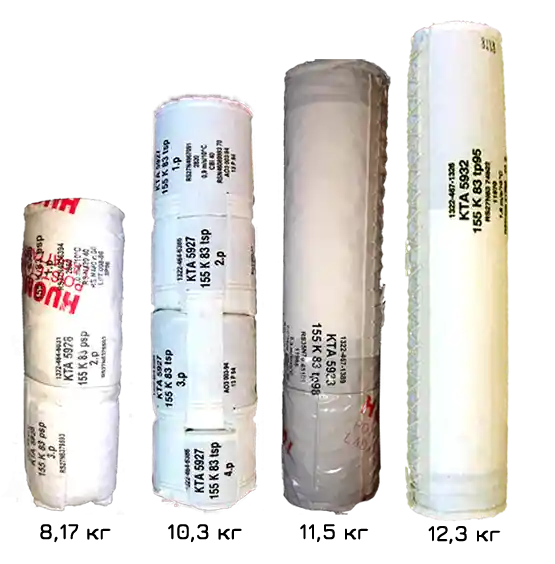
Description
Propellant charges from the Finnish manufacturer Nammo, series KTA: KTA 5927, KTA 5928, KTA 5932, KTA 5933 were specifically designed for use with projectiles KTA 5912, KTA 5934, KTA 5938, which in turn were intended for the Finnish towed field gun Tampella 155 K 83.
The KTA 5927 can be configured with 4 charges, while the KTA 5928 is a complete equivalent with three charges. Propellant charges KTA 5932 and KTA 5933 cannot be configured.
Technical characteristics
Name: KTA 5928
- Charge 1: Weight 2.92 kg, v₀ 380 m/s
- Charge 2: Weight 5.18 kg, v₀ 480 m/s
- Charge 3: Weight 8.17 kg, v₀ 620 m/s
Name: KTA 5927
- Charge 1: Weight 2.94 kg, v₀ 380 m/s
- Charge 2: Weight 5.20 kg, v₀ 480 m/s
- Charge 3: Weight 8.21 kg, v₀ 620 m/s
- Charge 4: Weight 10.3 kg, v₀ 720 m/s
Name: KTA 5933
- Weight 11.5 kg, v₀ 800 m/s
Name: KTA 5932
- Weight 12.3 kg, v₀ 810 m/s
Specifics of use
The KTA propellant charges are not fully described in Kropyva.
Replacement options:
- KTA 5927, KTA 5928 charge 2 – M3A1 charge 5
- KTA 5927, KTA 5928 charge 3 – M4A2 charge 6 (with KTA, there will be an overflight)
- KTA 5927, KTA 5928 charge 1 – M231, BC-E, DM82, TCME 101 charge 2 (conditionally)
- KTA 5927, KTA 5928 charge 2 – M232, M232A1, TC-F, DM72, DM92, TCME 100 charge 3 (conditionally)
- KTA 5927 charge 4 – M119A2 (with KTA, there will be a slight shortfall)
- KTA 5933 – M203
- KTA 5932 – M203A1 (with KTA, there will be a slight shortfall)
Propelling Charges M231, BC-E, DM82, TCME 101
Modular Artillery Charge System (MACS)

Description
Propellant charges M231, BC-E, and DM82 represent the most advanced modular (cartridge) loading system, MACS.
With these charges, no more than two cartridges are used (zone 1, zone 2).
Advantages of the Modular Loading System:
- Complete combustion.
- Stable ballistic characteristics in the range of -46°C to 49°C.
- Increased rate of fire due to convenient loading.
- Reduced barrel wear.
- Hard coating ensures resistance to mechanical damage and moisture.
- Compatibility with automatic loading systems due to high mechanical properties.
- Reduced cost of charges.
- Reduced response to all types of threats.
- Improved crew compartment environment due to reduced harmful vapors and clutter from spent metal boxes, thus enhancing crew efficiency.
- Reduced weight of the assembled charge, easing the workload on the gun crew and improving logistics.
M231 charges can be stacked in any order, while BC-E charges have a fitting groove for secure attachment. The nitrocellulose casing completely burns after firing, providing high resistance to moisture.
Technical characteristics
- Total weight: 1.93 kg
- Propellant weight: 1.5 kg
- Diameter: 158 mm
- Length: 155 mm
- Temperature range: -46°C to +49°C
Specifics of use
Do not use more than 2 cartridges.
Do not combine with similar charges M232, TC-F.
Those who started using this charge experienced all the benefits of the modular system.
It is easy to transport and assemble, and does not absorb moisture. The cartridges are made of a sturdy material with high precision, which positively affects shooting quality.
The gun crew noted that after using this charge, the gun barrel remains clean, thanks to modern substances placed in the cartridge.
M231 is described in Kropyva with certain projectiles. However, if data is not available in Kropyva for a specific projectile, it can be approximated as follows:
- M231 (BC-E) 1 cartridge – M3A1 charge 3
- M231 (BC-E) 2 cartridges – M4A2 charge 5
Conversion of Propelling Charges
Projectile charge Conversion – All Information
Modular Charge System. Video
Propelling Charges M232, M232A1, TC-F, DM72, DM92, TCME 100
Modular Artillery Charge System (MACS)
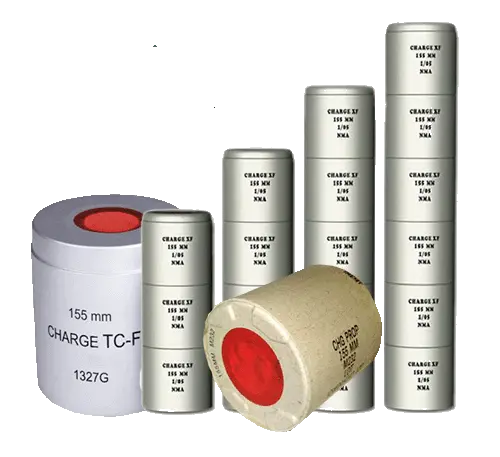
Description
Propellant charges M232, TC-F, and TCME 100 are representatives of the most advanced modular (cartridge) loading system, MACS.
With these charges, more than two cartridges are used (zone 3, zone 4, zone 5, zone 6).
Advantages of the Modular Loading System:
- Complete combustion.
- Stable ballistic characteristics in the range of -46°C to 49°C.
- Increased rate of fire due to convenient loading.
- Reduced barrel wear.
- Hard coating ensures resistance to mechanical damage and moisture.
- Compatibility with automatic loading systems due to high mechanical properties.
- Reduced cost of charges.
- Reduced response to all types of threats.
- Improved crew compartment environment due to reduced harmful vapors and clutter from spent metal boxes, thus enhancing crew efficiency.
- Reduced weight of the assembled charge, easing the workload on the gun crew and improving logistics.
M232 charges can be stacked in any order, while BC-E and TCME 100 have a fitting groove for secure attachment. The nitrocellulose casing completely burns after firing, providing high resistance to moisture.
Technical characteristics
- Total weight: 1.93 kg
- Propellant weight: 1.5 kg
- Diameter: 158 mm
- Length: 155 mm
- Temperature range: -46°C to +49°C
Specifics of use
Do not combine with similar charges M231, BC-E.
Those who started using this charge experienced all the benefits of the modular system.
It is easy to transport and assemble, and does not absorb moisture. The cartridges are made of a sturdy material with high precision, which positively affects shooting quality.
The gun crew noted that after using this charge, the gun barrel remains clean, thanks to modern substances placed in the cartridge.
M232 is described in Kropyva with certain projectiles. However, if data is not available in Kropyva for a specific projectile, it can be approximated as follows:
M232 with 3 cartridges – M4A2 charge 7
M232 with 4 cartridges – M119A2
M232 with 5 cartridges – M203A1
Range table for DM72/DM92 charges when fired with a 39-caliber gun presented by Rheinmetall Corporation:

Conversion of Propelling Charges
Projectile charges Conversion – All Information
Modular Charge System. Video
M91 Propelling Charge
Modular propellant
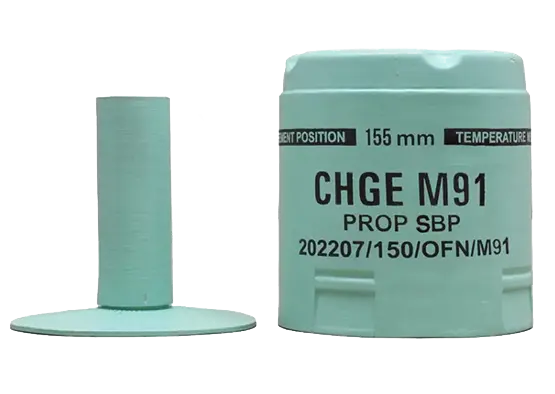
Description
Propellant charges M91 represent the most advanced modular (cartridge) loading system, developed by Indian Ordnance Factories (India).
These charges are used only in configurations of 1 or 2 cartridges (zone 1, zone 2).
They have similar ballistic characteristics to propellant charges M231, BC-E, and DM82.
The M91 charges have a fitting groove for secure attachment. The nitrocellulose casing completely burns after firing, ensuring high resistance to moisture.
Advantages of the Modular Loading System:
- Complete combustion.
- Stable ballistic characteristics in the range from -40°C to 60°C.
- Increased rate of fire due to convenient loading.
- Reduced barrel wear.
- Hard coating ensures resistance to mechanical damage and moisture.
- Compatibility with automated loading systems due to high mechanical properties.
- Reduced cost of charges.
- Reduced response to all types of threats.
- Improved crew compartment environment due to reduced harmful vapors and clutter from spent metal boxes, thus enhancing crew efficiency.
- Reduced weight of the assembled charge, easing the workload on the gun crew and improving logistics.
Technical characteristics
- Total weight: 1.93 kg
- Propellant weight: 1.5 kg
- Diameter: 158 mm
- Length: 155 mm
- Temperature range: -40°C to +60°C
- Shelf life: 10 years
Specifics of use
Do not combine with similar charges M92.
Those who started using this charge experienced all the benefits of the modular system.
It is easy to transport and assemble, and does not absorb moisture. The cartridges are made of a sturdy material with high precision, which positively affects shooting quality.
The gun crew noted that after using this charge, the gun barrel remains clean, thanks to modern substances placed in the cartridge.
Do not use more than 2 cartridges.
This is “fast propellant.” Using more than two elements leads to accelerated barrel wear, and there is a risk of barrel damage.
Conversion of Propelling Charges
Projectile charges Conversion – All Information
Modular Charge System. Video
Propelling Charge M92 Modular system

Description
Propellant charges M92 are representatives of the most advanced modular (cartridge) loading system, developed by Indian Ordnance Factories (India).
These charges are used in configurations of 3, 4, 5, and 6 cartridges (zone 3, zone 4, zone 5, zone 6). They have similar ballistic characteristics to propellant charges M232, M232A1, TC-F, DM72, and TCME 100.
The M92 charges have a fitting groove for secure attachment. The nitrocellulose casing completely burns after firing, ensuring high resistance to moisture.
Advantages of the Modular Loading System:
- Complete combustion.
- Stable ballistic characteristics in the range from -40°C to 60°C.
- Increased rate of fire due to convenient loading.
- Reduced barrel wear.
- Hard coating ensures resistance to mechanical damage and moisture.
- Compatibility with automated loading systems due to high mechanical properties.
- Reduced cost of charges.
- Reduced response to all types of threats.
- Improved crew compartment environment due to reduced harmful vapors and clutter from spent metal boxes, thus enhancing crew efficiency.
- Reduced weight of the assembled charge, easing the workload on the gun crew and improving logistics.
Technical characteristics
- Total weight: 1.93 kg
- Propellant weight: 1.5 kg
- Diameter: 158 mm
- Length: 155 mm
- Temperature range: -40 °C / +60 °C
- Shelf life: 10 years
Specifics of use
Do not combine with similar charges M91.
Anyone who has started using this charge has experienced all the advantages of the modular system.
It is easy to transport and assemble, and it does not get wet. The cartridges are made from a durable material with high precision, which positively affects the quality of firing.
The gun crew has noted that after using the charge, the barrel remains clean, thanks to the modern substances incorporated into the cartridge.
Conversion of Propelling Charges
Projectile charges Conversion – All Information
Syrota Oleh (Georhiych©) for the Armed Forces of Ukraine / Entropia.com.ua
Share your experience with 155-mm ammunition.
Comments and suggestions can be sent to: entropiaw@gmail.com
f Facebook
KHMS 88

