
High-explosive fragmentation shells 
High-explosive shells (HE)
– PROJECTILE M107 and L21 HE
– PROJECTILE M795
– Projectiles LU 211
– Projectile ER02A1
– Projectile L15A1
– Projectiles KTA 5912, KTA 5934, KTA 5938
– Projectile OFD MKM (HE-HB) Series
– Projectile M77B
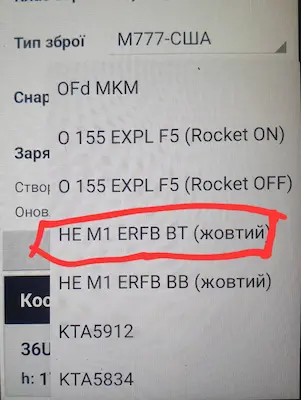
– Projectile HE M1 ERFB BT (Boat Tail)
– Projectile HE M1 ERFB BB (Base Bleed)
– Projectile M9603A1
– Projectile OE 155 56/59 HE
– Projectile M1128 (HE-BB)
– Projectiles DM121, DM131, M1711
155 mm caliber ammunition. Projectiles.
Smoke and chemical projectiles
Projectiles of remote mining
Rocket-assisted projectiles
Cluster projectiles
– M864 extended range cluster projectile
– M483A1 (DPICM) cluster projectile
(full ballistic equivalent of M1122, M1123, M1124, M110A3, M1125)
– DM642 cluster projectile
– M449 cluster, anti-personnel projectile
– BONUS Mk – cluster, armor-piercing projectile
Illuminating projectiles
Guided projectiles
Range tables
Projectile M107 and L21

Description
The M107 (with the L21 being its British equivalent) is one of the oldest high-explosive (HE) fragmentation projectiles used by NATO countries. It is currently being replaced by the more modern M795.
The 155 mm caliber ammunition is designed to engage stationary targets, large concentrations of infantry, field fortifications, lightly armored targets, weapon systems, military equipment, and transport vehicles.
The projectile affects the target through the kinetic energy of its metal fragments and the explosive blast wave of its charge.
Technical characteristics
- Maximum range: up to 18.7 km
- Weight with fuze: 43.2 kg
- Length without fuze: 607 mm
- Body material: forged steel
- Explosive content: 6.6 kg
- Packaging: wooden pallet of 8 units
Specifics of use
High-Explosive Fragmentation Projectiles: M107
- To be used only with propellant charges that can achieve the maximum range of 18.7 km.
Note: On some systems (e.g., FH70), the M107 projectile is not described in Kropyva software when using the propellant charge M232, VS-E, TCME-100. Refer to M777 howitzer calculations or use the calculation for M795 with an adjustment for under-range of approximately 150 m. Adjust ΔV by -5 (-7).
Conversion of propellant charges
Temperature range: from -54°C to +63°C
Collision of M107 with Leopard 2 - Video
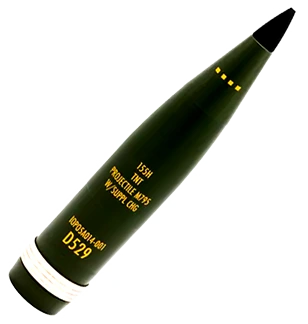
Projectile M795
Description
The M795 is a high-explosive (HE) fragmentation projectile that replaces the outdated M107.
The external configuration and ballistic data are similar to those of the M483A1 projectile, but the M795 is 5 cm shorter.
The 155 mm caliber ammunition is designed to engage stationary targets, large concentrations of infantry, field fortifications, lightly armored targets, weapon systems, military equipment, and transport vehicles.
The projectile affects the target through the kinetic energy of its metal fragments and the explosive blast wave of its charge.
Before use, the plug in the nose must be replaced with a fuze.
Fuzes can be used for high-explosive, fragmentation, delayed, and proximity actions.
Technical characteristics
Maximum range: up to 22.3 km (39 calibers)
- Weight with fuze: 46.9 kg
- Length with fuze: 843 mm
- Body material: HF-1 steel
- Explosive content: 10.8 kg
- Explosive content: 10.8 kg TNT
- Maximum range: up to 22.5 km (when used with M4A2 propellant charges)
- Initial maximum projectile velocity:
- Charge M3A1 – 441 m/s
- Charge M4A2 – 547 m/s
- Charge M119 A1/A2 – 651 m/s
- Charge M203A1 – 802 m/s
Packaging: Wooden pallet of 8 units.
Specifics of use
The M795 projectile is described in Kropyva.
Temperature range: from -45.5°C to +62.8°C
Projectile L15A1
Description
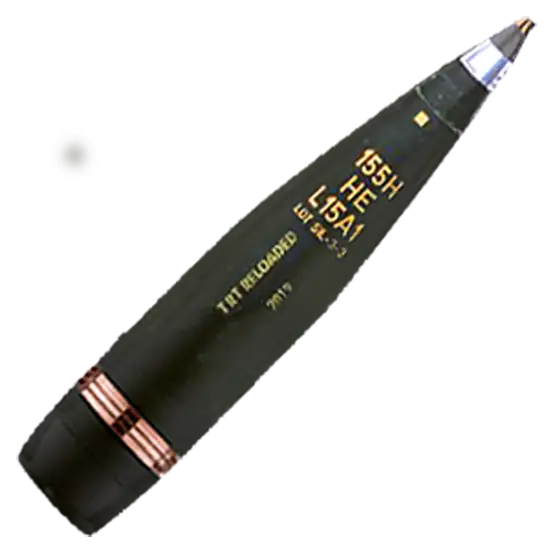
L15A1 is a high-explosive (HE) fragmentation projectile with increased range and explosive power, designed for the destruction of enemy personnel, lightly armored targets, and field fortifications.
This ammunition is produced by three countries: the United Kingdom, Italy, and Spain.
The projectile consists of a thin, specially hardened shell body, allowing for an increased volume of explosive (THT) and a greater number of fragments to effectively target enemy personnel.
The driving band, with a width of 37 mm, reliably stabilizes the projectile’s movement in the gun barrel. The projectile is supplied with a lifting plug designed to protect the fuze area from accidental damage.
The 155 mm L15A1 HE projectile provides a firing range of 24.7 km when used with propellant charge M232 charge 5, in 39-caliber guns.
Technical characteristics
Specifics of use
The L15A1 projectile is described in Kropyva for FH70 and M777 howitzers. In combat operations, it has proven highly effective. The L15A1‘s stable ballistic performance ensures accurate fire against the enemy.
Projectiles KTA 5912, KTA 5934, KTA 5938
Description
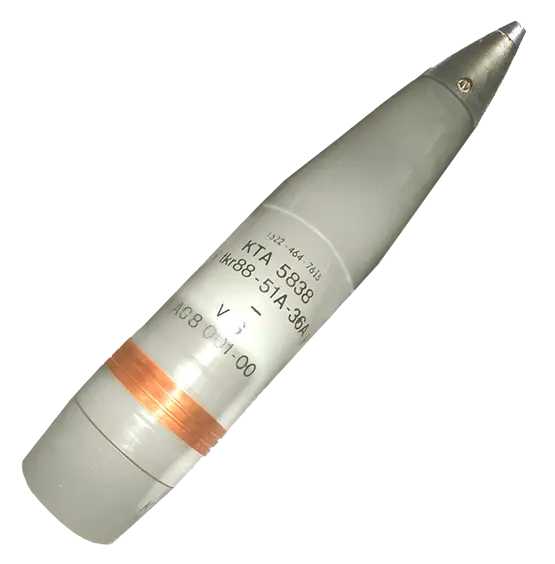
High-explosive fragmentation projectiles from the Finnish Nammo company, series KTA 5912, KTA 5934, KTA 5938, are designed to destroy enemy personnel, lightly armored targets, and field fortifications.
These projectiles are developed for use with the Finnish field, towed gun Tampella 155 K 83, as well as other NATO-standard artillery systems.
The projectile features a thin, specially hardened shell body, which increases the volume of explosive (THT) and the number of fragments to effectively target enemy personnel.
The projectiles differ in the number of driving bands:
- KTA 5912: 2 copper bands
- KTA 5934: 2 copper and 1 synthetic band
- KTA 5938: 3 copper bands
The UAF generally uses KTA 5938 or KTA 5934. The ballistic characteristics are identical.
During the use of the KTA 5912 projectile, unstable movement in the barrel was observed, leading to the development of the subsequent KTA models.
They are typically used with propellant charges KTA 5927, KTA 5928, KTA 5932, KTA 5933.
Technical characteristics
- Weight without fuze: 42.5 kg
- Length without fuze: 768 mm
- Explosive content: 9 kg
- Probable range error: ≤ 0.5% (range) / ≤ 0.1% (deflection)
- Maximum effective range: 24 km
- Temperature range: from -40°C to +52°C
Specifics of use
Projectiles KTA 5912, KTA 5934 are available in Kropyva, but with limited propellant charge options. When firing KTA 5938 (not listed in Kropyva), refer to the data for the KTA 5934 projectile.
Options for use with different propellants can be found HERE.
Projectiles LU211

Description
LU 211 is a series of high-explosive fragmentation shells produced by a French manufacturer, intended for destroying enemy personnel, lightly armored targets, and field engineering structures. The shell consists of a shell body filled with explosive and a hollow base or base bleed unit to increase maximum range. The driving band and plastic obturator are protected by a gasket. The shell is supplied with a lifting plug designed to protect the fuze area from accidental damage.
The 155-mm LU 211 HE shell provides the capability for extended-range firing. It may feature a hollow base (HB) or be equipped with a Base-Bleed (BB) unit—comparable to the British XL12E1. The Base-Bleed shell can engage targets up to 40 km when fired from a 52-caliber gun and up to 30 km from a 39-caliber gun.
Technical characteristics
Maximum range (39 caliber):
- HB: 24.7 km
- BB: 30 km
Weight without fuze:
- HB: 42.5 kg
- BB: 43.9 kg
Length with fuze:
- HB: 865 mm
- BB: 867 mm
Explosive filler weight: 8.8 kg
Maximum initial velocity:
- HB: 939 m/s
- BB: 946 m/s
Specifics of use
As of April 18, 2024, the LU 211 shell is not described in Kropyva.
The LU211 xx-HB shell (without base bleed) in Kropyva can be equated to the L15A1. Also, for the M777 system in Kropyva, there is a similar shell, the ER02A1 HB, and ER02A1 BB, but only with DM92 and M119A2 powders. On this website, you can see “Conversion of Powder Charges.”
Projectiles ER02A1

Description
ER02A1 is a series of high-explosive fragmentation shells produced by the Spanish manufacturer EXPAL, intended for destroying enemy personnel, lightly armored targets, and field engineering structures. The shell consists of a shell body filled with explosive and a hollow base or base bleed unit to increase maximum range. The driving band and plastic obturator are protected by a gasket.
It can be equipped with either an HB unit or a BB (base bleed) unit, with the latter reaching a maximum range of 30 km when fired from a 39-caliber gun and 39 km when fired from a 52-caliber gun.
These 155-mm shells comply with the Joint Ballistic Memorandum of Understanding for 155-mm artillery ammunition and can be used with 155-mm caliber guns of 39/45/52 calibers, both with older bag charges and the latest MCS and MACS charges.
The ER02A1 shell is equivalent to the German DM121 and a close counterpart to the French LU211 and the Bulgarian ER520.
Technical characteristics
Maximum range (39 caliber):
- HB: 23.6 km with DM92 5M charge
- BB: 28.8 km with DM92 5M charge
Weight without fuze:
- HB: 42.7 kg
- BB: 44.1 kg
Length with fuze:
- HB: 865 mm
- BB: 867 mm
Explosive filler weight: 10.6 kg
Maximum initial velocity:
- HB: 824 m/s
- BB: 917 m/s
Temperature range: from -53 °C to +63 °C
Specifics of use
The ammunition is a recent development by the German corporation Rheinmetall. The abbreviation “ER” indicates enhanced ballistic performance and extended range.
The ER02A1 shell is described in Kropyva for M777 systems, but only with DM92 and M119A2 powders. On this website, you can see the “Conversion of Powder Charges.”
Based on experience in Ukraine, the ER02A1, with propellant charges M231, M232, DM72, and DM92, shows stable ballistic characteristics.
The ER02A1 shell is equivalent to the German DM121 and a close counterpart to the French LU211 and the Bulgarian ER520.
Projectiles ofd mkm (HE-HB) Series
Description
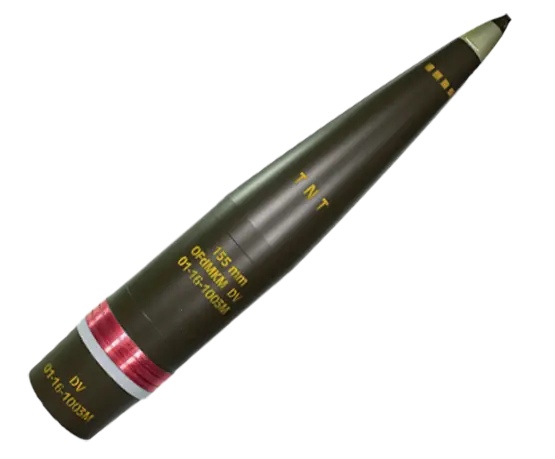
OFd MKM (HE-HB) is a 155-mm high-explosive fragmentation shell produced by a Slovak manufacturer, representing a whole series of 155-mm caliber ammunition with improved aerodynamics (DV).
The OFd MKM (HE-HB) shell is the simplest variant of this series. It lacks a base bleed unit and also lacks fins on the body for increased range and flight stabilization, unlike other shells in this series.
Technical characteristics
Maximum range (39 caliber):
With 4th charge: M232, M232A1, BC-E, DM72, TCME 100 – 19.9 km
With 5th charge: M232, M232A1, BC-E, DM72, TCME 100 – 24.8 km
Weight without fuze: 40.3 kg
Length without fuze: 816.5 mm
Explosive filler weight: 10 kg
Specifics of use
The OFd MKM (HE-HB) shell is described in Kropyva, but as of December 1, 2023, only with the TCME 100 charge. TCME 100 is comparable to other manufacturers’ charges like M232, BC-E, DM72, and M92.
This shell can be compared to the L15 shell, which is offered in Kropyva with other propellant charges.
Important! A similar shell, OFd MKM (HE-BB), features a base bleed unit, and its ballistic characteristics differ from those of the OFd MKM (HE-HB).
Projectile M77B
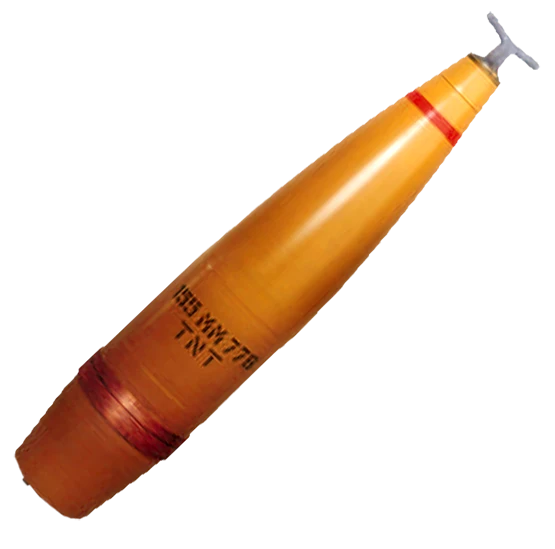
Description
The M77B is a 155-mm high-explosive fragmentation shell produced by Munitions India Limited (India), featuring improved aerodynamics for extended range, designed to destroy enemy personnel, lightly armored targets, and field engineering structures.
The Swedish M77 shell is painted olive green.
The shell consists of a body filled with explosive and a hollow base. The driving band and plastic obturator are protected by a gasket. The shell is supplied with a lifting plug designed to protect the fuze area from accidental damage.
The 155-mm M77B shell provides extended-range firing capability up to 24 km with 39-caliber guns.
Technical characteristics
Maximum range (39 caliber):
With 4th charge: M232, M232A1, BC-E, DM72, TCME 100 – 19.2 km
With 5th charge: M232, M232A1, BC-E, DM72, TCME 100 – 24 km
Weight without fuze: 41.7 kg
Length without fuze: 728 mm
Explosive filler weight: 9 kg
Maximum initial velocity: 779 m/s
Temperature range: -20 °C to +60 °C
Shelf life: 15 years
Projectile HE М1 ERFB BT (Boad Tail)
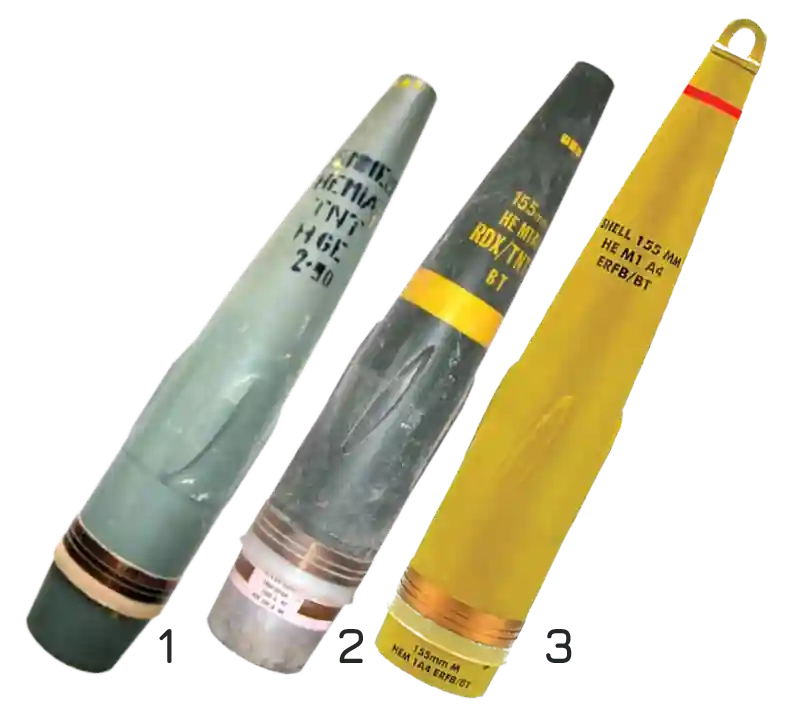
Description
The HE M1A1 ERFB BT (Boat Tail) is a high-explosive fragmentation artillery shell of 155-mm caliber, designed for increased range and effective target engagement. It belongs to the ERFB (Extended Range Full Bore) type, which implies extended range due to the aerodynamic shape of the shell body. The [BT (Boat Tail)](Технологія%20Boat Tail (буквально: хвіст човна) забезпечує збільшення дальності та стабільності польоту снаряда.) version features a tapered rear end, reducing air resistance, thus further improving range and flight stability.
Manufacturers:
This type of shell is produced by various countries, including:
- South Africa (Rheinmetall Denel Munition)
- South Korea (Hanwha Defense)
- Pakistan (Pakistan Ordnance Factories)
- Iraq (Fenix Insight)
- India (Indian Ordnance Factories)
Shells for the Asian and African markets are yellow, while those for NATO countries and Central Asia are olive green.
The HE M1A1 ERFB BT (Boat Tail) shell, without a base bleed unit, is generally supplied with an M557 fuze, propellant charges M91 and M92, and an M191 A2 primer (from the same manufacturer).
The HE M1A1 ERFB BT is intended for striking ground targets (counter-battery fire, attacking enemy columns, etc.) and barrage fire. It is used with guns having a barrel length of 39, 45, and 52 calibers.
The shell is described in Kropyva with the M92 propellant charge.
Technical characteristics
- Year of production: 2022/2023/2024
- Total weight: from 42.84 kg to 45.34 kg (without fuze)
- Total length: 843 mm (without fuze)
- Body: forged steel
- Maximum range: 28.6 km (39 caliber, 6th M92 charge)
- Number of fragments: ±10,700
- Safe operating temperature range: from -20 °C to +60 °C
Specifics of use
The HE M1 ERFB BT (Boat Tail) shell is described in Kropyva with the M92 propellant charge. This propellant charge is comparable in characteristics to M232, M232A1, TC-F, TCME 100, and DM72 charges.
Important! A similar shell, HE M1 ERFB BB (Base Bleed), features a base bleed unit, and its ballistic characteristics differ from those of the HE M1 ERFB BT (Boat Tail).
Projectile HE М1A1 ERFB BB (Base Bleed)
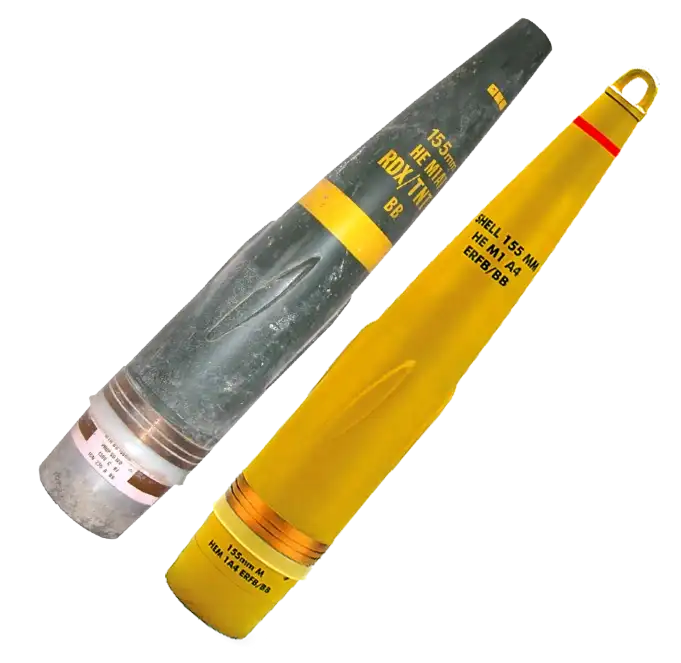
Description
The HE M1A1 ERFB BB (Base Bleed) is a high-explosive fragmentation artillery shell of 155-mm caliber, designed to extend firing range by reducing aerodynamic drag. The ERFB (Extended Range Full Bore) shells are intended for long-range firing, and the BB (Base Bleed) technology further increases range by using a gas generator at the rear of the shell.
Key Features:
- Base Bleed Unit: The base bleed reduces air resistance at the rear of the shell during flight, extending its maximum range.
- Caliber: 155 mm
- Body Material: Forged steel
- Maximum Range: Increased compared to the BT version, capable of reaching farther distances with guns of 39, 45, and 52 calibers.
- Purpose: Designed for targeting enemy personnel, lightly armored vehicles, and conducting counter-battery fire.
The HE M1A1 ERFB BB is similar in design to the HE M1A1 ERFB BT but differs significantly in its ballistic characteristics due to the base bleed unit, providing superior range capabilities. It is used with modular propellant charges such as M92, M232, and DM72, offering flexibility in achieving desired range and accuracy.
Yellow painting of the high-explosive fragmentation shell is not used in NATO countries; instead, dark green paint is applied for camouflage purposes.
The shell is described in Kropyva with the M92 propellant charge.
Technical characteristics
- Year of production: since 2022
- Manufacturer: Indian Ordnance Factories (India)
- Total weight: from 45.27 kg to 47.77 kg (without fuze)
- Total length: 861 mm (without fuze)
- Body: forged steel
- Maximum range: 36.2 km (39 caliber, 6th M92 charge)
- Number of fragments: ±10,700
- Safe operating temperature range: from -20 °C to +60 °C
Specifics of use
Projectile HE M1 ERFB BB (Base Bleed) shell is described in Kropyva with the M92 propellant charge. This propellant charge is similar in characteristics to M232, M232A1, TC-F, TCME 100, DM72.
Important! A similar shell, HE M1 ERFB BT (Boat Tail), lacks a base bleed unit, and its ballistic characteristics differ from those of the HE M1 ERFB BB (Base Bleed).
Projectile M9603A1 (Boat Tail)
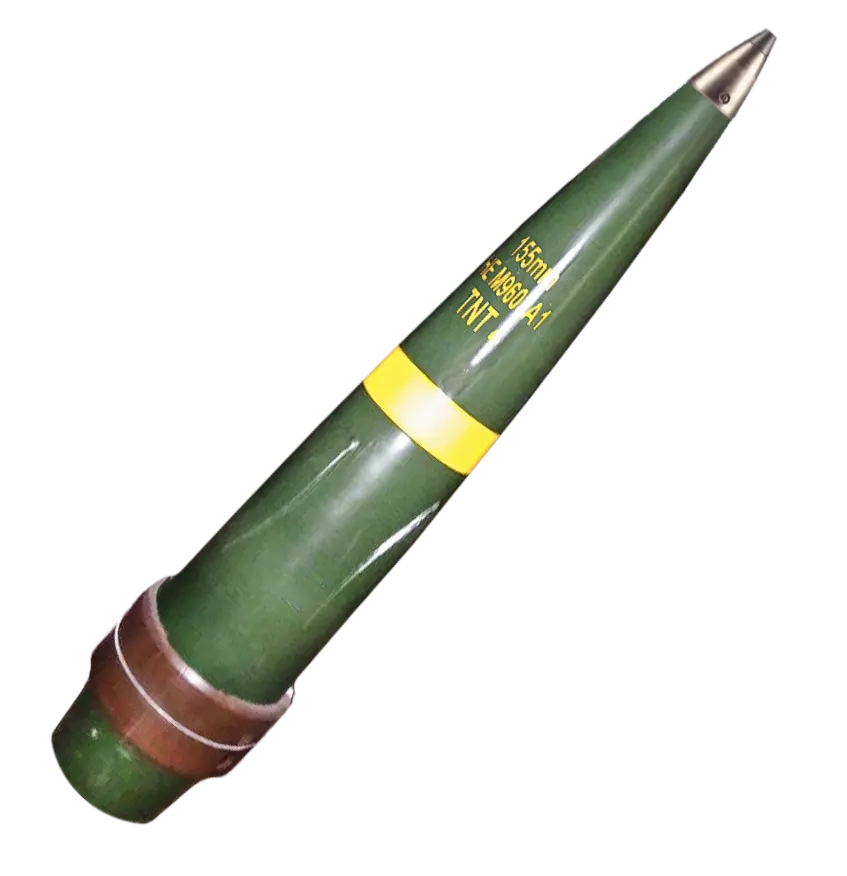
Description
M9603A1 BT (Boat Tail) projectile is an effective high-explosive fragmentation artillery shell with a caliber of 155 mm, designed to increase firing range and ensure high effectiveness in target engagement. It belongs to the ERFB (Extended Range Full Bore) class, which means it has an increased range due to its optimized aerodynamic body shape.
The BT version, with its tapered rear (Boat Tail – literally “boat tail”), features a conical tail segment that reduces air resistance, improving range and stability during flight.
Technical characteristics
- Manufacturer: Pakistan (Pakistan Ordnance Factories)
- Overall weight: from 42.84 kg to 45.34 kg – without the fuze
- Overall length: 843 mm – without the fuze
- Body: forged steel
- Maximum range: 28.6 km (39 caliber, 6 charge M92)
- Number of fragments: ±10,700
- Safe operating temperature range: °C from -20 to +60°
Specifics of use
Complete analog of the HE M1A1 ERFB BT projectile
The HE M1 ERFB BB (BASE BLEED) projectile is described in Kropyvnytskyi with the M92 propellant charge. This propellant charge is similar in characteristics to the M232, M232A1, TC-F, TCME 100, DM72
Warning.
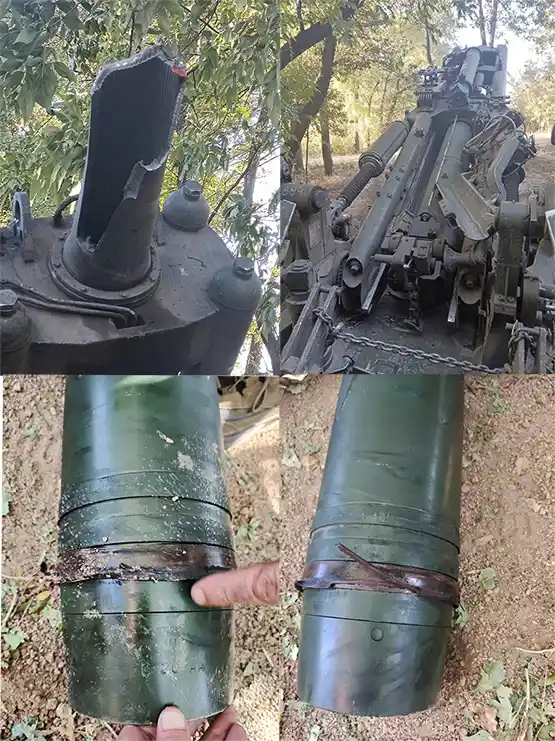
There are cases where, due to a damaged obturator ring, the projectile was fed with excessive force, resulting in the complete destruction of the barrel. In this case, the M203 propellant charge was used.
Projectile OE 155 56/69
Description
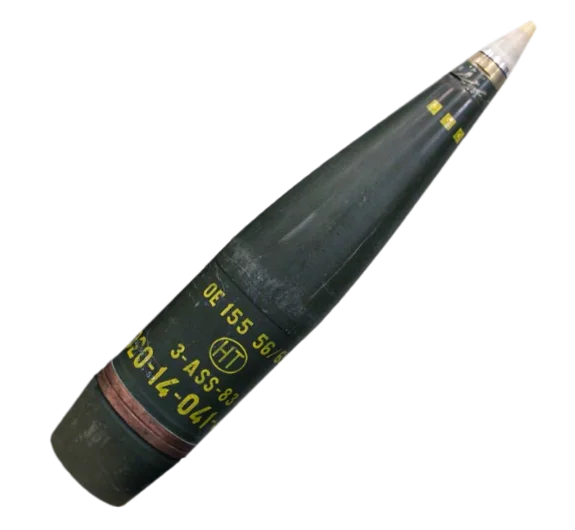
155 mm OE 155 56/69 is a high-explosive fragmentation shell produced by the French manufacturer Nexter Systems. This type of shell features a forged steel body with a flat boat-tail base and a long streamlined shank that ensures stability during flight.
The shell is painted in a gray-olive color with yellow markings, where the yellow indicates the hexogen-tolite filler, also known as hexolite or RDX/TNT mixture. This explosive composition provides a powerful blast effect upon impact.
The shell body is surrounded by a copper driving band that imparts spin to the shell and stabilizes it during flight. The band is usually covered with a sleeve until loading into the gun. The nose cavity of the shell has a thread that allows various types of fuzes to be installed, depending on the combat task, and is initially closed with a lifting plug for safe storage and transportation.
Technical characteristics
Specifics of use
The main 155-mm howitzers in NATO are the M114, FH70, and M109 series. France is an exception. All NATO howitzers, including the French ones, use American M107 HE-type ammunition. French OE 155 56/69 (HE) ammunition can be used in American howitzers, but specific firing tables are required for this.
Used with fuzes: M557, M564, M500, M51A4, M51A5, M520, M520A1, PD M51 A5, FU RALEC (F1, F2, and F3).
Weight adjustment table for the shell:
- ██ ██: 42.75 kg
- ██ ██ ██: 43.25 kg
- ██ ██ ██ ██: 43.75 kg
- ██ ██ ██ ██ ██: 44.25 kg
- ██ ██ ██ ██ ██ ██: 44.75 kg
It is usually paired with its own propellant charge CN 155 AU F1. This charge is present in Kropyva for the TR F gun, but for the OE 155 56/69 (HE) shell, data is only available with this CN 155 AU F1 charge. It can be conditionally compared to the M232A1 charge as follows:
- CN 155 AU F1 charge 5 (19 km) – M232A1 charge 4 (18.5 km)
- CN 155 AU F1 charge 4 (15.4 km) – M232A1 charge 3 (15.1 km)
However, the flight of the French OE 155 56/69 (HE) shell does not correlate with other NATO ammunition, and trends in flight cannot be determined from Kropyva. Personal experience is needed.
Projectile DM121, DM131, M1711
Description
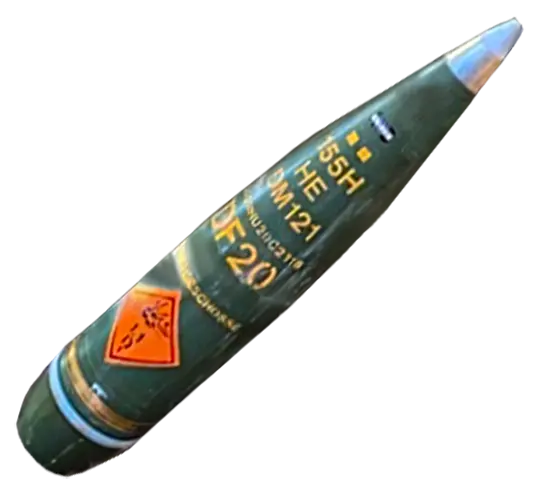
DM121 (also known as Rh30) is a 155 mm high-explosive fragmentation artillery shell manufactured by Rheinmetall Waffe Munition. It was adopted by the Bundeswehr in 2017. Developed for the PzH 2000 self-propelled howitzer, it can also be used by any NATO-standard 155 mm howitzer. Shells manufactured in Germany for the Netherlands are marked as M1712, while those produced by Rheinmetall Denel Munition in South Africa are designated as M0121A1 Assegai. The DM121 variant with a base bleed was previously designated DM131 (Rh40) but was later marked as M1711, or, if produced by Rheinmetall Denel Munition in South Africa, as M0121A2 Assegai.
Design Features:
Body: Made from special high-strength steel, providing resistance to high pressures and temperatures during firing.
Base Shape: Tapered (boat tail) to reduce aerodynamic drag and extend range.
Driving Band: Made of bronze, ensuring reliable obturation and stability in the gun barrel.
Obturator: Made of plastic and located behind the driving band to further seal the projectile during firing.
Shell Variants:
DM121 (Rh30): The standard version with a boat tail base.
M1711 (formerly known as DM131 or Rh40): A version with a base bleed allowing ranges over 40 km when fired from a 52-caliber howitzer.
Explosive:
The shell is filled with low-sensitivity explosive PBX Rh26, which meets NATO STANAG 4439 standards. This increases safety during transportation, storage, and use.
Production and Supply:
In 2009, the Bundeswehr signed a contract with Rheinmetall to supply 30,000 DM121 shells. In 2019, an additional 32,000 shells of this type were ordered. Production is carried out at the factory in Unterlüß, Lower Saxony.
Cost:
As of 2019, the cost of a single DM121 shell was approximately €3,400.
In Service:
Germany: The Bundeswehr actively uses DM121 shells in its artillery units.
Netherlands: Shells manufactured by Rheinmetall Denel Munition are supplied under the designation M1712.
Ukraine: In 2022, Ukraine received DM121 shells for use with PzH 2000 self-propelled howitzers.
The DM121 shell is a modern and effective munition for 155 mm artillery systems, combining long-range firing capability, powerful explosive effects, and enhanced safety due to the low-sensitivity explosive. Its compatibility with various NATO artillery systems makes it a versatile solution for modern armed forces.
Technical characteristics
Key Specifications:
- Caliber: 155 mm
- Shell Length: 841 mm
- Shell Weight: 43.5 kg
- Explosive Weight: 11 kg
- Explosive Type: PBX Rh26 (plastic explosive based on RDX)
Firing Range:
Up to 29.2 km when fired from a 39-caliber howitzer
Up to 36 km when fired from a 52-caliber howitzer
Specifics of use
The DM121 shell is described in Kropyva with the M777 and PzH 2000 systems using propellant charges DM72, DM82, and M119A2.
Shell Variant: M1711 (formerly known as DM131 or Rh40): A version with a base bleed that enables a range of over 40 km when fired from a 52-caliber howitzer.
Kropyva: The DM121 projectile is described for M777 systems. Its counterparts, DM131 and M1711, are designed for PzH2000 systems.
Syrota Oleh (Georhiych©) for the Armed Forces of Ukraine / Entropia.com.ua
Share your experience with 155-mm ammunition.
Comments and suggestions can be sent to: entropiaw@gmail.com
f Facebook
KHMS 88

