
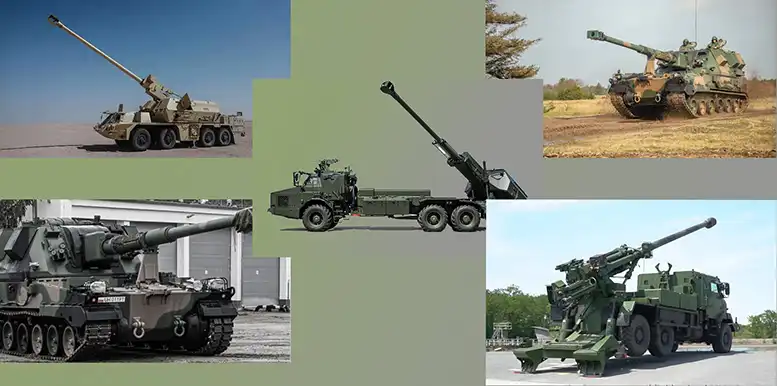
List of 155 mm guns with a 52 caliber barrel length
List of 52 caliber guns
Panzerhaubitze 2000 (PzH 2000) – Germany
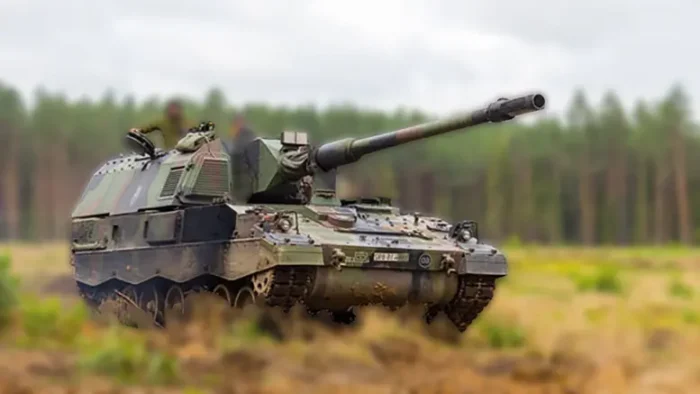
Panzerhaubitze 2000 (PzH 2000) is a self-propelled tracked howitzer with a caliber of 155 mm, developed and manufactured in Germany. It is considered one of the most modern and effective artillery systems in the world, thanks to its high rate of fire, accuracy, and firing range.
Development History:
The development of the PzH 2000 began in the 1980s as a replacement for outdated artillery systems in the Bundeswehr. The companies Krauss-Maffei Wegmann and Rheinmetall became the main contractors for the project. The first prototypes appeared in 1993, and in 1998, the system was officially adopted by the German army.
Technical Specifications:
- Caliber: 155 mm
- Barrel Length: 52 calibers (about 8 m)
- Combat Vehicle Weight: approximately 55.8 tons
- Crew: 5 personnel (commander, gunner, loader, driver, radio operator)
- Engine: MTU 881 Ka-500 diesel engine with 1000 hp
- Maximum Speed: up to 60 km/h on road
- Range: about 420 km
- Armament and Ammunition: Main armament: 155 mm howitzer with an automated loading system.
Rate of Fire:
- Close tempo: up to 3 rounds in 9 seconds.
- Rapid fire: 10 rounds in 56 seconds.
- Sustained fire: 8 rounds per minute (until ammunition is exhausted or barrel overheats).
Firing Range:
- Standard Ammunition: up to 30 km.
- Enhanced-Range Projectiles (ERFB): up to 40 km.
- Rocket-Assisted Projectiles: up to 56 km.
Design Features:
- Automated Fire Control System: allows quick target acquisition, ballistic calculations, and aiming.
- Ability to conduct "salvo fire": PzH 2000 can launch multiple projectiles at different angles to hit the target simultaneously.
- Protection: armor provides protection against small arms fire and shrapnel from artillery shells.
- Mobility: high cross-country capability due to tracked chassis and powerful engine.
Operational Use:
Operator Countries:
- Germany: primary user, with an initial order of 185 units.
- Netherlands: purchased 57 units.
- Italy: ordered 70 units, with partial localization of production.
- Greece: procured 24 units.
- Croatia: received 16 units from German stocks.
- Lithuania: purchased 21 units from Germany.
- Ukraine: received a certain number of PzH 2000 from Germany and the Netherlands for use in armed conflict.
Combat Use:
- Afghanistan: Dutch and German contingents used PzH 2000 to support NATO forces during ISAF operations.
- Ukraine: since 2022, PzH 2000 has been actively used by the Armed Forces of Ukraine to repel aggression and conduct counteroffensive actions.
Advantages and Disadvantages:
Advantages:
- High rate of fire and accuracy: provides effective fire support.
- Firing range: allows engaging targets at long distances.
- Automation of processes: reduces crew workload and increases reaction speed.
- Modularity: potential for upgrades and integration of new technologies.
Disadvantages:
- High cost: both for acquisition and operation, which can be a limiting factor for some countries.
- Maintenance complexity: requires highly qualified personnel and specialized equipment.
- Weight and size: limit air transport capabilities and require robust infrastructure.
Modernizations and Prospects:
Germany and other operator countries continue to work on modernizing the PzH 2000:
- Improving the fire control system: integrating new technologies for faster and more precise targeting.
- Using new types of ammunition: developing shells with greater range and accuracy, including guided projectiles.
- Enhancing protection: installing additional armor elements and active protection systems.
Conclusion:
The Panzerhaubitze 2000 remains one of the most powerful and modern artillery systems in the world. Its high effectiveness, technological sophistication, and combat capabilities make it a vital element of fire support on the modern battlefield. Despite its high cost and operational complexity, the PzH 2000 demonstrates outstanding results and continues to play a key role in the armed forces of operator countries.
Operator Countries of PzH 2000:
- Germany: 185 units, primary manufacturer and operator.
- Netherlands: 57 units, actively used in Afghanistan.
- Italy: 70 units, partial local production.
- Greece: 24 units, used in the Greek army.
- Croatia: 16 units, procured from German stocks.
- Lithuania: 21 units, received from Germany.
- Ukraine: number undisclosed, received from Germany and the Netherlands.
Additional Facts:
- Range record: during trials, the PzH 2000 achieved a firing range of over 67 km using special V-LAP projectiles.
- Barrel cooling system: allows maintaining high rates of fire without overheating.
- NATO compatibility: full integration with NATO-standard command and ammunition systems.
K9 Thunder – South Korea
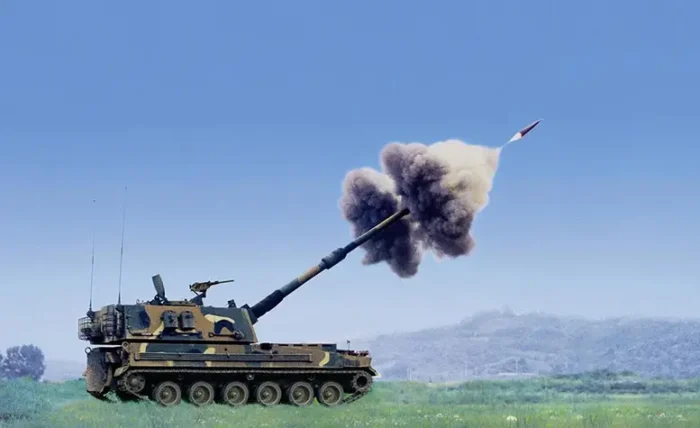
K9 Thunder is a self-propelled tracked howitzer with a caliber of 155 mm, developed by the South Korean company Hanwha Defense (formerly Samsung Techwin). It is one of the most modern and widely used artillery systems in the world, thanks to its combination of high mobility, firepower, and technological innovations.
Development History
In the 1980s and 1990s, South Korea sought a replacement for the outdated M109A2 artillery systems used in its army. In response to this need, Samsung Aerospace Industries, which later became part of Hanwha Group, began developing a new self-propelled howitzer. The first prototypes were created in 1996, and mass production began in 1999.
Technical Specifications
- Caliber: 155 mm
- Barrel Length: 52 calibers (approximately 8 m)
- Combat Vehicle Weight: approximately 47 tons
- Crew: 5 personnel (commander, gunner, two loaders, driver)
- Engine: MTU MT 881 Ka-500 diesel engine with 1000 hp
- Maximum Speed: up to 67 km/h on road
- Range: about 480 km
Armament and Ammunition
- Main Armament: 155 mm howitzer with a semi-automatic loading system.
- Rate of Fire:
- Close Tempo: 3 rounds in 15 seconds (salvo fire mode).
- Sustained Fire: 6-8 rounds per minute for 3 minutes.
- Firing Range:
- Standard Ammunition: up to 30 km.
- Extended-Range Ammunition (ERFB): up to 40 km.
- Rocket-Assisted Projectiles: up to 50-60 km.
Design Features
- Fire Control System: equipped with modern electronics for navigation, ballistic calculations, and communication.
- Armored Hull: provides protection against small arms fire and shrapnel from artillery shells.
- Automation: semi-automatic loading system reduces physical strain on the crew and increases firing speed.
- Mobility: high-performance engine and tracked chassis provide excellent cross-country capability in various terrains.
- MRSI (Multiple Round Simultaneous Impact) System: ability to fire multiple rounds at different angles to strike the target simultaneously.
Operational Use
Operator Countries
- South Korea: primary operator with over 1000 units in service.
- Turkey: localized version T-155 Fırtına, manufactured under license with some modifications.
- Poland: version AHS Krab, combining K9 chassis and AS90M turret, local production.
- Finland: acquired 48 used K9 units from South Korea.
- Estonia: purchased 12 K9 units.
- Norway: acquired 24 units.
- India: localized version K9 Vajra-T, produced in collaboration with Larsen & Toubro.
- Egypt, Australia, and other countries are also showing interest or have contracts for K9 procurement.
Combat Use
- Korean Peninsula: K9s were used during the Yeonpyeong Island incident in 2010 when North Korea shelled the island, and South Korean K9s responded with fire.
- India: K9 Vajra-T is actively used in high-altitude and rugged terrain.
Advantages and Disadvantages
Advantages
- High Mobility: due to a powerful engine and modern chassis.
- Rate of Fire and Firing Range: meet modern NATO standards.
- Modularity and Production Localization Capability: allows adaptation of the system to customer needs.
- Cost: more competitive compared to Western counterparts, making it attractive for export.
Disadvantages
- Dependence on Electronics: complex electronic systems can be vulnerable to electromagnetic interference or cyber threats.
- Weight: although lighter than some counterparts, it still requires robust infrastructure for transport.
Modernizations and Prospects
South Korea and other operator countries are actively working on modernizing the K9:
- K9A1: upgraded version with enhanced fire control, navigation, and automation systems.
- K9A2: future version with a fully automated loading system, reducing crew size to 3 personnel and increasing rate of fire to 9-10 rounds per minute.
- Integration with UAVs and drones: for improved reconnaissance and target acquisition.
- Development of new ammunition: including guided projectiles and rounds with extended range.
Conclusion
K9 Thunder is a significant player in the modern artillery systems market. Its success can be attributed to its high technical specifications, relatively low cost, and flexibility in adapting to the needs of various countries. With active modernization and the introduction of new technologies, the K9 remains competitive and in demand in the global arms market.
K9 Thunder Operator Countries
- South Korea: K9 Thunder, 1000+ units, primary manufacturer and operator.
- Turkey: T-155 Fırtına, approximately 350 units, licensed production with local modifications.
- Poland: AHS Krab, approximately 120 units, K9 chassis with AS90M turret, local production.
- Finland: K9FIN Moukari, 48 units, acquisition of used units.
- Estonia: K9EST Kõu, 12 units, acquisition of used units.
- Norway: K9 VIDAR, 24 units, new units with local modifications.
- India: K9 Vajra-T, over 100 units, licensed production, adapted for high-altitude use.
- Australia: AS9 Huntsman, 30 units (planned), contract signed, local production.
- Egypt: 200+ units (planned), contract for supply and localization of production.
Additional Facts
- K10 Ammunition Support Module: designed for the K9, it is an armored vehicle for automatic replenishment of ammunition in field conditions.
- High Reliability: the K9 has proven to be a reliable system in various climatic conditions, from deserts to high altitudes.
- NATO Compatibility: complies with NATO standards, facilitating integration into the armed forces of member countries.
CAESAR – France
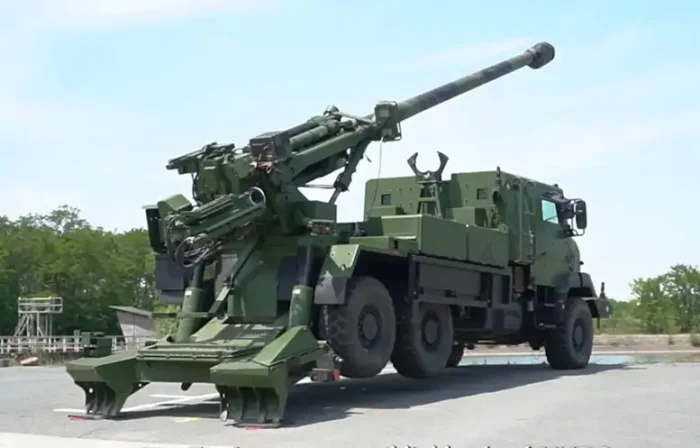
CAESAR (CAmion Équipé d'un Système d'ARtillerie) is a 155 mm self-propelled wheeled artillery system developed by the French company Nexter Systems. With its combination of high mobility, accuracy, and effective firepower, CAESAR has become one of the most popular artillery systems in the world.
Development History
In the 1990s, France sought to replace outdated artillery systems and aimed to develop a lightweight and mobile system that could quickly respond to modern threats. GIAT Industries (now Nexter Systems) began the development of CAESAR in 1994. The first prototypes were unveiled in 1994, and mass production began in 2000.
Technical Specifications
- Caliber: 155 mm
- Barrel Length: 52 calibers (approximately 8 m)
- Combat Vehicle Weight: approximately 18–30 tons (depending on chassis)
- Crew: 4–5 personnel
- Chassis: 6×6 or 8×8 truck (depending on modification)
- Maximum Speed: up to 100 km/h on road
- Range: about 600 km
Armament and Ammunition
- Main Armament: 155 mm howitzer with a semi-automatic loading system.
- Rate of Fire:
- Maximum: 6 rounds per minute.
- Firing Range:
- Standard Ammunition: up to 30 km.
- Extended-Range Ammunition (ERFB): up to 40 km.
- Rocket-Assisted Projectiles: up to 50–55 km.
- Onboard Ammunition: 18 rounds.
Design Features
- High Mobility: thanks to the wheeled chassis, CAESAR can quickly maneuver on roads and off-road.
- Rapid Deployment: transition time from march to combat position is less than 1 minute.
- Fire Control System: equipped with modern electronic systems for navigation, ballistic calculations, and communication.
- Automation: semi-automatic loading system increases firing speed and reduces physical strain on the crew.
- Light Weight: allows for air transport using military transport aircraft.
Operational Use
Operator Countries
- France: primary operator with over 80 units in service.
- Saudi Arabia: acquired 136 units.
- Indonesia: purchased 55 units.
- Thailand: has 6 units.
- Denmark: ordered 19 units on an 8×8 chassis.
- Czech Republic: ordered 52 units on Tatra 8×8 chassis.
- Ukraine: received a certain number of CAESAR units for use in armed conflict.
Combat Use
- Afghanistan: French troops used CAESAR to support NATO forces in operations against the Taliban.
- Mali: employed by the French army in operations against terrorist groups.
- Yemen: Saudi Arabia used CAESAR in the conflict in Yemen.
- Ukraine: since 2022, CAESAR has been actively used by the Armed Forces of Ukraine to repel aggression and conduct counteroffensive operations.
Advantages and Disadvantages
Advantages
- High Mobility: wheeled chassis provides quick movement and deployment.
- Cost-Effectiveness: lower production and operational costs compared to tracked counterparts.
- Flexibility: ability to mount on different chassis and adapt to customer needs.
- Light Weight: allows for air transportation and operation in areas with limited infrastructure.
Disadvantages
- Lower Protection: wheeled chassis provides less armor compared to tracked systems.
- Mobility: may be limited in difficult off-road conditions.
- Onboard Ammunition: limited ammunition supply (18 rounds), requiring regular resupply.
Modernizations and Prospects
- CAESAR 8×8: upgraded version on an 8×8 chassis with enhanced mobility, larger ammunition capacity (30 rounds), and improved protection.
- Improvement of Fire Control System: integration of new technologies for faster and more accurate targeting.
- Automation: development of a fully automated loading system to increase the rate of fire.
- Integration with Unmanned Systems: for improved reconnaissance and target acquisition.
Conclusion
CAESAR is one of the most successful examples of wheeled self-propelled artillery systems. Its high mobility, effectiveness, and flexibility make it attractive for many countries. Despite some limitations, CAESAR continues to improve and remains an important element of modern armed forces.
CAESAR Operator Countries
- France: 80+ units, primary manufacturer and operator.
- Saudi Arabia: 136 units, used in the conflict in Yemen.
- Indonesia: 55 units, used for artillery modernization.
- Thailand: 6 units, in service with the royal army.
- Denmark: 19 units (ordered), modification on an 8×8 chassis with improved protection.
- Czech Republic: 52 units (ordered), modification on Tatra 8×8 chassis.
- Ukraine: number undisclosed, received for use in armed conflict.
Additional Facts
- Deployment and Retraction Speed: less than 1 minute, allowing for quick avoidance of counter-battery fire.
- Ability to Conduct "Salvo Fire": firing multiple rounds at different angles to simultaneously strike a target.
- Compatibility with NATO Ammunition: uses standard 155 mm shells.
AHS Krab – Poland
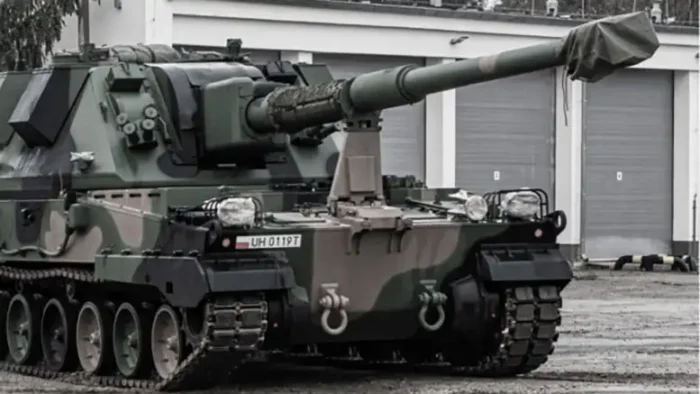
AHS Krab is a Polish self-propelled tracked howitzer with a caliber of 155 mm, designed to meet NATO standards. It combines modern artillery technology with high mobility and firepower. Krab has become a key element in the modernization of the artillery units of the Polish Armed Forces and has attracted attention from other countries due to its specifications.
Development History
The development of AHS Krab began in the 1990s as part of the modernization program for the Polish army. The goal was to create a self-propelled howitzer that would meet NATO standards and could replace outdated Soviet systems. The project was carried out by Huta Stalowa Wola (HSW) in collaboration with international partners.
Development Stages
- First Prototype (2001): Used a Polish-designed chassis and the turret from the British howitzer AS90M Braveheart with a 155 mm/52 caliber gun.
- Testing and Improvement (2001–2011): The first prototypes faced technical issues, particularly regarding the reliability of the chassis.
- Use of K9 Chassis (2014): It was decided to use the proven tracked chassis from the South Korean K9 Thunder to enhance reliability and reduce risks.
- Mass Production (since 2015): After successful tests of the upgraded version with the new chassis, mass production began for the Polish army.
Technical Specifications
- Caliber: 155 mm
- Barrel Length: 52 calibers (approximately 8 m)
- Combat Vehicle Weight: approximately 48 tons
- Crew: 5 personnel (commander, gunner, loader, driver, radio operator)
- Engine: MTU MT 881 Ka-500 diesel engine with 1000 hp
- Maximum Speed: up to 60 km/h on road
- Range: about 400 km
Armament and Ammunition
- Main Armament: 155 mm howitzer with an automated loading system.
- Rate of Fire:
- Maximum: 6 rounds per minute.
- Firing Range:
- Standard Ammunition: up to 30 km.
- Extended-Range Ammunition (ERFB): up to 40 km.
- Rocket-Assisted Projectiles: up to 50 km.
- Onboard Ammunition: 40 rounds.
Design Features
- Turret: based on the British AS90M Braveheart, adapted to Polish requirements.
- Chassis: tracked chassis from the South Korean K9 Thunder, providing high mobility and reliability.
- Fire Control System: equipped with the modern Polish system "Topaz," integrating navigation, ballistic calculations, and communication.
- Armoring: protection against small arms fire and shrapnel from artillery shells.
- Salvo Fire Capability: the ability to fire multiple rounds at different angles to simultaneously hit a target.
Operational Use
Operator Countries
- Poland:
- Plans to have over 120 units of AHS Krab in service.
- The first units were delivered to the army in 2012, with subsequent mass production.
- Ukraine:
- In 2022, Poland transferred a certain number of AHS Krab to the Armed Forces of Ukraine for use in the armed conflict.
Combat Use
- Ukraine (since 2022):
- AHS Krab is actively used for fire support for Ukrainian forces, demonstrating high effectiveness and reliability.
- Noted for its accuracy and firing range, allowing it to strike targets at great distances.
Advantages and Disadvantages
Advantages
- Modern Technology: a combination of proven solutions with the latest developments.
- High Mobility: thanks to a powerful engine and tracked chassis.
- Automation: modern fire control system and automated loading system.
- NATO Compatibility: full integration with NATO-standard command and ammunition systems.
Disadvantages
- High Cost: complexity of construction and the use of imported components affect the price.
- Dependence on Suppliers: the use of foreign components can create risks in the supply chain.
- Limited Export: so far, AHS Krab does not have a wide range of foreign customers.
Modernizations and Prospects
- Localization of Production: Poland is working to increase the share of local components in manufacturing.
- Upgrading the Fire Control System: continuous improvement of software and integration of new technologies.
- Development of New Ammunition: including guided shells to enhance accuracy and firing range.
- Potential Export Contracts: actively promoting AHS Krab in the international arms market.
Conclusion
AHS Krab is a significant achievement of the Polish defense industry. It combines modern technologies and meets the demands of the contemporary battlefield. Its use in Ukraine has confirmed its combat effectiveness and reliability. Further development and modernization of AHS Krab may make it competitive in the global market for self-propelled artillery systems.
AHS Krab Operator Countries
- Poland: 120+ units (planned), primary manufacturer and operator.
- Ukraine: number undisclosed, received from Poland for use in the conflict.
Additional Facts
- "Topaz" Fire Control System: allows real-time information sharing and integrates with other battlefield systems.
- Modular Design: simplifies maintenance and upgrades.
- NATO Compliance: ensures compatibility with allied forces and ammunition.
Archer Artillery System – Sweden
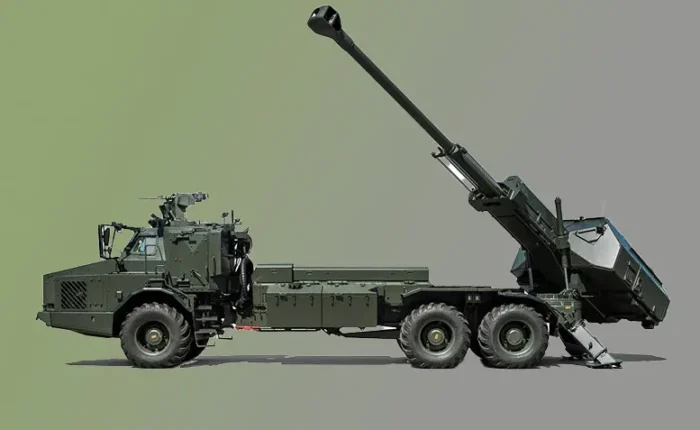
Archer Artillery System, also known as FH77 BW L52 Archer, is a 155 mm self-propelled wheeled artillery system developed by the Swedish company BAE Systems Bofors. Archer is characterized by a high level of automation, mobility, and the ability to quickly respond to modern threats. It is designed to provide rapid and effective fire support on the battlefield.
Development History
The development of Archer began in 1995 as an upgrade to the towed howitzer FH77 B. The goal was to create a self-propelled artillery system with high mobility and automation that would meet the requirements of the modern battlefield.
Key Development Stages
- 1995: start of the FH77 B modernization project to a self-propelled system.
- 2003: signing of an agreement between Sweden and Norway for the joint development of Archer.
- 2009: manufacturing of the first prototypes and commencement of testing.
- 2013: start of mass production for the Swedish Armed Forces.
- 2013: Norway withdraws from the project, citing changes in defense priorities.
- 2016: Sweden continues to develop the system independently and seeks potential export customers.
Technical Specifications
- Caliber: 155 mm
- Barrel Length: 52 calibers (approximately 8 m)
- Combat Vehicle Weight: approximately 33 tons
- Crew: 3–4 personnel (commander, driver, two operators)
- Chassis: Volvo A30D 6×6 (or A30E)
- Maximum Speed: up to 70 km/h on road
- Range: about 500 km
Armament and Ammunition
- Main Armament: 155 mm howitzer with a fully automated loading system.
- Rate of Fire:
- Maximum: 8–9 rounds per minute.
- Salvo Fire Mode: the ability to fire 3 rounds in 15 seconds.
- Firing Range:
- Standard Ammunition: up to 30 km.
- Extended-Range Ammunition (ERFB): up to 40 km.
- Rocket-Assisted Projectiles: up to 50–60 km.
- Onboard Ammunition: 21 rounds in an automated magazine.
Design Features
- High Automation: the loading, aiming, and firing systems are fully automated, reducing crew size and increasing safety.
- Rapid Deployment: transition time from march to combat position is less than 30 seconds.
- Crew Protection: armored cabin provides protection against small arms fire and shrapnel.
- Mobility: wheeled chassis provides high speed on roads and good off-road capability.
- MRSI (Multiple Rounds Simultaneous Impact) System: the ability to fire multiple rounds at different angles to hit a target simultaneously.
- Additional Armament: 12.7 mm machine gun for self-defense and remote-controlled module.
Operational Use
Operator Countries
- Sweden:
- Ordered 48 units for the Swedish Armed Forces.
- United Kingdom:
- Announced intentions in 2023 to procure Archer as a temporary replacement for AS90.
- Ukraine:
- In 2023, the UK announced the transfer of some Archers to Ukraine for use in the armed conflict.
Combat Use
- As of October 2023, Archer has not participated in active combat, but its deployment in Ukraine may change this situation.
Advantages and Disadvantages
Advantages
- High Automation: reduces crew size and increases reaction speed.
- Rapid Deployment and Retraction: allows for avoidance of counter-battery fire.
- Range and Accuracy: meets modern artillery requirements.
- Crew Protection: armored cabin and remote operation capabilities.
- Mobility: high speed on roads and good off-road capability.
Disadvantages
- Cost: a high level of automation affects the system's price.
- Maintenance Complexity: requires highly qualified personnel.
- Limited Number in Service: currently a small number of produced units.
Modernizations and Prospects
- Expansion of Exports: actively promoting Archer in the international market.
- Upgrading the Fire Control System: integrating new technologies and software.
- Adaptation to Other Chassis: the possibility of installing the system on various platforms at the customer's request.
- Development of New Ammunition: including guided shells to enhance accuracy.
Conclusion
Archer Artillery System represents a modern artillery system that combines a high level of automation, mobility, and firepower. It meets the demands of the contemporary battlefield and has the potential for further development. The deployment of Archer in the armed forces of other countries, including Ukraine, could confirm its effectiveness in real combat conditions.
Archer Artillery System Operator Countries
- Sweden: 48 units, primary manufacturer and operator.
- United Kingdom: 14 units (planned), temporary replacement for AS90, some may be transferred to Ukraine.
- Ukraine: number undisclosed, received from the UK for use in the conflict.
Additional Facts
- Reaction Time: Archer can open fire within 30 seconds after stopping and leave the position within 30 seconds after the last shot.
- Navigation System: equipped with inertial and satellite navigation for precise positioning.
- Ammunition Loading: the automated system allows for resupplying ammunition in a matter of minutes.
Zuzana 2 – Slovak
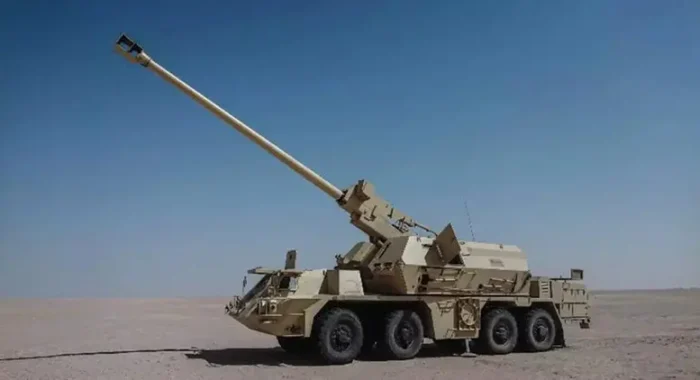
Zuzana 2 is a Slovak self-propelled tracked howitzer with a caliber of 155 mm, developed to meet NATO standards. It combines modern artillery technology with high mobility and firepower. Zuzana 2 has become a key element in the modernization of the artillery units of the Slovak Armed Forces and has attracted attention from other countries due to its characteristics.
Development History
The development of Zuzana 2 began in the 1990s as part of the modernization program for the Slovak army. The goal was to create a self-propelled howitzer that would meet NATO standards and could replace outdated Soviet systems. The project was carried out by KONŠTRUKTA-Defence in collaboration with international partners.
Key Development Stages
- 1995: start of the modernization project for the towed howitzer FH77 B to a self-propelled system.
- 2003: signing of an agreement between Slovakia and Norway for the joint development of Zuzana 2.
- 2009: manufacturing of the first prototypes and commencement of testing.
- 2013: start of mass production for the Slovak Armed Forces.
- 2013: Norway withdraws from the project, citing changes in defense priorities.
- 2016: Slovakia continues to develop the system independently and seeks potential export customers.
Technical Specifications
- Caliber: 155 mm
- Barrel Length: 52 calibers (approximately 8 m)
- Combat Vehicle Weight: approximately 48 tons
- Crew: 5 personnel (commander, gunner, loader, driver, radio operator)
- Engine: MTU MT 881 Ka-500 diesel engine with 1000 hp
- Maximum Speed: up to 60 km/h on road
- Range: about 400 km
Armament and Ammunition
- Main Armament: 155 mm howitzer with an automated loading system.
- Rate of Fire:
- Maximum: 6 rounds per minute.
- Firing Range:
- Standard Ammunition: up to 30 km.
- Extended-Range Ammunition (ERFB): up to 40 km.
- Rocket-Assisted Projectiles: up to 50 km.
- Onboard Ammunition: 40 rounds.
Design Features
- Turret: based on the British AS90M Braveheart, adapted to Slovak requirements.
- Chassis: tracked chassis from the South Korean K9 Thunder, providing high mobility and reliability.
- Fire Control System: equipped with the modern Slovak system "Topaz," integrating navigation, ballistic calculations, and communication.
- Armoring: protection against small arms fire and shrapnel from artillery shells.
- Salvo Fire Capability: the ability to fire multiple rounds at different angles to simultaneously hit a target.
Operational Use
Operator Countries
- Slovakia:
- Plans to have over 120 units of Zuzana 2 in service.
- The first units were delivered to the army in 2012, with subsequent mass production.
- Ukraine:
- In 2022, Slovakia transferred a certain number of Zuzana 2 units to the Armed Forces of Ukraine for use in the armed conflict.
Combat Use
- Ukraine (since 2022):
- Zuzana 2 is actively used for fire support for Ukrainian forces, demonstrating high effectiveness and reliability.
- Noted for its accuracy and firing range, allowing it to strike targets at great distances.
Advantages and Disadvantages
Advantages
- Modern Technology: a combination of proven solutions with the latest developments.
- High Mobility: thanks to a powerful engine and tracked chassis.
- Automation: modern fire control system and automated loading system.
- NATO Compatibility: full integration with NATO-standard command and ammunition systems.
Disadvantages
- High Cost: complexity of construction and the use of imported components affect the price.
- Dependence on Suppliers: the use of foreign components can create risks in the supply chain.
- Limited Export: so far, Zuzana 2 does not have a wide range of foreign customers.
Modernizations and Prospects
- Localization of Production: Slovakia is working to increase the share of local components in manufacturing.
- Upgrading the Fire Control System: continuous improvement of software and integration of new technologies.
- Development of New Ammunition: including guided shells to enhance accuracy and firing range.
- Potential Export Contracts: actively promoting Zuzana 2 in the international arms market.
Conclusion
Zuzana 2 is a significant achievement of the Slovak defense industry. It combines modern technologies and meets the demands of the contemporary battlefield. Its use in Ukraine has confirmed its combat effectiveness and reliability. Further development and modernization of Zuzana 2 may make it competitive in the global market for self-propelled artillery systems.
Zuzana 2 Operator Countries
- Slovakia: primary manufacturer and operator.
- Ukraine: received a certain number of units for use in the conflict.
Additional Facts
- Topaz Fire Control System: allows for real-time information exchange and integrates with other battlefield systems.
- Modular Design: simplifies maintenance and upgrades.
- NATO Compliance: ensures compatibility with allied forces and ammunition.
G6 Rhino – South Africa
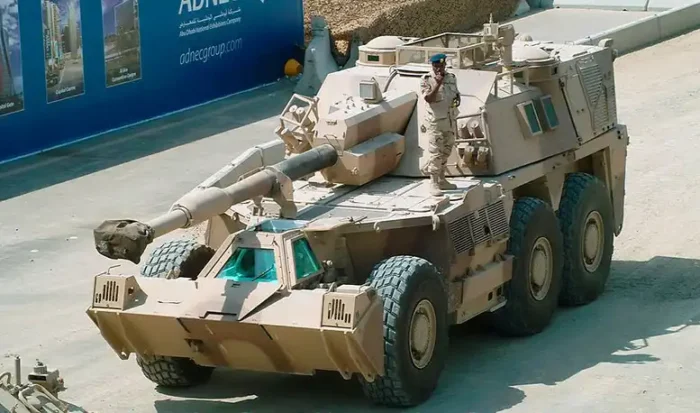
G6 Rhino is a 155 mm self-propelled wheeled artillery system developed in the Republic of South Africa by Denel Land Systems (formerly LIW). It is one of the most powerful and mobile wheeled artillery systems in the world, combining long-range fire, crew protection, and high maneuverability.
Development History
The development of G6 Rhino began in the 1970s in response to South Africa's need for mobile and long-range artillery to counter threats from neighboring countries. Based on the successful towed howitzer G5, the decision was made to create a self-propelled version.
Key Development Stages
- 1970s: initiation of design based on combat experience in South Africa.
- 1981: completion of the 155 mm howitzer G5, which served as the basis for the self-propelled unit.
- 1988: first production models of G6 Rhino delivered to the South African Defence Force.
- 1990s: system modernization, improvements, and the beginning of export sales.
Technical Specifications
- Caliber: 155 mm
- Barrel Length: 45 or 52 calibers (depending on the version)
- Combat Vehicle Weight: approximately 47 tons
- Crew: 6 personnel (commander, driver, 4 operators)
- Chassis: wheeled formula 6×6
- Maximum Speed: up to 90 km/h on road
- Range: up to 700 km
Armament and Ammunition
- Main Armament: 155 mm howitzer with a semi-automatic loading system.
- Rate of Fire:
- Maximum: 4 rounds per minute.
- Sustained: 2 rounds per minute.
- Firing Range:
- Standard Ammunition: up to 30 km.
- Extended-Range Ammunition (ERFB): up to 39 km.
- Rocket-Assisted Projectiles: up to 50–58 km (depending on the version).
- Onboard Ammunition: 45 rounds.
Design Features
- Armor: protects the crew from small arms fire and shrapnel from artillery shells, with the possibility of additional mine and explosive device protection systems.
- Mobility: wheeled chassis provides high maneuverability even in desert conditions and rough terrain.
- Autonomy: a large fuel and ammunition supply allows the system to operate for extended periods without resupply.
- Fire Control System: modern navigation, ballistic calculation, and communication systems ensure precise targeting.
- Salvo Fire Capability: G6 can conduct multiple shots at all angles to simultaneously strike a target.
Operational Use
Operator Countries
- South Africa: primary user of G6 Rhino.
- United Arab Emirates: acquired 78 units for its armed forces.
- Oman: purchased 24 units for its army.
- Algeria: acquired an undisclosed number of units for its armed forces.
Combat Use
- South African Border Wars: G6 Rhino was used during conflicts in desert areas, where mobility and range provided a significant tactical advantage.
- Middle East: the UAE and Oman have employed G6 Rhino in their regional conflicts to support their armed forces.
Advantages and Disadvantages
Advantages
- Long Firing Range: ability to strike targets at distances of up to 58 km.
- High Mobility: wheeled chassis ensures rapid movement and high maneuverability.
- Crew Protection: armored cabin and the possibility of additional protection create a reliable system in combat conditions.
- Autonomy: the system can operate for extended periods without the need for resupply.
Disadvantages
- Weight and Size: significant dimensions can complicate transportation, especially in areas with limited infrastructure.
- High Cost: modern technology and armor increase the overall price of the vehicle.
- Maintenance Complexity: the system requires highly skilled personnel for maintenance and specialized equipment.
Modernizations and Prospects
- G6-52: updated version with a longer barrel (52 calibers), significantly improving range and accuracy.
- Fire Control System Enhancements: integration of new technologies for more effective targeting and rapid data acquisition.
- Active Protection: installation of additional systems for protection against mines and explosive devices.
- Export Potential: South Africa is actively promoting G6 Rhino in the international arms market, adapting the system to customer requirements.
Conclusion
G6 Rhino is a powerful and mobile artillery system that combines long-range fire, crew protection, and autonomy. It has demonstrated its effectiveness in various combat conditions and, thanks to ongoing upgrades, remains relevant and competitive in the global arms market.
G6 Rhino Operator Countries
- South Africa: 43 units, primary operator and manufacturer.
- United Arab Emirates: 78 units, used by the UAE armed forces.
- Oman: 24 units, acquired for the Omani armed forces.
- Algeria: number undisclosed, purchased for the Algerian army.
Additional Facts
- Deployment Speed: G6 Rhino can commence firing within 1-2 minutes after stopping.
- Operational Capability in Various Climates: the system is adapted for use in both desert and rugged terrain.
- High Autonomy: capable of operating for several days without the need for resupply.
ATMOS 2000 – Israel
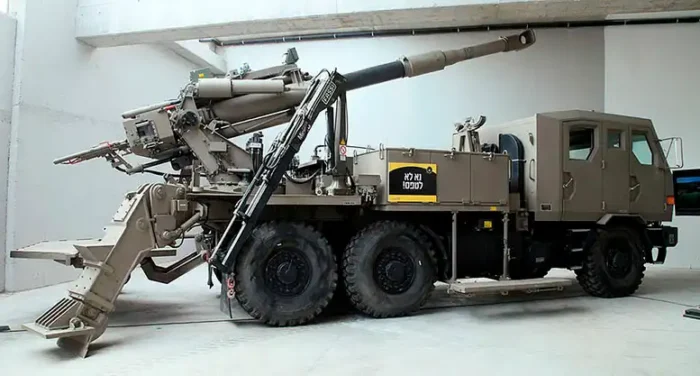
ATMOS 2000 (Autonomous Truck Mounted Howitzer System) is an Israeli self-propelled wheeled artillery system with a caliber of 155 mm, developed by Elbit Systems (formerly Soltam Systems). ATMOS 2000 is designed to provide high mobility and powerful fire support. The main idea behind this system is to utilize a wheeled platform to reduce costs and enhance mobility on the battlefield.
Development History
ATMOS 2000 was developed as an alternative to traditional tracked self-propelled howitzers, offering an economical and more mobile version for the rapid deployment of artillery units. Development began in the 1990s, when the demand for flexible artillery systems capable of operating on various platforms in a changing combat environment increased.
Key Development Stages
- 1990s: initiation of the ATMOS 2000 development as a wheeled alternative to traditional artillery systems.
- 2001: first test systems in the field.
- 2003: first deliveries of ATMOS 2000 to the Israeli Defense Forces and the start of international promotion.
Technical Specifications
- Caliber: 155 mm
- Barrel Length: 39, 45, or 52 calibers (depending on configuration)
- Combat Vehicle Weight: approximately 22–27 tons (depending on configuration)
- Crew: 4–6 personnel
- Chassis: standard wheeled truck 6×6 or 8×8
- Maximum Speed: up to 80 km/h on road
- Range: up to 1000 km (depending on chassis)
Armament and Ammunition
- Main Armament: 155 mm howitzer with a semi-automatic loading system.
- Rate of Fire:
- Maximum: up to 5 rounds per minute.
- Firing Range:
- Standard Ammunition: up to 30 km.
- Extended-Range Ammunition (ERFB): up to 40 km.
- Rocket-Assisted Projectiles: up to 50–55 km.
- Onboard Ammunition: up to 27 rounds (depending on model).
Design Features
- Modularity: ATMOS 2000 is designed as a modular system that can be mounted on various types of chassis (regardless of customer requirements), making it versatile and easily adaptable to different conditions.
- Automation: the system features a semi-automatic loading system and an automated fire control system, reducing the physical workload on the crew.
- Mobility: due to its wheeled base, ATMOS 2000 has high movement speed and maneuverability across various terrains.
- Fire Control System: ATMOS 2000 is equipped with modern fire control systems, including inertial and satellite navigation for precise targeting.
Operational Use
Operator Countries
ATMOS 2000 is successfully used in Israel and exported to many other countries. Among the operators of this system:
- Israel: main user and developer of the system.
- Philippines: received ATMOS 2000 for artillery modernization.
- Thailand: purchased several units to support its armed forces.
- Azerbaijan: actively uses ATMOS 2000 in its army.
- Uganda: also operates this system.
Combat Use
ATMOS 2000 has been employed in various regional conflicts due to its flexibility, mobility, and powerful fire support. Its high deployment speed allows for rapid repositioning and avoidance of counter-battery fire.
Advantages and Disadvantages
Advantages
- Mobility: the wheeled platform allows for quick movement on roads and rough terrain.
- High Deployment Speed: ATMOS 2000 can initiate fire within a few minutes after stopping and quickly leave the position.
- Flexibility: the ability to mount on various chassis allows for adaptation to specific customer needs.
- Low Operating Costs: maintenance on a wheeled base makes operations cheaper compared to tracked systems.
Disadvantages
- Lower Protection: compared to tracked self-propelled artillery systems, the wheeled base provides a lower level of armor and crew protection.
- Limited Ammunition Capacity: compared to tracked units, ATMOS 2000 has a smaller onboard ammunition supply.
- Reduced Off-Road Capability: while the system performs well on roads and moderately difficult terrains, it may face challenges in very rugged areas.
Modernizations and Prospects
ATMOS 2000 continues to improve according to the demands of modern combat conditions:
- ATMOS Iron Sabre: an upgraded version equipped with enhanced navigation and fire control systems, as well as the capability to use guided munitions.
- Integration of New Technologies: ATMOS 2000 is being integrated with the latest technologies, including drone systems for improved reconnaissance and target acquisition.
Conclusion
ATMOS 2000 is one of the leading solutions for mobile artillery worldwide. It features high movement speed, powerful fire capability, and flexibility in adapting to the needs of various armies. With its modular design and the use of a wheeled base, this system is economically advantageous and suitable for various types of combat missions. Ongoing modernization and the integration of new technologies ensure its relevance and competitiveness in the future.
ATMOS 2000 Operator Countries
- Israel: number undisclosed, main user and manufacturer.
- Philippines: number undisclosed, used in the armed forces.
- Thailand: number undisclosed, purchased for the national army.
- Azerbaijan: number undisclosed, used in national armed forces.
- Uganda: number undisclosed, used in the Ugandan armed forces.
Additional Facts
- Deployment Speed: ATMOS 2000 can start firing within 3 minutes after stopping and quickly leave the position, allowing it to avoid counter-battery fire.
- NATO Ammunition Compatibility: the system uses standard 155 mm shells, ensuring compatibility with international artillery systems.
- Capability to Operate in Extreme Conditions: the design allows operation across a wide range of temperatures and weather conditions, from desert to winter environments.
NORA B-52 – Serbia
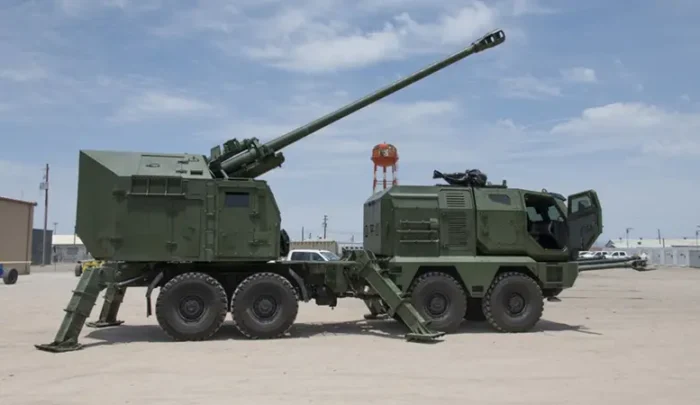
NORA B-52 is a Serbian self-propelled wheeled artillery system with a caliber of 155 mm, developed by the defense company Yugoimport SDPR. It is one of the most well-known and sought-after artillery systems in Serbia, designed for mobile battlefield support with a long range of fire. The NORA B-52 meets NATO standards and can be adapted to the requirements of various armies.
History of Development
The development of NORA B-52 began in the 1990s as part of Serbia's program to modernize artillery systems. After the breakup of Yugoslavia, there was a need for new systems capable of effectively supporting mobile forces and meeting modern requirements. The NORA B-52 platform resulted from Serbian engineers' work to improve previous models, such as the NORA M-84.
Key Development Stages
- 1990s: Initiation of the development of a self-propelled artillery system on a wheeled platform.
- 2000s: Initial testing and system refinement.
- 2006: Presentation of the NORA B-52 on the international arms market.
- 2010s: System modernization and increase in the number of export contracts.
Technical Specifications
- Caliber: 155 mm
- Barrel Length: 52 calibers (approximately 8 meters)
- Combat Weight: Approximately 28 tons
- Crew: 4-5 personnel
- Chassis: Wheeled configuration 8×8
- Maximum Speed: Up to 80 km/h on the road
- Range: Up to 1000 km (depending on the chassis)
Armament and Ammunition
- Main Armament: 155 mm howitzer with an automated loading system.
- Rate of Fire:
- Maximum: 4-6 rounds per minute.
- Firing Range:
- Standard Ammunition: Up to 32 km.
- Extended Range Ammunition (ERFB): Up to 42 km.
- Rocket-Assisted Projectiles: Up to 50 km.
- Onboard Ammunition: Up to 36 rounds.
Design Features
- Wheeled Platform: The NORA B-52 is built on an 8×8 wheeled chassis, providing high mobility and the ability to move quickly on both roads and rough terrain.
- Automation: The system has an automated loading and fire control system, reducing the physical burden on the crew and allowing for increased firing speed.
- Crew Protection: An armored cabin protects the crew from small arms fire and artillery shrapnel.
- Modular Design: The NORA B-52 can be adapted to various customer requirements and equipped with additional systems to enhance protection or navigation.
Operation and Combat Use
Operator Countries
The NORA B-52 is successfully used in Serbia and exported to many other countries. Among the operators of this system are:
- Serbia: Main user and developer of the NORA B-52 system.
- Bangladesh: Acquired NORA B-52 for the modernization of its artillery.
- Kenya: Uses NORA B-52 in its army.
- Myanmar: Actively uses the system in its armed forces.
- Kazakhstan: Also an operator of the NORA B-52.
Combat Use
The NORA B-52 has been employed in various regional conflicts, demonstrating high mobility and effectiveness on the battlefield. Its wheeled platform allows for rapid movement between positions, helping to avoid counter-battery fire.
Advantages and Disadvantages
Advantages
- High Mobility: The wheeled platform allows for quick movement on roads and rough terrain, making the system ideal for modern maneuver warfare.
- Rapid Reaction: The automated fire control and loading system enable quick engagements and repositioning.
- Crew Protection: An armored cabin provides basic protection against small arms fire and shrapnel.
- Flexibility: The modular design allows the system to adapt to various requirements and install additional systems.
Disadvantages
- Lower Level of Protection: Compared to tracked self-propelled artillery, the NORA B-52 offers less armor protection.
- Limited Ammunition: Compared to other self-propelled systems, the onboard ammunition capacity is limited to 36 rounds.
- Dependence on Road Infrastructure: While the system can operate on rough terrain, its effectiveness is maximized on roads.
Modernizations and Prospects
The NORA B-52 continues to be improved with each new version. Key areas of modernization include:
- NORA B-52K1: An upgraded version with a longer barrel (52 calibers) that significantly enhances range and accuracy.
- Integration of New Fire Control Systems: The possibility of installing new electronic control systems to improve targeting accuracy and speed.
- Additional Protection Systems: Options for active and passive protection systems to enhance crew safety.
Conclusion
The NORA B-52 is a powerful and mobile artillery system that meets the demands of modern battlefields. Its high mobility, automation, and flexibility make it appealing to many countries seeking effective artillery solutions. Continuous modernization and improvements ensure that the NORA B-52 remains a competitive system in the international arms market.
Operator Countries of NORA B-52
- Serbia: Number undisclosed, main operator and manufacturer.
- Bangladesh: Number undisclosed, acquired for artillery modernization.
- Kenya: Number undisclosed, used in its armed forces.
- Myanmar: Number undisclosed, used in the national army.
- Kazakhstan: Number undisclosed, used in the national armed forces.
Additional Facts
- Deployment Speed: The NORA B-52 can be ready to fire in 1-2 minutes after stopping, helping to avoid counter-battery fire.
- Compatibility with NATO Ammunition: The system supports the use of standard 155 mm shells.
- Capability to Operate in Extreme Conditions: Designed to function effectively in a wide range of temperatures and weather conditions, from desert to winter environments.
PLZ-05 – China
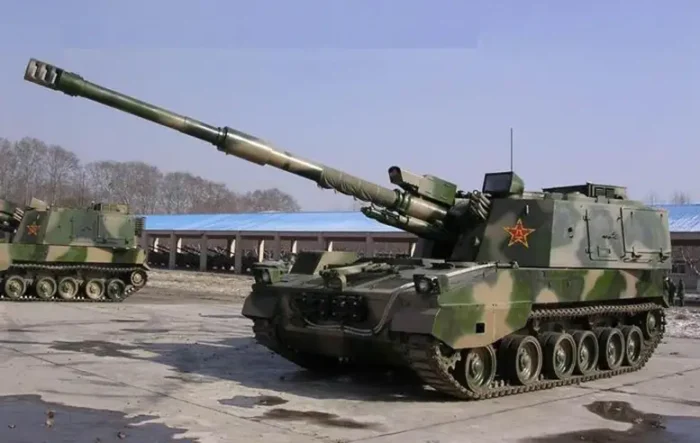
PLZ-05: Chinese Self-Propelled Artillery System
PLZ-05 (sometimes known as Type 05 or Tip 05) is a Chinese 155mm self-propelled howitzer developed for the People's Liberation Army of China (PLA). This system, first introduced in the mid-2000s, is the result of the ongoing development of Chinese military technologies in the field of artillery. The PLZ-05 has become a key component of artillery support on the modern battlefield.
Development History
PLZ-05 is a continuation of a series of Chinese self-propelled artillery systems that began development in the 1980s. Its development was based on the model PLZ-45, which was designed for export orders and used by several countries. However, the PLZ-05 was specifically created for the PLA, addressing the needs of the national army for a modern high-precision artillery system.
Main Characteristics
- Caliber and Range:
- The main armament of the PLZ-05 is a 155mm howitzer capable of using various types of ammunition, including precision-guided projectiles.
- The maximum firing range is approximately 30 km with standard shells, and up to 50 km with rocket-assisted projectiles.
- Automation and Fire Control:
- The PLZ-05 is equipped with a modern fire control system that allows for rapid target acquisition and effective firing even in challenging conditions.
- This system supports the use of precision-guided munitions, allowing for strikes with high accuracy.
- Mobility:
- The vehicle is based on a wheeled chassis, providing high mobility even in difficult terrain.
- The maximum speed of the PLZ-05 on the road is approximately 55 km/h, allowing for rapid repositioning.
- Protection:
- The armor of the PLZ-05 protects the crew from small arms fire and shrapnel from artillery shells.
- The vehicle can also be equipped with an active protection system to intercept anti-tank munitions.
- Crew:
- The system is operated by a crew of five: commander, gunner, loader, driver, and fire control system operator.
Armament
The main weapon of the PLZ-05 is a 155mm howitzer with an automatic loading system. It can fire up to 8 rounds per minute. The system is compatible with various types of ammunition, including:
- Standard high-explosive shells;
- Cluster munitions;
- Improved munitions with precision-guidance systems (e.g., laser-guided shells GP155).
Comparison with Other Artillery Systems
The PLZ-05 is often compared with Western counterparts such as the American M109A6 Paladin and the German PzH 2000. The Chinese system does not match the technical specifications of these models, demonstrating high mobility and accuracy of fire. However, some experts note that the PLZ-05 may be less reliable than established Western examples.
Strategic Importance
The PLZ-05 is an important part of the PLA's strategy for conducting highly mobile combat operations using modern artillery. It provides massed fire support for ground forces and the ability to conduct precision strikes against enemy positions and equipment.
Conclusion
The PLZ-05 is a modern Chinese self-propelled artillery system that demonstrates high technical capabilities and effectiveness. With its long firing range, accuracy, and mobility, it serves as a key tool for the Chinese army in contemporary conflicts.
Countries Operating the PLZ-05
- China: number not disclosed, primary user and manufacturer.
- Philippines: number not disclosed, used in the armed forces.
- Thailand: number not disclosed, acquired for the national army.
- Azerbaijan: number not disclosed, used in national armed forces.
- Uganda: number not disclosed, used in the armed forces of Uganda.
Additional Facts
- Deployment Speed: The PLZ-05 can be ready to fire within 3 minutes of stopping, allowing it to avoid counter-battery fire.
- NATO Ammunition Compatibility: The system supports the use of standard 155mm shells, ensuring compatibility with international artillery systems.
- Ability to Operate in Extreme Conditions: the design allows for operation in a wide range of temperatures and weather conditions, from desert to winter environments.
PCL-181 – China
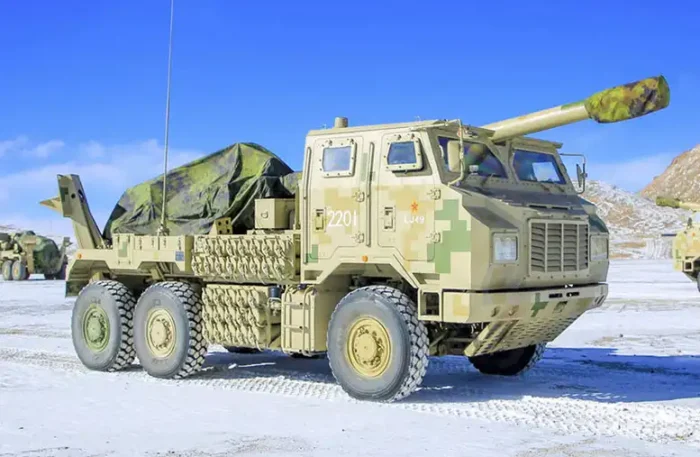
PCL-181: Chinese Wheeled Self-Propelled Artillery System
PCL-181 is a Chinese 155mm wheeled self-propelled howitzer developed for the People's Liberation Army of China (PLA). This system is an important part of the modernization of China's artillery units, providing enhanced mobility and firepower. The PCL-181 was first showcased during the 70th anniversary of the founding of the People's Republic of China in 2019 and has since become a key component of the Chinese ground forces.
History of Development
The PCL-181 was created to replace outdated artillery systems such as the towed howitzer Type 59-1 and the self-propelled artillery system PLZ-05. While the PLZ-05 remains the main self-propelled artillery complex on tracked chassis, the PCL-181 offers a different concept—it is mounted on a wheeled chassis, providing significantly greater operational mobility on roads and in challenging terrain conditions.
Main Features
- Caliber and Range:
- The primary armament of the PCL-181 is a 155mm howitzer, compatible with NATO standards.
- The maximum range of fire with standard shells is approximately 40 km, and with the use of rocket-assisted projectiles, it can reach 53 km.
- Wheeled Chassis:
- One of the main differences of the PCL-181 from traditional self-propelled howitzers is its wheeled chassis, either 6x6 or 8x8. This provides rapid movement on roads, making the system ideal for long-distance operations.
- The maximum road speed of the PCL-181 is about 90 km/h, significantly exceeding the performance of traditional tracked systems.
- Weight and Transport:
- The PCL-181 has a weight of approximately 25 tons, making it much lighter than tracked analogs such as the PLZ-05.
- The lighter weight allows for easy transport of the system by Y-20 aircraft, which is important for the rapid deployment of military forces over long distances.
- Automation and Fire Control System:
- The PCL-181 is equipped with a modern fire control system that allows for rapid targeting and high-precision firing.
- This system supports the use of precision-guided munitions, enabling accurate strikes.
- Crew:
- The system is operated by a crew of 5 personnel, including a driver, commander, gunner, and load handlers.
- Protection and Maneuverability:
- While the armor of the PCL-181 protects the crew from small arms fire and shrapnel, it is significantly lighter compared to tracked self-propelled howitzers, allowing for higher speed and maneuverability.
- The system can be deployed in hard-to-reach areas where tracked vehicles may face mobility issues.
Armament
The main armament of the PCL-181 is a 155mm howitzer with an automated loading system. It can fire up to 8 rounds per minute. The system is compatible with various types of ammunition, including:
- Standard high-explosive shells;
- Cassette munitions;
- Enhanced munitions with precision guidance systems (e.g., laser-guided GP155 shells).
Comparison with Other Systems
The PCL-181 is often compared to similar systems from other countries, such as the French Caesar and the Swedish Archer. Wheeled artillery systems are typically lighter and more mobile than tracked systems and provide effective solutions for rapid operations over long distances.
The Chinese PCL-181 distinguishes itself from these models with its combined concept of lightness, range, and reliable fire control system. It is capable of quickly deploying and changing positions, which is a critical factor on modern battlefields where artillery systems often become targets of counter-battery fire.
Strategic Importance
The PCL-181 has become an important element in China's strategy for developing mobile and flexible armed forces. Its high mobility and powerful firepower make this system ideal for deployment in regions with complex geography, such as Tibet or Xinjiang, where a rapid response to potential threats is required.
Combined with modern communication and command systems, the PCL-181 provides the Chinese ground forces with an effective means of artillery support, which is vital in high-intensity conflicts.
Conclusion
PCL-181 is a modern, lightweight, and mobile wheeled self-propelled artillery system that reflects new approaches in the development of the Chinese armed forces. It features high operational flexibility, rapid mobility, and the use of modern fire control technologies, making it an important tool on the modern battlefield.
Denel G5 – South Africa
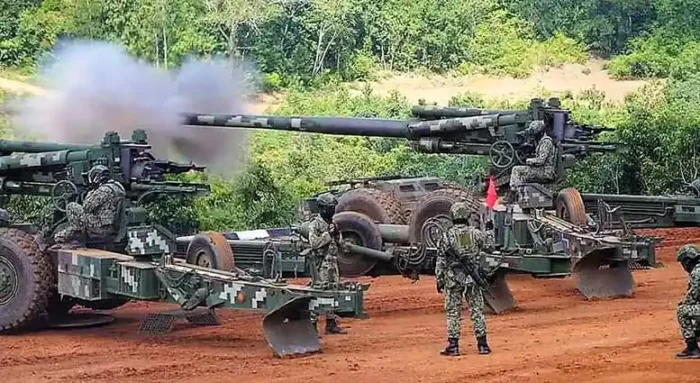
Denel G5 is a South African 155mm towed howitzer developed by Denel Land Systems (formerly LIW) for the South African National Defense Force (SANDF). This system was created to meet the need for modern long-range artillery and is used by both national and foreign armed forces. Denel G5 is considered one of the best howitzers in its class due to its high range and accuracy.
History of Development
The development of the G5 began in the 1970s in response to the SANDF's need for modern artillery with high mobility and long-range fire. The main idea was to create a system capable of destroying targets at great distances and providing effective support to ground forces. The G5 became part of a broader artillery system that also included self-propelled units (G6) and multiple rocket launcher systems.
Main Characteristics
- Caliber and Range:
- The Denel G5 is a 155mm howitzer that uses NATO-standard ammunition.
- It can fire standard shells up to 30-39 km, and with active-reactive ammunition, it can reach up to 50 km.
- When using precision-guided munitions with GPS guidance, both range and accuracy are significantly improved.
- Mobility:
- The G5 is a towed howitzer, meaning it requires a vehicle for transportation, usually a truck. However, the system is also equipped with an auxiliary engine for short movements on the battlefield, allowing the howitzer to move up to 15 km on its own.
- Its towed design allows it to be used in areas with difficult terrain, making the G5 ideal for flexible and mobile operations.
- Ammunition:
- The G5 can use a wide range of 155mm munitions, including high-explosive, cluster, smoke, and active-reactive shells.
- An important feature is the ability to use precision-guided munitions with GPS or laser guidance, allowing for highly accurate strikes.
- Fire Control System:
- The Denel G5 is equipped with a modern digital fire control system that ensures accurate targeting and rapid response to changes in battlefield conditions.
- The system allows for calculations to adjust fire and provide target information in real-time.
- Weight and Rate of Fire:
- The weight of the howitzer is about 13.75 tons, which is typical for towed artillery systems of this caliber.
- The rate of fire is 3-4 rounds per minute during standard operations.
Design Features
The Denel G5 was designed with the requirements for operation in African climates and difficult terrain in mind. Thanks to the auxiliary engine, the howitzer can independently change positions, providing high mobility. Its design allows for long-range fire with high accuracy, making it effective for both counter-battery warfare and fire support for ground operations.
Armament
The main armament of the G5 is its 155mm gun, which can use several types of ammunition:
- Standard high-explosive shells;
- Active-reactive shells for increased range;
- Precision munitions with GPS or laser guidance.
Additionally, the Denel G5 can use cluster munitions to target enemy personnel and light equipment.
Comparison with Other Artillery Systems
The Denel G5 is often compared to similar artillery systems from other countries, such as the French TRF1 and the American M198. However, the G5 stands out for its ability to fire at significantly greater distances, especially when using active-reactive munitions. Its auxiliary engine also gives it an advantage in battlefield mobility compared to other towed systems.
Strategic Importance
The G5 is an important element of the South African Republic's artillery units as it provides the army with long-range support capable of engaging the enemy at great distances. This is especially important for regional conflicts where mobility and range are key factors.
Additionally, the G5 has been widely exported to other countries, including India and nations in the Middle East, where it has proven to be a reliable and highly effective artillery system.
Conclusion
The Denel G5 is a powerful and modern 155mm towed howitzer that combines range, accuracy, and mobility. It has become an important tool for South Africa and is exported to other countries due to its unique characteristics and ability to provide effective artillery support on the battlefield.
Denel T5-52 – South Africa
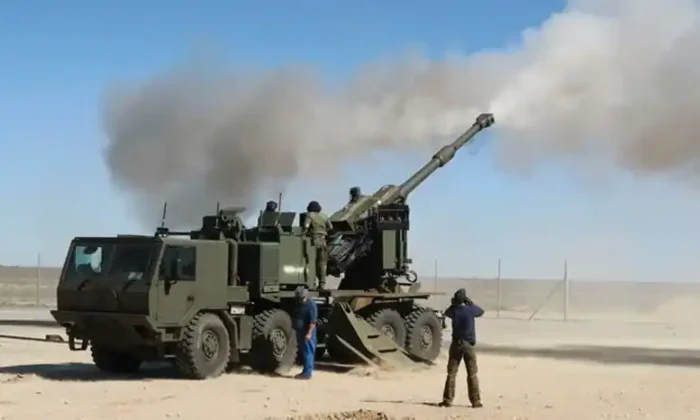
Denel T5-52 is a modern 155mm wheeled self-propelled artillery system developed by the South African company Denel Land Systems. This system is a mobile version of a cannon mounted on a wheeled chassis, providing it with high maneuverability and the ability to quickly change combat positions. The T5-52 is designed for use in both the South African National Defense Force (SANDF) and for export to other countries.
History of Development
The Denel T5-52 was developed based on the successful previous artillery systems of the company, such as the Denel G5 and G6 Rhino. The need for a modern and mobile artillery system arose due to the requirement for systems capable of effectively supporting forces at long ranges while being lightweight for transportation and able to move quickly on roads and rough terrain. Wheeled self-propelled artillery systems gained popularity due to their combination of great firepower and increased mobility.
Key Characteristics
Caliber and Range of Fire:
- The T5-52 is equipped with a 155mm howitzer that complies with international standards (NATO) for artillery systems of this class.
- The standard firing range is approximately 30-40 km, and with the use of rocket-assisted projectiles, it can reach up to 55 km.
- It can also use precision-guided munitions with GPS guidance, significantly increasing the effectiveness and accuracy of target engagement at long distances.
Wheeled Chassis:
- The gun is mounted on a 6x6 or 8x8 wheeled chassis, providing high mobility compared to tracked self-propelled howitzers.
- The maximum road speed is about 80-90 km/h, which allows the T5-52 to rapidly deploy and change combat positions, an important advantage in modern combat conditions.
Weight and Mobility:
- The system weighs approximately 28 tons, making it one of the lighter self-propelled artillery systems in its class.
- Its mobility allows it to operate effectively in both urban and rugged conditions, particularly in regions with challenging geography.
Fire Control System:
- The T5-52 is equipped with an advanced digital fire control system that integrates with targeting and fire adjustment systems.
- This system allows for quick targeting and correction of fire, significantly enhancing accuracy and effectiveness in combat, and allows for operation within a networked integration with other combat units.
Rate of Fire:
- The rate of fire for the T5-52 can reach 6-8 rounds per minute, making it an effective tool for delivering mass fire strikes against enemy positions.
Crew:
- The T5-52 is operated by a crew of 4-5 personnel, including the driver, commander, gunner, and loaders.
- The system features an automated loading system that reduces the crew's workload and increases operational efficiency in combat situations.
Ammunition
The T5-52 uses a wide range of 155mm projectiles, including:
- Fragmentation and explosive shells;
- Cluster munitions for targeting personnel and light vehicles;
- Precision-guided munitions with GPS guidance;
- Rocket-assisted projectiles for extended range.
This variety provides the T5-52 with high versatility and the ability to perform various artillery tasks on the battlefield.
Comparison with Other Systems
Denel T5-52 is often compared to other wheeled self-propelled artillery systems, such as the French Caesar and the Swedish Archer. The main advantage of the T5-52 is its high firing range and ability to operate in challenging climatic conditions and rough terrain. The system also benefits from its mobility, allowing for rapid movement between firing positions and the ability to evade counter-battery fire.
Strategic Importance
The Denel T5-52 is an important tool in the arsenal of the South African armed forces and has significant export potential. Its combination of mobility, firepower, and advanced technology makes it an attractive option for many countries looking to modernize their artillery units. Additionally, the T5-52's mobility allows for effective use in a wide range of combat operations, from counter-battery fire to providing fire support for infantry.
Conclusion
Denel T5-52 is a modern wheeled self-propelled howitzer that combines high firing range, accuracy, and mobility. It is an important element of the artillery forces of the Republic of South Africa and has a great export potential. Due to its ability to move quickly across various terrain types and deliver effective fire at long ranges, the T5-52 meets the demands of modern armed conflicts.
AHS Kryl – Poland
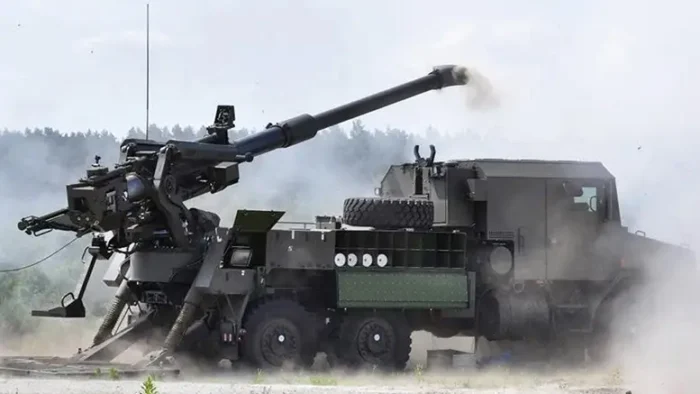
AHS Kryl is a Polish 155mm self-propelled howitzer developed by Huta Stalowa Wola (HSW) in collaboration with several Polish defense companies. This artillery system was designed to enhance the mobility of the Polish armed forces and is part of Poland's military modernization program. It serves as an important component of fire support for modern Polish ground forces.
Development History
The development of the AHS Kryl began in the early 2010s as part of Poland's efforts to upgrade its artillery capabilities. The primary aim was to create a mobile system that could meet NATO standards, utilize advanced technologies, and provide high maneuverability and rapid deployment in various conditions.
Kryl is an evolution of the concept of wheeled self-propelled artillery systems, which are becoming increasingly popular among European armies due to their mobility, reduced weight, and ease of operation compared to tracked counterparts.
Key Characteristics
Caliber and Range:
- AHS Kryl is equipped with a 155mm howitzer that complies with NATO standards, capable of using all types of standard alliance ammunition.
- The maximum range with standard ammunition is approximately 30 km, while with the use of rocket-assisted projectiles, it can reach 40 km or more.
- The system can also utilize precision-guided munitions, enhancing effectiveness and accuracy for striking targets at great distances.
Wheeled Chassis:
- One of Kryl's key features is its 6x6 wheeled chassis, providing high mobility compared to tracked self-propelled howitzers.
- The wheeled self-propelled systems are lighter than tracked ones, allowing for easy transport by aircraft and rapid movement on roads.
Weight and Transportability:
- The mass of the Kryl system is approximately 18 tons, making it significantly lighter than traditional self-propelled artillery systems on tracked chassis.
- This lighter weight allows the system to be transported by medium-class aircraft, facilitating rapid deployment over long distances.
Fire Control System:
- Kryl is equipped with a modern digital fire control system, which allows for rapid calculations for firing adjustments and coordination with other artillery units.
- The system integrates with networked military command structures, ensuring full interoperability with other combat systems on the battlefield.
Rate of Fire:
- The firing rate of the T5-52 is up to 6-8 rounds per minute, making it an effective tool for delivering massed fire support at medium and long ranges.
Crew:
- The crew of the system consists of 4-5 people: commander, gunner, loaders, and driver. Due to partial automation of loading and maintenance, the number of required operators is reduced.
Ammunition
AHS Kryl utilizes standard 155mm NATO ammunition, including:
- High-explosive shells;
- Precision-guided munitions with GPS or laser guidance;
- Smoke and illumination rounds;
- Rocket-assisted projectiles for increased firing range.
This array of ammunition provides the Kryl system with high versatility and the ability to perform various artillery tasks on the battlefield.
Comparison with Other Systems
AHS Kryl is compared with other wheeled artillery systems such as the French Caesar, the Israeli ATMOS, and the South African T5-52. Kryl stands out for its adaptability to Polish conditions and integration with national fire control systems. Wheeled systems generally differ from tracked ones in greater mobility and the ability to rapidly relocate over long distances without the need for towing or special transportation.
Strategic Importance
AHS Kryl is an important element of the modernization plan for the Polish armed forces. Its mobility and modern technologies make it a vital tool for supporting ground troops in fast-paced conflicts. Moreover, its ability to quickly change positions makes Kryl an effective solution for avoiding enemy counter-battery fire.
The system also has significant export potential, as it offers advanced capabilities at a relatively moderate price, making it attractive to other countries looking to modernize their artillery units.
Conclusion
AHS Kryl is a modern wheeled self-propelled artillery system that combines high mobility, firepower, and advanced fire control systems. It is a key component of Poland's artillery forces and has substantial export potential. Due to its ability to operate in complex tactical conditions and deliver effective fire at long distances, Kryl is an important instrument in modern warfare, meeting the needs of both Polish and international armed forces.
GHN-45 – Austria
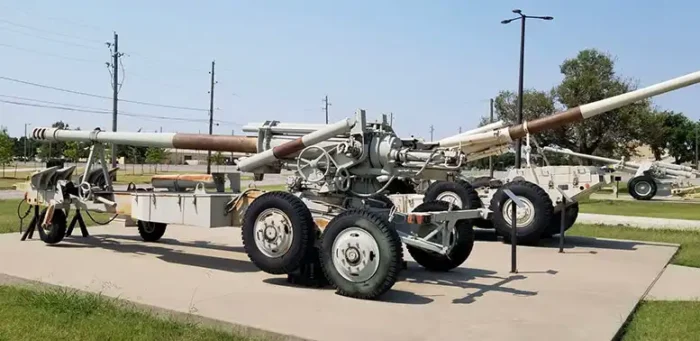
GHN-45: Austrian 155mm Towed Howitzer
GHN-45 (or Gun, Howitzer, Noricum 45) is an Austrian towed 155mm howitzer developed by Voest-Alpine Noricum (later known as Noricum Maschinenbau GmbH). The howitzer was designed to provide high mobility, accuracy, and long-range fire capability, making it an effective artillery support tool in field conditions.
Development History
GHN-45 was developed in the 1970s in response to the need for modern artillery systems with long-range fire capabilities. This system became important for many countries seeking to upgrade their artillery capabilities to NATO standards. The GHN-45 howitzer is based on the design of the previous model GHN-40, but has significant improvements in range, accuracy, and fire control.
Main Characteristics
- Caliber and Range:
- GHN-45 features a 155mm caliber, which is standard for modern NATO artillery systems.
- The maximum firing range with standard rounds is approximately 30 km, and with rocket-assisted projectiles, it can reach up to 39-40 km.
- Due to its capability to utilize various types of ammunition, the howitzer can perform a wide range of tasks on the battlefield.
- Ammunition:
- GHN-45 uses standard 155mm NATO ammunition, including:
- High-explosive fragmentation shells for general purposes;
- Smoke and illumination rounds;
- Precision-guided projectiles for accurate target engagement;
- Rocket-assisted projectiles to extend firing range.
- GHN-45 uses standard 155mm NATO ammunition, including:
- Fire Control System:
- The GHN-45 howitzer is equipped with an advanced fire control system, significantly enhancing firing accuracy and effectiveness.
- This system allows for rapid adjustments in aiming and calculation of firing parameters, making it highly effective in tactical operations.
- Mobility:
- GHN-45 is a towed artillery system, meaning it requires a vehicle for transport, typically a truck. However, the system also has an auxiliary engine for short movements on the battlefield, allowing the howitzer to move independently up to 15 km.
- Its towed design allows it to be used in regions with difficult terrain, making the G5 ideal for flexible and mobile operations.
- Weight and Transportability:
- The weight of the GHN-45 is approximately 9 tons, which is typical for towed artillery systems of this caliber.
- The system can be transported by trucks or medium-class aircraft for quick deployment.
- Rate of Fire:
- The GHN-45 can fire at a rate of 3-4 rounds per minute, which is standard for towed howitzers of this class.
Design Features
The GHN-45 was designed with consideration for harsh combat conditions, ensuring high reliability and resilience against damage. Its design allows for quick movement across the battlefield, deployment, and firing even in challenging conditions. With its long-range fire capabilities and the ability to utilize precision-guided munitions, the GHN-45 is a versatile tool for both offensive and defensive operations.
Ammunition
The GHN-45 can utilize various types of 155mm ammunition:
- High-explosive fragmentation shells as the primary type of ammunition for engaging enemy personnel and equipment;
- Cluster munitions for targeting large groups of infantry and light vehicles;
- Precision-guided munitions with GPS or laser guidance for striking critical targets;
- Rocket-assisted projectiles, which allow for increased firing range up to 40 km.
Comparison with Other Artillery Systems
The GHN-45 is often compared with other 155mm howitzers such as the French TRF1 and the American M198. The main advantage of the GHN-45 lies in its greater firing range and ability to use advanced munitions with high accuracy. Additionally, its auxiliary engine provides it with mobility advantages on the battlefield compared to other towed systems.
Strategic Significance
The GHN-45 has been adopted by the armed forces of several countries, including Austria and other nations looking for an effective, long-range artillery system. It has become an important element in defense strategies due to its ability to provide powerful fire support at long distances and perform both offensive and defensive missions.
Export Potential
The GHN-45 has gained popularity in the international market due to its relatively low cost, high efficiency, and ability to use standard NATO ammunition. The howitzer has been supplied to several countries, strengthening Austria's position as a producer of modern artillery systems.
Conclusion
GHN-45 is a powerful and mobile 155mm towed howitzer that combines long-range fire capabilities, accuracy, and reliability. It is an essential component of modern artillery units used for both counter-battery operations and support for ground operations. Due to its mobility and ability to fire at great distances, the GHN-45 is an effective tool on the modern battlefield.
155 mm SpGH DANA M2 – Czech Republic/Slovakia
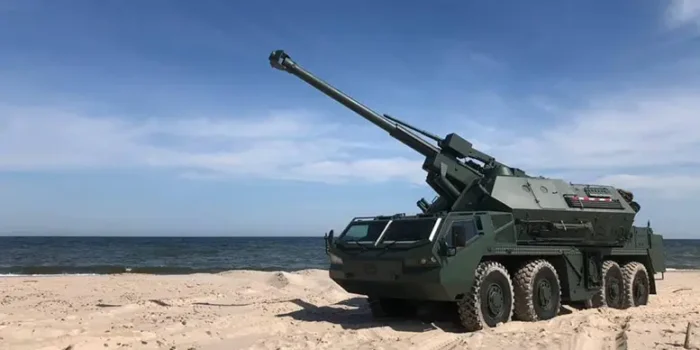
155 mm SpGH DANA M2: Czech-Slovak wheeled self-propelled howitzer
DANA M2 is a modernized version of the legendary Czech-Slovak wheeled self-propelled howitzer DANA (Dělo Automobilní Nabíjené Automaticky) of caliber 155 mm, developed by Excalibur Army (Czech Republic) based on the original model DANA vz. 77. The DANA M2 continues the evolution of this renowned artillery system, which was first developed in the 1970s. The updated version includes modern technologies that enhance mobility, automated loading, accuracy, and overall effectiveness on the battlefield.
Development History
The original howitzer DANA vz. 77 was the world's first serial wheeled self-propelled artillery system and had great success in Warsaw Pact countries and beyond. The DANA M2 is the latest modification, addressing modern combat needs and NATO artillery standards (caliber 155 mm).
The modernization aims to improve reliability, increase shooting accuracy, and enhance crew working conditions, as well as integrate modern fire control and communication systems. The development of the DANA M2 was carried out for the armed forces of the Czech Republic and Slovakia, as well as for export.
Main Characteristics
- Caliber and Range:
- The DANA M2 uses a 155 mm howitzer that complies with NATO standards.
- The maximum firing range with standard munitions is about 25-30 km, and with the use of active-reactive projectiles, it can reach 40-41 km.
- The system supports the use of modern precision munitions with GPS guidance.
- Wheeled Chassis:
- One of the key features of the Kryl is its 6x6 wheeled chassis, which provides high mobility and the ability to quickly change positions on the battlefield.
- Wheeled self-propelled systems are lighter than tracked systems, allowing them to be easily transported by aircraft and quickly maneuver on roads.
- Weight and Transport:
- The weight of the Kryl system is approximately 18 tons, making it much lighter than traditional self-propelled artillery systems on tracked chassis.
- This allows the system to be transported by mid-class aircraft, facilitating its deployment over long distances.
- Fire Control System:
- The DANA M2 is equipped with a modern digital fire control system that allows for quick calculations of firing parameters and real-time adjustments of fire.
- The system integrates automated aiming and loading systems, reducing preparation time for firing and increasing system efficiency.
- Loading Automation:
- One of the key features of the DANA M2 is its automated loading system, which maintains a high firing rate of up to 6 shots per minute without significant crew intervention.
- Automation significantly enhances crew safety and reduces their workload during combat operations.
- Crew:
- The crew of the system consists of 4-5 persons: commander, gunner, driver, and two loaders. Due to automation, the number of personnel required for operation is reduced, increasing operational efficiency.
Ammunition
The AHS Kryl uses standard 155 mm NATO munitions, including:
- High-explosive projectiles;
- Precision-guided munitions;
- Smoke and illumination projectiles;
- Active-reactive projectiles for extended firing range.
This ammunition set provides the system with high versatility and the ability to perform a wide range of tasks on the battlefield.
Comparison with Other Systems
The DANA M2 is compared to other modern wheeled self-propelled artillery systems, such as the French Caesar, the Israeli ATMOS, and the South African T5-52. Its main advantages include:
- High automation of loading processes;
- Ability to quickly change positions due to its wheeled chassis;
- Long firing range with active-reactive projectiles;
- Integration of modern fire control systems and digital communications.
Wheeled self-propelled systems like the DANA M2 offer advantages over tracked systems in scenarios where quick mobility and the ability to traverse long distances without towing or special transport are necessary.
Strategic Importance
The DANA M2 is an important element of the artillery modernization in the Czech Republic and Slovakia, complying with modern NATO standards. Its mobility and ability to quickly change positions make it a vital component in providing fire support for ground forces. With its long firing range and use of precision munitions, the DANA M2 can effectively perform both counter-battery tasks and support offensive operations.
Export Potential
The DANA M2 also has significant export potential due to its versatile capabilities, relatively low cost, and compatibility with various military structures. The system has already been exported to several countries and is seen as an important element for artillery modernization.
Conclusion
DANA M2 is a modern 155 mm wheeled self-propelled howitzer that combines high mobility, automated processes, and powerful fire support at long ranges. Its development is the result of years of experience in artillery systems manufacturing, ensuring compliance with modern battlefield requirements. With innovative technologies and digital fire control systems, the DANA M2 is a crucial element of the arsenal for both the national armed forces of the Czech Republic and Slovakia, as well as the international market.
Sholef – Israel
Sholef: Israeli Self-Propelled Howitzer
Sholef (sometimes known as Sholef L33 or Soltam Sholef) is an Israeli self-propelled artillery system based on the Merkava tank, developed in the 1980s by Soltam Systems. The name Sholef in Hebrew means "shooter" or "firing." This system was created to replace American M109 howitzers in the Israeli armed forces and to provide greater firepower and crew protection.
Development History
The development of Sholef began in response to Israel's need for a more modern and powerful artillery system to replace the aging M109. The system was based on the chassis of the Israeli Merkava Mk.3 tank, providing high mobility, protection, and integration with the country's overall military strategy. Although Sholef demonstrated high capabilities during testing, it was never officially adopted, and the project was later frozen.
Key Characteristics
- Caliber and Range:
- Sholef is equipped with a 155mm howitzer that meets NATO standards.
- The maximum firing range with conventional munitions is about 30-40 km, and with rocket-assisted projectiles, it can exceed 40 km.
- The system supports firing precision-guided munitions with GPS guidance.
- Merkava Tank Base:
- Sholef utilized the chassis of the Merkava, providing exceptional crew protection. This allowed the howitzer to be safeguarded against small arms fire, mines, and artillery shrapnel.
- The armored chassis and front-mounted engine offered the crew additional protection and comfort while performing combat tasks.
- Automation:
- Sholef had a high level of automation, including an automatic loading system that allowed for a high rate of fire—up to 9 rounds per minute.
- The fire control system was fully digital, ensuring rapid targeting and accurate shooting under various conditions.
- Mobility:
- Thanks to the Merkava base, Sholef had excellent mobility on rough terrain and high maneuverability in challenging conditions.
- The maximum speed on roads was around 60 km/h, allowing for quick repositioning.
- Crew:
- The Sholef system was operated by a crew of 4-5 people, including a commander, gunner, loader, and driver.
Advantages
- Protection: Thanks to the armored Merkava chassis, Sholef offered significantly better crew protection compared to most self-propelled artillery systems of its time, such as the M109.
- Automation: The high level of automation of the system allowed for intense fire and reduced crew workload, increasing effectiveness in battle.
- Firepower: The modern 155mm howitzer with precision-guided munitions and long firing range made Sholef ideal for striking strategic targets at long distances.
Reasons for Cancellation
Despite all its advantages, the Sholef project was frozen and not adopted for service. The main reasons included:
- High production and maintenance costs compared to more affordable alternatives like modernized M109s.
- In the 1990s, Israel preferred to modernize existing artillery systems, particularly M109s, due to close military and economic ties with the U.S.
- The high level of armor proved to be less important for self-propelled howitzers, as artillery systems rarely engage in frontline combat and often perform tasks at long range.
Conclusion
Sholef is an innovative artillery system that combined modern automation technologies with a high level of protection characteristic of Merkava tank chassis. Although this system was not adopted due to financial and strategic reasons, Sholef remains an important milestone in the development of Israeli artillery, demonstrating the potential of self-propelled howitzers with high firepower and strong protection.
Bohdana – Ukraine
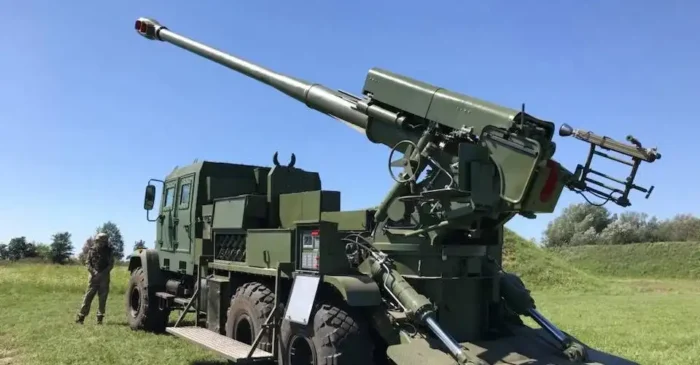
"Bohdana" is a modern Ukrainian self-propelled artillery system with a caliber of 155 mm, designed for use by the Armed Forces of Ukraine. It is the first Ukrainian artillery system that meets NATO standards, making it an important element in Ukraine's integration into international defense structures and the modernization of its armed forces. The development of this system is led by the Kramatorsk Heavy Machine Tool Plant (KZVV) in collaboration with other Ukrainian defense enterprises.
History of Development
The "Bohdana" project was officially announced in 2018 as part of the modernization program for the Armed Forces of Ukraine. Ukraine aimed to create its own system that met NATO standards, especially following the outbreak of military conflict in the eastern part of the country. Adopting a 155 mm caliber system allows Ukraine to abandon reliance on Soviet-standard ammunition (152 mm) and transition to NATO standards, enhancing interoperability with allies.
The first tests of "Bohdana" took place in 2020, and its combat use began in 2022 during Russia's full-scale invasion.
Key Characteristics
Caliber and Range:
- The "Bohdana" gun has a caliber of 155 mm, meeting NATO standards.
- The maximum firing range with standard ammunition is 30-40 km, while using active-reactive shells can reach 42-50 km.
- The system can utilize precision-guided munitions with GPS guidance for accurate target engagement.
Wheeled Chassis:
- "Bohdana" is mounted on a wheeled chassis from the KraZ-63221 truck (6x6), providing high mobility and the ability to travel long distances on both roads and rough terrain.
- The wheeled chassis allows the gun to quickly change combat positions, reducing the risk of counter-battery fire from the enemy.
Fire Control System:
- The gun is equipped with a modern digital fire control system that enables rapid calculation of firing parameters and real-time fire adjustments.
- The digital system also allows for integration of the gun into networked military command structures, enhancing coordination with other combat units.
Weight and Mobility:
- The "Bohdana" system weighs around 28 tons, making it quite mobile compared to tracked self-propelled howitzers.
- The wheeled chassis allows for speeds of up to 80 km/h, which is a significant advantage for rapid repositioning.
Rate of Fire:
- The "Bohdana" gun has an automated loading system, ensuring a firing rate of 5-6 rounds per minute, making it an effective tool for conducting mass artillery barrages.
Crew:
- The crew of the gun consists of 5-6 members, including the commander, gunner, driver, and loaders. Automation of the loading process reduces the number of crew members required, enhancing operational efficiency.
Armament
The main armament of "Bohdana" is a 155 mm gun, capable of using a wide range of munitions:
- High-explosive shells for destroying enemy personnel and equipment;
- Active-reactive shells for increasing range;
- Precision-guided munitions with GPS or laser guidance for accurate target destruction;
- Cluster munitions for hitting large areas and enemy equipment.
Advantages
- Transition to NATO Standards: Transitioning to 155 mm munitions is a significant step in integrating the Armed Forces of Ukraine into NATO standards, facilitating collaboration with allies.
- Mobility: The use of a wheeled chassis provides the howitzer with high mobility, which is critical in modern combat scenarios.
- Technology: Thanks to the automated loading system and digital fire control system, "Bohdana" demonstrates high firing speed and accuracy.
Combat Application
In 2022, the "Bohdana" gun was first used in combat conditions during Ukraine's defense against the Russian invasion. According to open sources, the gun successfully struck several key enemy targets at long ranges, demonstrating its effectiveness and reliability in combat conditions.
Conclusion
"Bohdana" is the first Ukrainian self-propelled artillery system that meets NATO standards and an important element in the modernization process of the Armed Forces of Ukraine. With its mobility, firing range, and high accuracy, "Bohdana" is a powerful tool for providing fire support to Ukrainian ground forces in modern combat operations.
Сирота Олег для ЗСУ / Entropia.com.ua
Поділіться досвідом роботи з боєприпасами 155 мм. Зауваження, пропозиції відправляйте на пошту: entropiaw@gmail.com